THE DAILY BS: HOW MUCH CAN YOU HANDLE?
SPARE ME THE BS (I’ve got things to do).
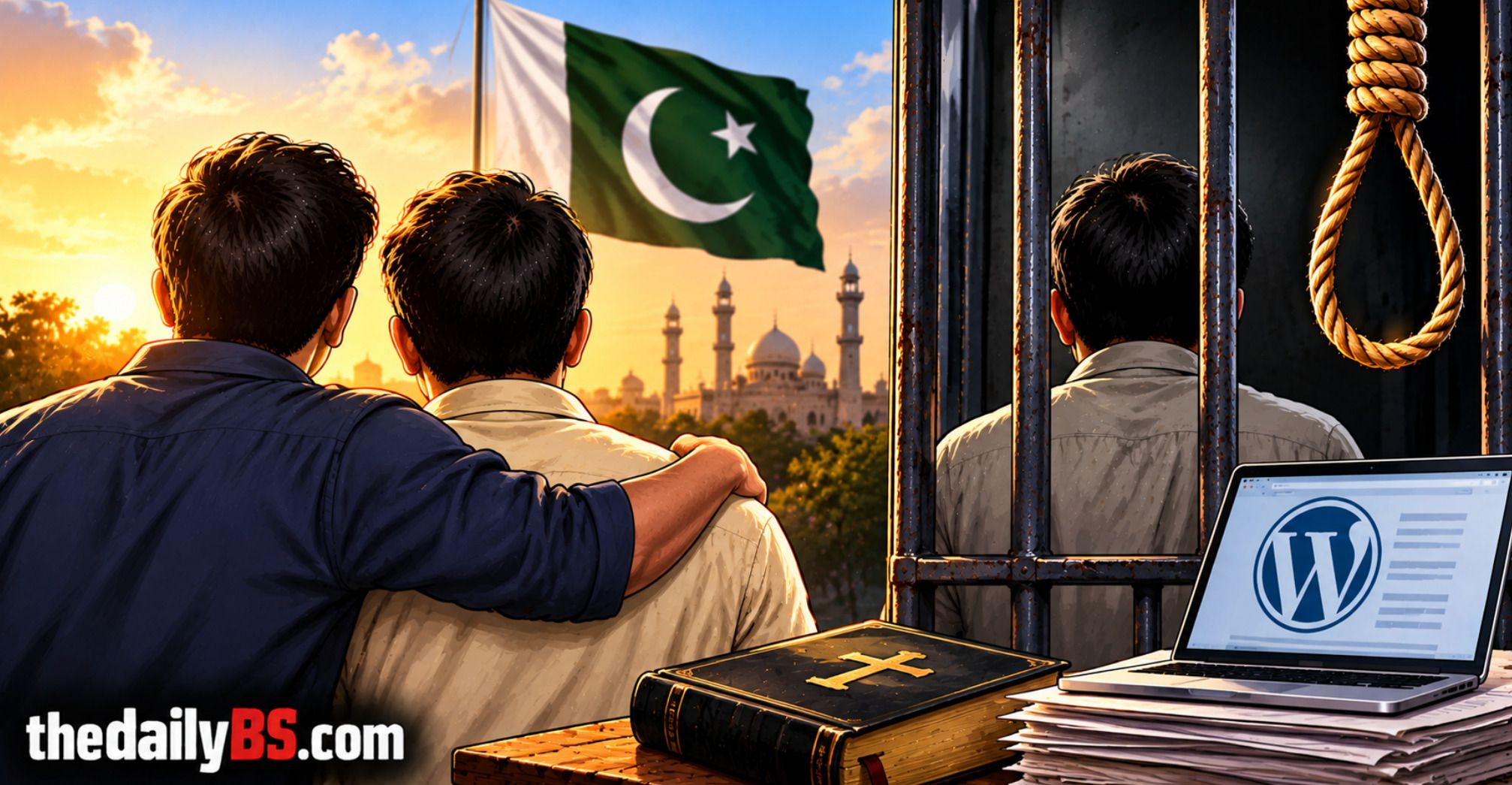
- Pakistan’s Supreme Court upheld Christian father Qaisar Ayub’s death sentence for alleged online blasphemy while acquitting his brother Amoon after roughly a decade in prison.
- The brothers’ lawyers dispute whether prosecutors proved who actually controlled the WordPress website containing the offending material, and UN experts previously raised concerns about insufficient evidence.
- Attorneys are preparing a final court challenge, pursuing a presidential pardon and seeking UN intervention as Qaisar remains imprisoned.
LAY IT ON ME (I’ve got time).
One brother is finally free after spending roughly ten years behind bars.
The other is still facing the hangman’s noose.
And the case that could cost him his life revolves around offensive material posted on a WordPress website more than a decade ago.
Welcome to Pakistan’s blasphemy justice system, where a disputed internet posting can carry a death sentence.
On October 7, Pakistan’s Supreme Court upheld the conviction and capital punishment imposed on Qaisar Ayub, a Christian father of three accused of insulting the Prophet Muhammad through material published online.
His younger brother, Amoon Ayub, who was prosecuted in connection with the same website, was acquitted because the court found insufficient evidence against him.
Two brothers. One case. Two radically different outcomes.
And according to the attorneys who have spent years representing them, serious questions remain about whether investigators ever established who actually posted the offending material.
The case began in 2011 when allegedly blasphemous content appeared on a website bearing information associated with the brothers.
Qaisar maintains that he had shut down the website in 2009 and that someone else subsequently revived it while retaining his identifying information.
His legal defenders say the accusations emerged after a workplace dispute, raising concerns that Pakistan’s blasphemy laws may have been used to settle a personal score.
There is something particularly chilling about that possibility.
Imagine having a disagreement with someone at work, only to find yourself fighting for your life because of words posted online by a person you insist wasn’t you.
The brothers fled Pakistan for a time, traveling to Singapore and Thailand before returning home. They were arrested in 2014.
In December 2018, a Pakistani trial court sentenced both men to death.
The hearings were conducted inside Jhelum prison because of security concerns surrounding the highly charged blasphemy allegations.
The Lahore High Court upheld the convictions in 2022.
Then came the October 7 Supreme Court ruling, which finally cleared Amoon while leaving Qaisar under sentence of death.
That ruling has alarmed Christian legal advocates who say the evidence in the case has never justified such an irreversible punishment.
CeCe Heil, senior counsel and international legal director for the American Center for Law and Justice, told Fox News that prosecutors had failed to prove the brothers were genuinely connected to the offending WordPress material.
The prosecution reportedly relied substantially on electronic evidence recovered from a laptop, but defense advocates continue to challenge the reliability and attribution of that material.
And the consequences could reach well beyond the Ayub family.
The ACLJ says this may be the first time Pakistan’s Supreme Court has upheld a death sentence in a blasphemy case, raising fears about how lower courts will handle similar prosecutions in the future.
Pakistan’s law permits capital punishment for insulting Islam’s prophet under Section 295-C of its penal code.
That is not simply an abstract provision buried in a statute book. Human rights groups have documented its use against members of religious minorities, along with allegations of fabricated accusations, intimidation and pressure on judges.
Heil described a threatening atmosphere surrounding blasphemy trials.
In one case she discussed, a crowd reportedly threatened to kill a judge if he refused to impose death by hanging.
Consider what that means for an accused person trying to receive a fair hearing.
You’re not merely hoping that the court weighs the evidence. You’re also hoping the people outside the courthouse don’t intimidate everyone responsible for weighing it.
And the danger does not necessarily end with an acquittal.
Amoon Ayub is legally free, but his defenders remain concerned about possible retaliation from extremists who believe the courts should have imposed punishment regardless of the evidence.
His release comes after years that cannot simply be returned to him.
For Qaisar, the situation is considerably more urgent.
He remains at Sahiwal Jail while his wife and three children continue waiting for a resolution.
The Centre for Legal Aid, Assistance and Settlement, a Christian legal organization supporting the family, says it is seeking further judicial review and urging Pakistani authorities to consider clemency.
The ACLJ and its Pakistani partner, the Organization for Legal Aid, are also seeking international intervention.
Their efforts include an appeal to the United Nations special rapporteur responsible for examining extrajudicial and arbitrary executions.
And this isn’t the first time UN officials have raised objections to the case.
In September 2025, UN human rights experts wrote to Pakistan about the Ayub brothers and another Christian defendant, Shahzad Masih, expressing grave concern about mandatory death sentences for religious offenses and apparent gaps in the evidence.
The experts questioned whether the charges met international legal standards for crimes serious enough to warrant capital punishment.
Pakistan responded that its constitution prevents the executive branch from interfering in individual judicial proceedings.
That’s its legal position, but it doesn’t make the international human rights concerns disappear.
The country’s wider record illustrates why this case is receiving so much attention.
The UK government’s July 2026 assessment of religious freedom in Pakistan documented continuing blasphemy prosecutions, risks of intimidation and discriminatory treatment of religious minorities.
It also noted that Pakistan has not carried out state-sanctioned executions for blasphemy, even though courts continue imposing death sentences.
Qaisar has been sentenced to death, but there is no reported execution date. His lawyers are still pursuing legal remedies.
And there have been remarkable reversals in other cases.
In 2025, Pakistan’s Supreme Court acquitted Christian defendant Anwar Kenneth after he had spent more than two decades on death row.
Another Christian defendant, pastor Zafar Bhatti, was released after years of imprisonment but died shortly afterward.
For anyone who believes that religious freedom includes the right to express unpopular or offensive ideas without facing execution, the underlying principle should not be complicated.
The state should not put someone to death for disputed religious speech.
And it certainly should not do so when serious questions remain about whether the accused person actually wrote the words in question.
Pakistan’s government presents itself internationally as an important diplomatic partner and regional power.
But its reputation for protecting religious freedom will ultimately be judged by what happens to people such as Qaisar Ayub.
His brother has already lost roughly ten years of his life to a prosecution that ended in acquittal.
Qaisar now faces the possibility of losing his life altogether.
The attorneys trying to save him are asking courts, government officials and international human rights organizations to act before that possibility becomes irreversible.
DBS WIRE SOURCES (I’ve got all day).
- Fox News — October 27 reporting on the Ayub brothers and international legal response
- CLAAS-UK — October 8 statement on the ruling, disputed evidence and legal appeals
- American Center for Law and Justice — October 20 request for UN intervention
- The News International — Pakistani reporting on the Supreme Court decision
- UK Home Office — July 2026 report on Christians, blasphemy laws and prosecutions in Pakistan
- Dawn — 2025 Supreme Court acquittal in another Christian blasphemy prosecution