THE DAILY BS: HOW MUCH CAN YOU HANDLE?
SPARE ME THE BS (I’ve got things to do).
- The Trump administration is suspending a special program allowing prescreened Chinese nationals to visit the Northern Mariana Islands for up to 14 days without obtaining a traditional U.S. visa.
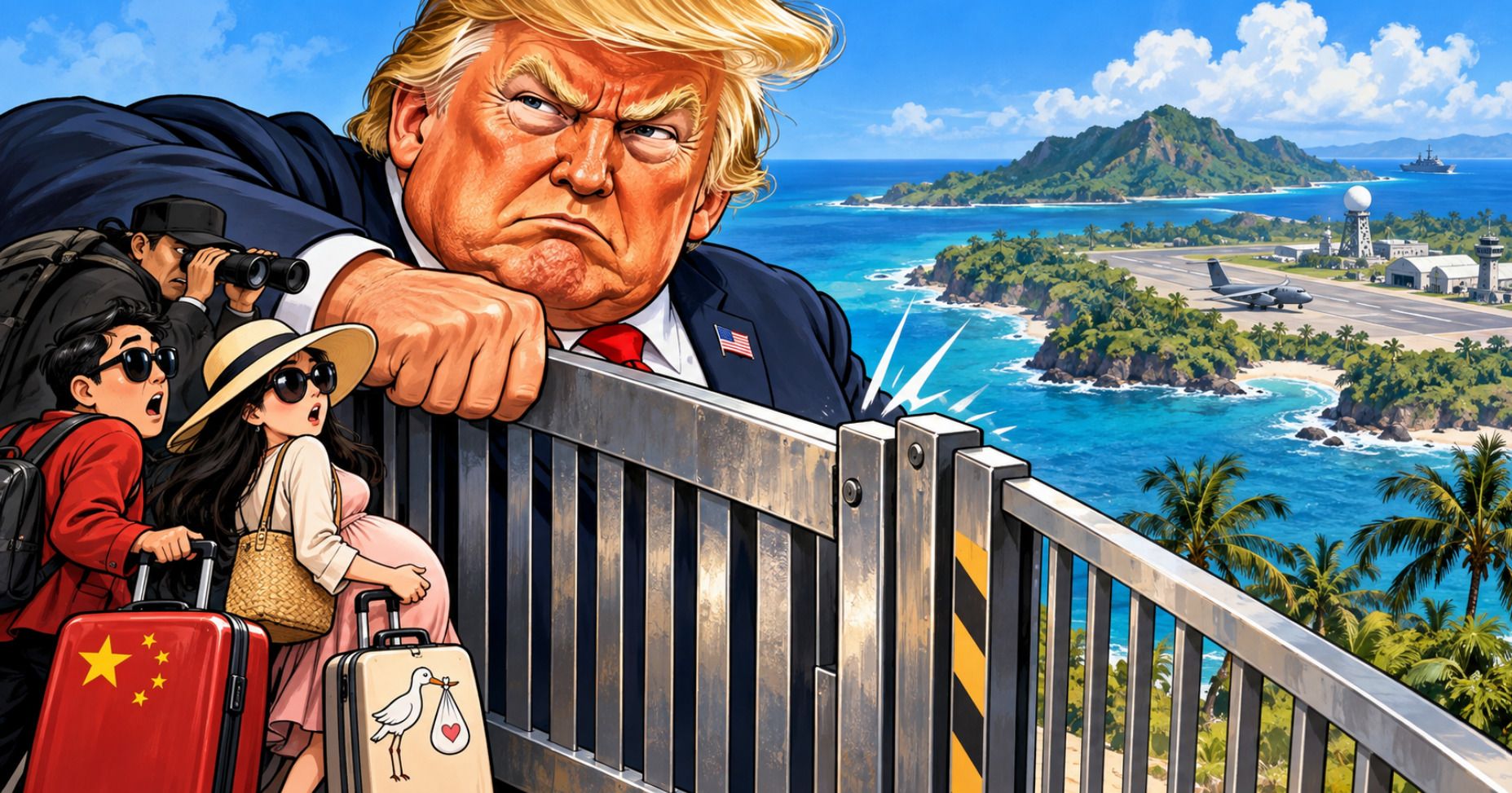
- DHS cited birth tourism, potential espionage near American military installations and past cases of Chinese nationals being smuggled by boat to nearby Guam.
- More than 3,000 Chinese nationals used the program in fiscal 2025. The suspension takes effect October 30, canceling existing travel authorizations while allowing visitors already admitted to finish their authorized stays.
LAY IT ON ME (I’ve got time).
The Trump administration has discovered another immigration arrangement that probably deserves a much closer look.
This one involves Chinese nationals, American military installations, babies born on U.S. soil and a rather inconvenient boat ride to Guam.
What could possibly go wrong?
Homeland Security Secretary Markwayne Mullin is suspending a special visa-free travel program that has allowed eligible Chinese citizens to visit the Northern Mariana Islands, an American territory in the western Pacific.
The arrangement, formally known as the Economic Vitality & Security Travel Authorization Program, permitted prescreened visitors from China to enter the islands for up to 14 days without obtaining a traditional U.S. consular visa.
It was created under the Biden administration and became operational in February 2025.
Now DHS says the program raises enough national security and immigration-enforcement concerns to warrant suspension.
And once you look at the geography, you begin to understand why Washington is paying attention.
The Northern Mariana Islands sit near Guam, home to strategically important American military facilities. The islands themselves include Tinian, where the United States is expanding military infrastructure.
Not exactly the neighborhood where you want to experiment casually with travel-security procedures.
According to DHS, more than 3,000 Chinese nationals entered the Northern Marianas through the special program during fiscal year 2025.
Those travelers were screened by U.S. Customs and Border Protection, but the arrangement eliminated the need for a conventional visa application at an American consulate.
That distinction matters because DHS now argues the streamlined process may have lowered barriers to activities that go well beyond an ordinary beach vacation.
First, there’s birth tourism.
That’s the practice of traveling to the United States primarily to give birth so that the child can acquire American citizenship under existing citizenship rules.
And let’s be clear: We’re not talking about an American family taking the kids on vacation.
We’re talking about people who may deliberately arrange overseas travel around a delivery date because of the citizenship benefits associated with being born on American soil.
DHS warned that easier visa-free travel could encourage this practice and increase pressure on the Northern Marianas’ limited medical resources.
The department’s notice did not establish how many births were actually attributable to travelers using this particular program.
But birth tourism has been a longstanding issue in the territory, and federal officials say the special travel arrangement may make it more attractive.
Then there’s the second concern: national security.
DHS warned that visa-free access could be exploited by people seeking information about American military infrastructure and operations in the region.
The Northern Mariana Islands include facilities connected to America’s military posture in the Pacific, while nearby Guam is one of the country’s most important strategic outposts.
Given China’s military ambitions in the region, it’s hardly unreasonable for federal officials to ask whether the visitor-screening process provides adequate protection.
And then we come to the boats.
Visitors admitted under the program were not authorized to travel onward to Guam or the U.S. mainland.
But DHS pointed to previous cases in which Chinese nationals were smuggled from the Northern Marianas to Guam by boat.
Those incidents occurred under earlier immigration arrangements, not necessarily the specific program now being suspended.
Still, the department argues that the cases demonstrate a geographic vulnerability that the newer travel program did not eliminate.
In other words, the government may write “no onward travel” into the regulations, but that doesn’t do much good if people can circumvent the restriction using a boat.
Republican lawmakers had been sounding the alarm for months.
Sens. Mike Lee, Rick Scott, John Cornyn and Bill Cassidy urged Mullin in April to suspend the arrangement, citing both birth tourism and national security concerns.
Lee celebrated the decision Monday with a particularly pointed statement.
“America is not a nursery for the CCP to steal citizenship,” he wrote on X, referring to the Chinese Communist Party.
“Thank you, President Trump!”
Rep. Chip Roy’s office also welcomed the suspension, saying Roy and Rep. Tom Tiffany had previously warned about the program.
The administration’s action takes effect at 2 p.m. Eastern on October 30.
Existing authorizations will be canceled, and Chinese nationals seeking to use the suspended arrangement will instead need an appropriate visa unless another lawful exemption applies.
Visitors already admitted under the program may complete their authorized stays.
DHS says the suspension will remain in place while officials review the program with the Departments of State and Interior.
There is, however, another side to the decision.
The Northern Mariana Islands rely heavily on tourism, and their economy has struggled with reduced visitor traffic and limited air service.
Territorial Delegate Kimberlyn King-Hinds emphasized Tuesday that the program has been suspended rather than permanently terminated.
She said she had spoken with Mullin and the White House and wanted federal officials to address the security concerns while finding a path to restore the program.
That’s a legitimate economic concern. Restaurants, hotels, airline workers and other local businesses depend on visitors.
But tourism revenue and national security are two different questions, and both deserve serious examination.
There’s also a distinction worth keeping straight: DHS has identified security vulnerabilities and risks. It has not established that all 3,000 program participants engaged in wrongdoing, birth tourism or espionage.
The larger question is whether the United States should maintain a special visa exemption for citizens of a strategic rival when the government believes the arrangement creates avoidable enforcement problems near sensitive military installations.
DBS WIRE SOURCES (I’ve got all day).
- Fox News — DHS suspends Chinese visa-free program over birth tourism and security concerns
- Federal Register — Official DHS notice suspending EVS-TAP
- Just the News — Chinese travel program suspended over security concerns
- Northern Mariana Islands News Service — Delegate King-Hinds responds to suspension
- Isla Public Media — Local economic concerns and DHS security findings