THE DAILY BS: HOW MUCH CAN YOU HANDLE?
SPARE ME THE BS (I’ve got things to do).
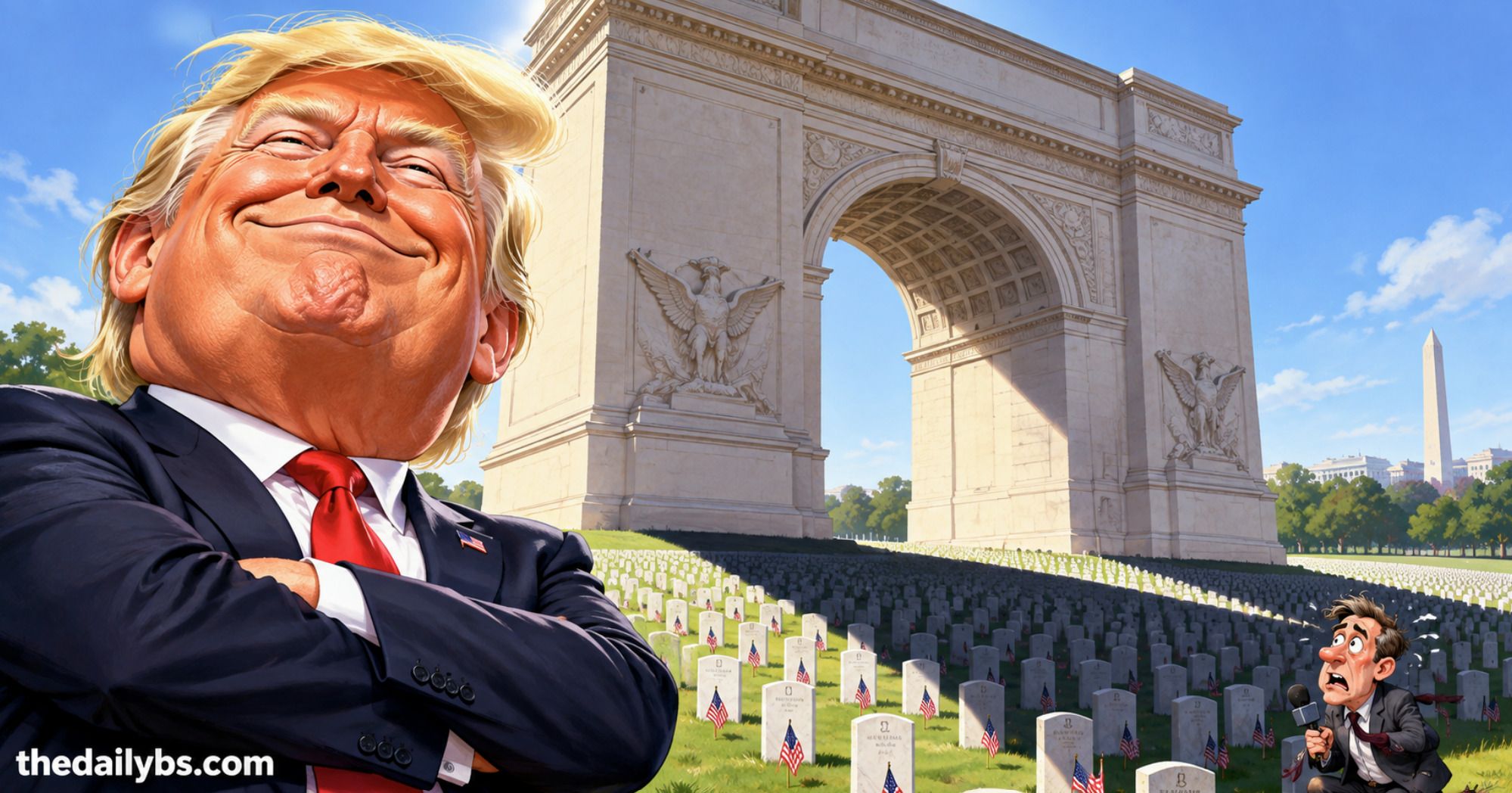
- The Washington Post modeled shadows from Trump’s proposed 250-foot arch reaching Arlington National Cemetery, including JFK’s grave.
- The model projects shadows touching more than 75,000 graves during the year, but on most days they vanish before the cemetery opens at 8 a.m.
- Critics call the shadows an affront to the fallen; the White House says the monument would honor veterans.
LAY IT ON ME (I’ve got time).
Donald Trump has apparently discovered another way to offend Washington’s architectural establishment.
His proposed triumphal arch will cast a shadow. An actual shadow.
The Washington Post devoted a three-dimensional computer analysis to identifying precisely which graves, memorials and monuments will experience the consequences of a huge object standing between the sun and the ground.
The newspaper’s October 27 investigation examined Trump’s proposed 250-foot triumphal arch at Memorial Circle, near Arlington National Cemetery.
Using computer modeling, reporters calculated that the monument would cast shadows across portions of the cemetery on 284 days each year, reaching more than 75,000 graves over the course of those days.
That certainly sounds dramatic. Then comes a rather important detail: The shadows generally occur shortly after sunrise, before the cemetery opens to visitors.
The Post’s own calculations indicate that the shadow would remain after Arlington’s 8 a.m. opening on 26 days of the year.
One of the newspaper’s most detailed examples involves May 12, when the sun’s position would produce a particularly long shadow.
At approximately 6:02 a.m., the arch would briefly shade President John F. Kennedy’s memorial, including the eternal flame, for about nine minutes.
At approximately 6:06 a.m., it would reach the graves of Supreme Court Justices Thurgood Marshall, William Rehnquist and Ruth Bader Ginsburg.
Minutes later, the shadow would cross sections containing World War I and World War II veterans. By approximately 6:23 a.m., more than 2,000 graves would have experienced temporary shade.
For anyone unfamiliar with the science involved, shadows have been known to occur when large objects obstruct sunlight. The phenomenon has previously been observed around buildings, trees, statues and occasionally people standing in inconvenient places.
But opponents of Trump’s arch see something considerably more sinister.
University of Connecticut history professor Micki McElya argued that the symbolism of the shadow crossing Arlington was troubling, regardless of whether visitors would actually witness it.
Retired Army Maj. Gen. Paul Eaton, whose parents are buried at Arlington, described the projected shadow as “a sacrilege.”
Eaton is associated with VoteVets, a veterans’ advocacy organization that has opposed Trump’s arch project.
VoteVets has already challenged the administration’s plans, while other veterans, historians and preservation organizations have raised objections concerning the monument’s size, location, historic views and construction near burial grounds.
Those are longstanding disagreements over the proposed structure. The shadow controversy adds a particularly unusual dimension: Whether temporary shade across a cemetery carries an unacceptable political or symbolic message.
Hot Air columnist John Sexton examined the Post’s analysis and noted that Arlington already contains thousands of trees, which naturally cast shadows across the grounds. Sexton also mentioned that his own grandfather is buried at Arlington.
The White House offered a different interpretation. Spokesman Davis Ingle said the arch would “enhance the visitor experience” at Arlington National Cemetery and honor the sacrifices of American veterans.
The administration envisions a monumental entrance near Arlington Memorial Bridge, commemorating America’s 250th anniversary and creating a dramatic architectural feature linking the capital with the national cemetery.
The proposed arch would be approximately 250 feet tall and topped with a large gilded, winged statue holding a torch.
Trump has also discussed incorporating military features into the structure, including drone capabilities and observation positions, although those ideas are absent from the submitted architectural plans.
The project has already generated legal and preservation disputes. Federal officials have acknowledged that the arch would alter historic views and affect nearby landmarks, while opponents have challenged the administration’s review process and construction authority.
Arlington County has filed suit, and three Vietnam War veterans have also sought to stop the project.
Meanwhile, the National Capital Planning Commission is scheduled to consider final approval November 5, with construction potentially beginning shortly afterward.
But the latest controversy has moved beyond the monument’s appearance to an extraordinary calculation of how many minutes its shadow might touch individual graves.
The Post’s model estimates that the arch would cast shadows over the Military Women’s Memorial on 109 days and touch Kennedy’s eternal flame on 18 days during the year.
The newspaper’s analysis is meticulous. The political argument over what those fleeting shadows represent is considerably more subjective.
At this rate, somebody may eventually demand an environmental impact statement for the shade cast by the Washington Monument.
DBS WIRE SOURCES (I’ve got all day).
- Twitchy — Shadow debate
- Hot Air — John Sexton’s commentary
- Washington Post — Original analysis
- Mediaite — Reporting and White House response
- Washington Post — Preservation findings