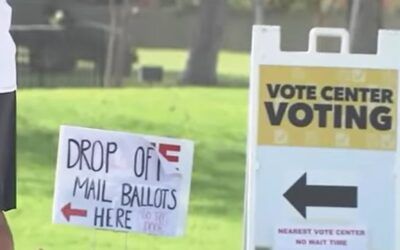
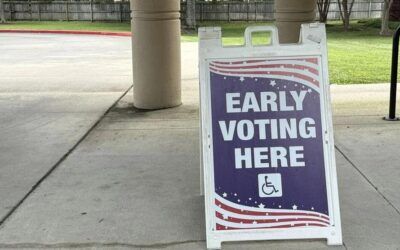
Power bills will be on the ballot Tuesday in states where voters directly choose the officials who approve their electric rates.
Nine states, from Georgia and Alabama to Montana and the Dakotas, have utility commission seats up for election, Stateline reported Monday.
In Georgia, Democrats would control the Public Service Commission, holding three of its five seats, if both of their candidates win, according to election tracker Ballotpedia.
Democratic Commissioner Peter Hubbard faces Republican Fitz Johnson, the commissioner he unseated in 2025, the site noted.
Democrat Shelia Edwards and Republican Josh Tolbert are running for the seat Republican Commissioner Tricia Pridemore gave up to mount an unsuccessful bid for the U.S. House, the elections site added.
Hubbard wrote in a May 13 post on X that Georgians “who pay a power bill deserve Public Service Commissioners who are engaged, ask tough questions, don’t take money from companies they regulate.”
He said in a Sept. 14 campaign statement that data centers “should not be allowed here in Georgia, unless they agree to” conditions including renewable power, union labor and no nondisclosure agreements.
Lead Locally, a group that backs what it calls “local climate champions,” named Hubbard and Edwards in an Oct. 20 slate of candidates it said “can regulate, restrict and stop data centers.”
Former Vice President Kamala Harris raised money Oct. 27 for Democratic commission hopefuls in Arizona and Georgia, warning “the stakes are high” because “people cannot afford the basics,” Politico reported.
Johnson warned in an Aug. 3 post on his campaign’s X account that the state “cannot turn over the keys to Georgia’s grid to out-of-state climate activists who give no concern to your job, your monthly power bill, energy supply, or national security concerns.”
Georgia Power cut rates statewide by $285 million under a commission-approved settlement over storm-repair and fuel costs that closed the case in June, a spokesman for the Georgia Public Service Commission said in a statement to the Daily Caller News Foundation.
“Georgia Power estimated the average household would see their bills drop by about $50 a year,” the spokesman added.
He noted in the same statement that he “cannot comment on the election or on party politics.”
A Democratic majority on Georgia’s commission could slow power deals for big corporate projects, John Boyd Jr., a principal at The Boyd Co., which advises companies on where to build, told Bisnow in an Oct. 28 report.
“Public service commissions are critical gatekeepers in this environment,” Boyd said.
“A new board could delay power contract approvals and spike industrial electricity rates by shifting grid costs onto corporations,” he added.
“People need to understand that blue states have stopped pipelines and shut down dependable power while increasing costs to consumers,” Stuart Turley, president and CEO of the Sandstone Group, said in a statement to the DCNF.
Through August, residential electricity cost about 52 percent more per kilowatt-hour in the 19 states Harris won in 2024 than in the 31 states President Donald Trump carried, Turley said, citing his analysis of Energy Information Administration numbers.
Jordan Nader, a resident senior fellow for energy and environment at the R Street Institute, said in a statement to the DCNF that “Campaign promises to reduce power bills can run into the limits of a commissioner’s authority.”
“Prior rate decisions cannot be undone, but a commissioner can shape future rates by evaluating whether the plants and power lines are needed before cost recovery is evaluated and allocated across customer classes,” Nader added.
All five members of Arizona’s Corporation Commission are Republicans.
Republican Commissioner Kevin Thompson and Republican state Rep. Ralph Heap face Democrats Jonathon Hill and Clara Pratte and Green Party candidate Mike Cease for two seats, according to Ballotpedia. Heap beat Republican Commissioner Nick Myers in the July primary.
The Arizona Corporation Commission did not immediately respond to the DCNF’s request for comment.
About $2 million in spending on Arizona’s race, against billions at stake in one data center project near Tucson, makes the commission “the cheapest veto in American politics,” Alexander Muse, a John Milton Freedom Foundation fellow, wrote in a Nov. 1 op-ed.
Alabama Republicans already turned out both commissioners who sought new terms in 2026, according to Ballotpedia. Matt Gentry beat Commissioner Jeremy Oden in the May primary, and Jim Zeigler edged Commissioner Chris Beeker III in a June runoff.
Most of the country does not vote on these posts. Ten states elect their utility regulators directly, while governors or legislatures appoint them elsewhere, Canary Media reported in May.
Jamie Van Nostrand, who once led Massachusetts’ utility regulator and is now with the University of Pennsylvania’s Kleinman Center for Energy Policy, spoke to Reuters for an Oct. 31 report.
“The governors are using this crisis on energy affordability as an opportunity to take a deeper dive into the utility regulatory model and see if it makes any sense,” Van Nostrand said.
“We’re in a moment where utility profits are soaring, customers are struggling and the asymmetry there is something that affects everyone in this country,” Karlee Weinmann, a researcher at the Energy and Policy Institute, a self-described utility industry watchdog, told Straight Arrow News.
“Regulators are sitting right in the middle of it,” she added.
Ted Thomas, a Republican former chairman of Arkansas’ utility commission who advises PowerLines, a consumer advocacy group, told Stateline that power prices as a campaign issue “began to emerge in 2024 as part of the overall concern on inflation.”
In some regulator races, power bills were a central issue well before 2024.
In Louisiana, newcomer Davante Lewis unseated Lambert Boissiere III, a member of the state’s utility commission for almost 18 years, in a December 2022 runoff, the Associated Press reported. Both men are Democrats.
Entergy customers had seen their bills jump months after Hurricane Ida, when the commission approved storm-repair charges the utility said it needed, Grist reported.
Lewis campaigned against such fees and had the backing of a super PAC funded largely by the Environmental Defense Fund’s advocacy arm, the outlet noted.
Lewis won 59.5 percent of the vote, according to Ballotpedia.
In Georgia, Republican Commissioner Lauren “Bubba” McDonald narrowly held his seat in a January 2021 runoff against Democrat Daniel Blackman, keeping every seat on the commission Republican, E&E News reported. This happened at the same time both then-incumbent Georgia Senators, Republicans David Perdue and Kelly Loeffler, lost reelection to their Democratic challengers Jon Ossoff and Raphael Warnock, respectively.
Who should pay for Georgia Power’s over-budget expansion of its Vogtle nuclear plant was a central issue in that race, Georgia Public Broadcasting reported.
Georgia Power customers saw a monthly line item on their electric bills covering Vogtle costs, the outlet noted at the time.
Blackman wanted to move some of the Vogtle costs back onto Georgia Power, while McDonald backed the project, the AP reported.
In Arizona, utility giant Arizona Public Service gave $10.7 million to dark-money groups in 2014, the Phoenix New Times reported in 2019, citing company documents.
Millions of those dollars backed groups that poured money into electing Republicans Doug Little and Tom Forese to the commission, the outlet noted.
Four years later, Democrat Sandra Kennedy won back a commission seat, according to Ballotpedia.
She had called recent rate increases the commission approved for the utility “unjustified,” Cronkite News reported less than two weeks before the vote.
Voters get rare say over who sets their electric rates
All republished articles must include our logo, our reporter’s byline and their DCNF affiliation. For any questions about our guidelines or partnering with us, please contact [email protected].