THE DAILY BS: HOW MUCH CAN YOU HANDLE?
SPARE ME THE BS (I’ve got things to do)
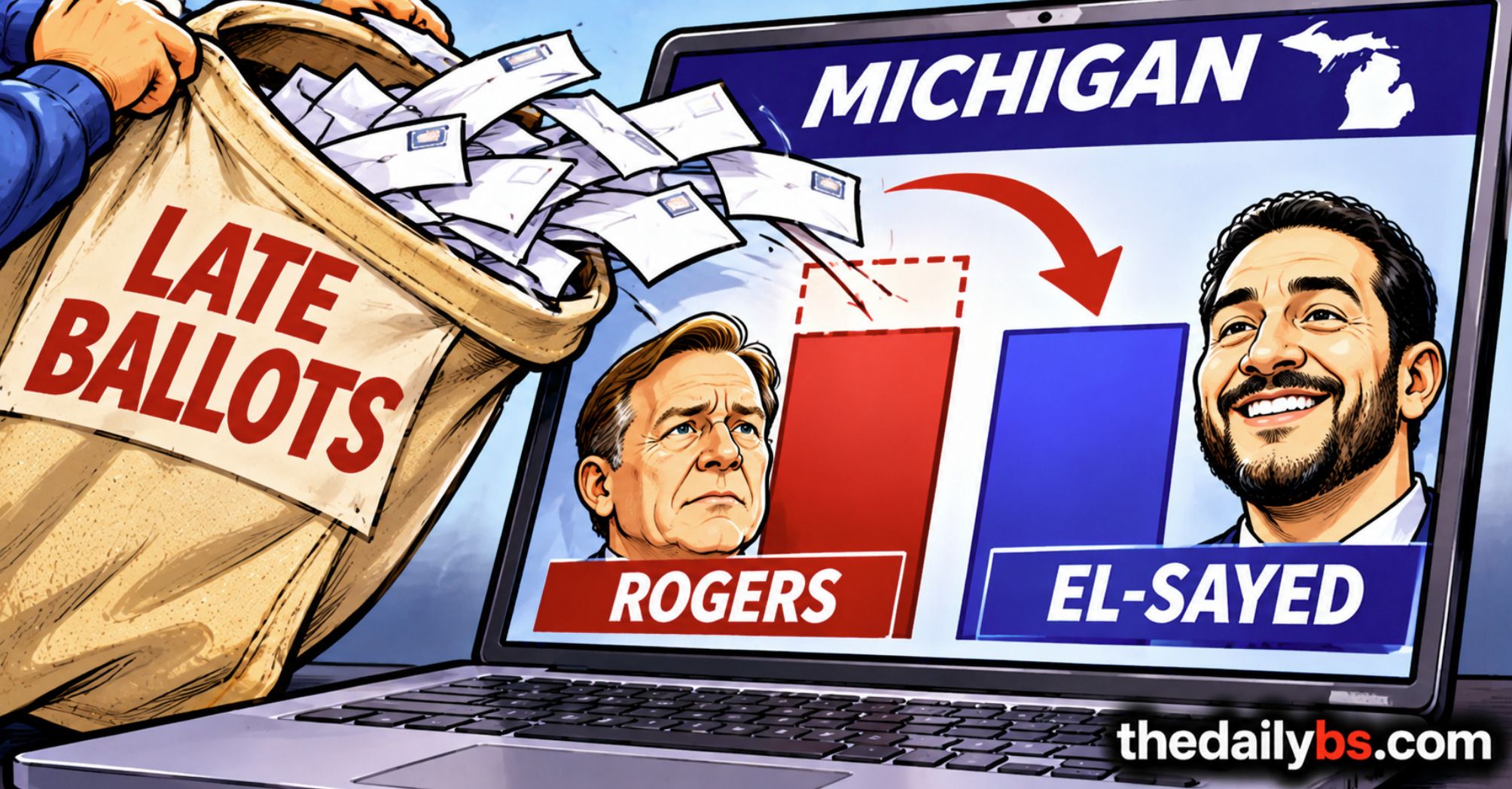
- Election analyst VoteHub has published a Michigan Senate reporting model showing Republican Mike Rogers ahead by nearly three points around 1 a.m., before late-reporting Democratic areas erase the advantage.
- The model places much of the final vote in Detroit, Flint, Lansing, Kalamazoo and other Democratic-leaning communities — with an estimated 15% of ballots still unreported late into the night.
- VoteHub says the scenario deliberately assumes a tied final election to illustrate counting patterns. Michigan officials confirm that large jurisdictions and absentee-ballot processing can produce late results.
LAY IT ON ME (I’ve got time)
If you’re watching Michigan’s Senate race tonight and Republican Mike Rogers is leading after midnight, don’t order the victory cake just yet.
According to a new election-night model, the lead could disappear before breakfast.
And the timing is certainly interesting.
On Monday, the day before one of America’s most consequential midterm elections, election-data organization VoteHub released an analysis explaining how results could unfold in five closely watched races.
The Michigan scenario is particularly striking.
VoteHub’s model shows Republican Mike Rogers ahead by approximately 2.8 percentage points shortly before 1 a.m.
Then the final ballots arrive.
And the lead disappears.
Now that’s the kind of Election Night cliffhanger that makes cable television producers reach for a second pot of coffee.
The analysis, written by VoteHub’s Zachary Donnini, examines which Michigan communities tend to report their results early and which frequently finish counting well after midnight.
The late-reporting areas, according to the model, are disproportionately Democratic.
Among them are Lansing, Kalamazoo, Flint, Saginaw, Washtenaw County, suburban Wayne County and Detroit’s final batches of absentee ballots.
Those aren’t obscure little precincts with a dozen voters and a volunteer carrying a shoebox.
We’re talking about major population centers capable of moving statewide election totals substantially.
VoteHub estimates that approximately 15% of Michigan’s ballots could remain unreported during the late-night stages of its illustrative scenario.
And here’s where the numbers become especially interesting.
The organization specifically designed its example around a hypothetical election that finishes in a tie.
So the 2.8-point Rogers lead isn’t a prediction that Rogers will be ahead by that amount tonight. It’s a demonstration of how the order of reporting could create the appearance of a substantial lead before the remaining votes are counted.
That distinction is important.
But it doesn’t make the reporting sequence any less interesting.
Imagine watching Rogers build a comfortable-looking advantage as Republican communities report their results.
Then, hours later, another large batch arrives from heavily Democratic Detroit.
Then Flint.
Then portions of Washtenaw County.
Suddenly, the percentages on the television screen look very different.
And somewhere, an Election Night analyst is frantically explaining why the race that looked settled at 1 a.m. isn’t settled anymore.
Of course, this is hardly the first time late-arriving election returns have generated controversy.
Americans have spent years arguing about absentee ballots, delayed counting, election administration and what happens when an apparent lead evaporates overnight.
Michigan has been at the center of some of those debates.
But the mechanics of counting ballots aren’t supposed to be a mystery.
Michigan law permits election officials to begin processing certain absentee ballots before Election Day, although election results cannot be released until polls close.
The state also uses paper ballots and requires election workers to reconcile ballots with voting records.
The Associated Press notes that Michigan’s reporting schedule varies substantially among counties.
Wayne, Oakland, Macomb, Kent, Genesee and Washtenaw counties can report relatively small portions of their results in their earliest updates.
In the 2024 presidential election, Michigan’s reported count did not reach the halfway point until shortly after midnight.
The final update of that election night arrived around 4:40 a.m., when approximately 99% of votes had been counted.
In other words, Michigan has a history of taking its time.
And the political circumstances this year are anything but ordinary.
Rogers is competing against Democratic nominee Abdul El-Sayed for the Senate seat being vacated by Democrat Gary Peters.
The contest could help determine which party controls the United States Senate.
It has already become one of the year’s more extraordinary political spectacles.
Democratic Rep. Haley Stevens, who lost her party’s Senate primary to El-Sayed, stunned Michigan politics by endorsing Rogers.
She subsequently declared that she did not consider El-Sayed fit to serve in the Senate.
That endorsement prompted furious reactions from Democratic officials and resignations among Stevens’s staff.
El-Sayed’s campaign then reported raising $2.4 million in a single day.
Not exactly a quiet final weekend.
On Monday, Rogers praised Stevens for crossing party lines.
At his own final campaign events, El-Sayed focused on his economic agenda and criticized the Trump administration.
Sen. Elizabeth Warren appeared at one of his rallies, while actor and rapper Common joined another event in Detroit.
The Senate campaign has attracted more than $100 million in political advertising, according to Associated Press reporting.
And now VoteHub has introduced another element for voters to keep in mind tonight: the possibility that the order of reported results could make the race look very different at 1 a.m. than it does later Wednesday morning.
The organization’s larger report also considers late-counting patterns in Texas, Wisconsin and other competitive states.
The common theme is geography.
Early-reporting communities can produce a temporary lead for one party, while later-reporting communities can shift the statewide percentage in another direction.
Election analysts sometimes call these patterns political mirages.
Which is a perfectly appropriate term, considering how many Americans will be staring at television screens trying to determine whether the numbers they’re seeing tell the whole story.
The obvious question is whether Michigan’s actual reporting sequence follows VoteHub’s illustrative scenario.
That won’t be known until results begin arriving.
The state has also changed some of its absentee-ballot processing procedures in recent years, potentially affecting how quickly particular jurisdictions report.
And the amount of support each candidate receives in those communities will determine what the remaining ballots actually mean.
Still, VoteHub has provided a remarkably specific example of the Election Night scenario that political junkies will be watching.
Rogers ahead after midnight.
Democratic-leaning communities still outstanding.
Large batches coming in overnight.
And a statewide lead that might look considerably different by morning.
The best advice for anyone watching tonight is simple.
Watch the counties.
Watch the outstanding vote.
And remember that a television graphic showing 85% reporting still leaves a rather important 15%.
Especially when the missing ballots come from some of the state’s largest communities.
As for the candidates?
They might want to keep the coffee brewing.
Michigan may not be finished with Election Night until Wednesday morning.
DBS WIRE SOURCES (I have all day)
- VoteHub: What to expect on election night in five close races — November 2, 2026
- Twitchy: VoteHub expects Mike Rogers’ lead to vanish overnight thanks to late ballots
- Associated Press: What to expect in Michigan on Election Day
- Michigan Public: When will Michigan election results come in? What to expect
- Michigan Secretary of State: Official election procedures and ballot-counting information
- CBS News Detroit: Abdul El-Sayed rallies voters the night before Election Day