THE DAILY BS: HOW MUCH CAN YOU HANDLE?
SPARE ME THE BS (I’ve got things to do)
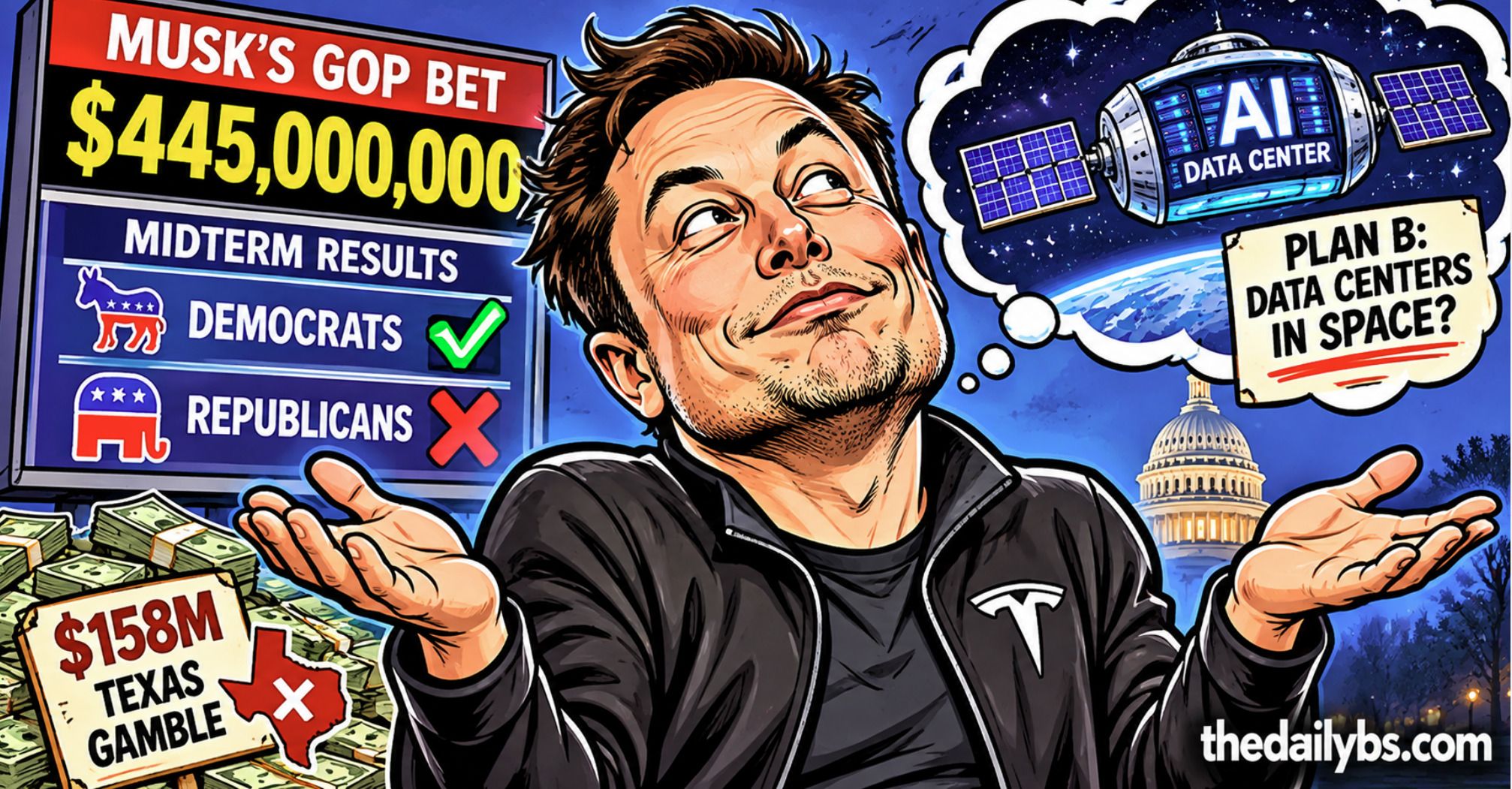
- Elon Musk spent an estimated $445 million backing Republicans in the midterms.
- His $158 million contribution to a Senate GOP super PAC helped finance Ken Paxton’s losing Texas campaign.
- After Democrats won, Musk joked that putting AI data centers in space was looking attractive.
LAY IT ON ME (I’ve got time)
When you’ve spent hundreds of millions of dollars trying to influence an election and your candidates still lose, what do you do?
If you’re Elon Musk, apparently you start looking for real estate somewhere above the atmosphere.
The Tesla and SpaceX billionaire responded to Tuesday’s Republican election disaster with a couple of characteristically sarcastic posts on X, including one that suggested the future of artificial intelligence might be better off somewhere other than Planet Earth.
“Data centers in space looking pretty appealing right now,” Musk wrote early Wednesday.
And then came another wisecrack.
“Guess my election-interfering space lasers didn’t work this time.”
Well, at least somebody still has a sense of humor.
But behind the jokes is an extraordinary political and financial story.
Musk spent an estimated $445 million during the 2026 election cycle supporting Republican candidates and causes, according to Axios. That makes him one of the most prolific political donors in modern American history.
And nowhere was his investment more dramatic than Texas.
Musk gave $158 million to the Senate Leadership Fund, the major Republican Senate super PAC, in two September contributions. The organization subsequently transferred matching amounts to Texas PAC, which supported Republican Senate candidate Ken Paxton.
Musk also contributed directly to other Republican-aligned political organizations working to influence the race.
The money helped finance an enormous advertising campaign against Democrat James Talarico.
It didn’t work.
Talarico defeated Paxton, giving Democrats their first Texas Senate victory since 1988.
And that wasn’t the only Texas surprise.
Democrat Gina Hinojosa defeated Republican Gov. Greg Abbott, delivering another major political setback in a state that has become central to Musk’s business operations.
Tesla, SpaceX and X have all established major operations in Texas. Musk has invested heavily in the state, making its political direction considerably more than an academic concern.
And Hinojosa has an especially interesting position on one of the technology industry’s biggest priorities.
She has called for a moratorium on new artificial intelligence data centers until lawmakers establish stronger protections for electricity supplies, water resources and surrounding communities.
That brings us back to Musk’s sudden enthusiasm for putting those enormous computing facilities in orbit.
Across the country, AI data centers have become increasingly controversial.
The facilities require tremendous amounts of electricity to operate servers, cool equipment and process the enormous computing workloads associated with modern AI systems.
Some also consume significant amounts of water for cooling, depending on their design.
Communities worry that massive new facilities could increase pressure on local power grids, raise utility costs and compete for resources that residents and businesses already need.
Those aren’t concerns limited to Democrats.
Opposition to data centers has emerged in Republican communities, rural counties and politically mixed areas where residents are asking why their neighborhoods should absorb the costs of infrastructure built for some of the world’s wealthiest technology companies.
Democrats successfully made those concerns part of their election campaigns in several states.
In Texas, Hinojosa’s proposed moratorium now raises the possibility of a very different regulatory environment for companies hoping to expand AI infrastructure.
There is one important catch: Texas Republicans are expected to retain control of the state Legislature, so the incoming governor cannot simply impose every proposed policy by herself.
But the election certainly changes the political conversation.
Musk’s space-data-center idea isn’t entirely out of nowhere, either.
Space-based computing has attracted growing interest as companies explore whether solar-powered orbital infrastructure could eventually support AI processing without placing the same demands on terrestrial power grids.
There are, of course, a few technical complications.
Like launching enormous amounts of equipment into orbit.
Keeping that equipment cool in space.
Maintaining and replacing hardware hundreds of miles above Earth.
And figuring out whether any of this makes economic sense.
Small details, really.
Still, if anybody is going to suggest solving a terrestrial infrastructure problem by launching it into orbit, Musk is probably the fellow you’d expect to do it.
The more immediate question concerns his political spending.
Hundreds of millions of dollars went into helping Republicans retain power, and Democrats nevertheless captured both houses of Congress while producing stunning victories in places like Texas.
Campaign money can buy advertising, political consultants and an extraordinary amount of attention.
It cannot guarantee that voters will cooperate.
And there’s a lesson here that goes well beyond Elon Musk.
Americans are becoming increasingly concerned about the cost of electricity, the strain on local resources and whether the technology revolution is delivering benefits that ordinary households can actually afford.
Republicans and Democrats alike would be wise to pay attention.
Musk may eventually figure out how to put the next generation of AI computing infrastructure above the clouds.
But for now, the political problems facing his preferred candidates remain firmly planted on Earth.
And apparently, not even $445 million could provide enough thrust for liftoff.
DBS WIRE SOURCES (I have all day)
- Axios — Musk laughs off election drubbing with space lasers joke
- Associated Press — Elon Musk becomes biggest known donor in midterm contests
- Texas Tribune — Musk gave $158 million to Senate GOP group helping Ken Paxton
- CBS News — Musk’s $158 million donation and its connection to Texas
- Benzinga — Musk floats space data centers after Hinojosa’s Texas victory
- Fox Business — Elon Musk discusses data centers in space