THE DAILY BS: HOW MUCH CAN YOU HANDLE?
SPARE ME THE BS (I’ve got things to do)
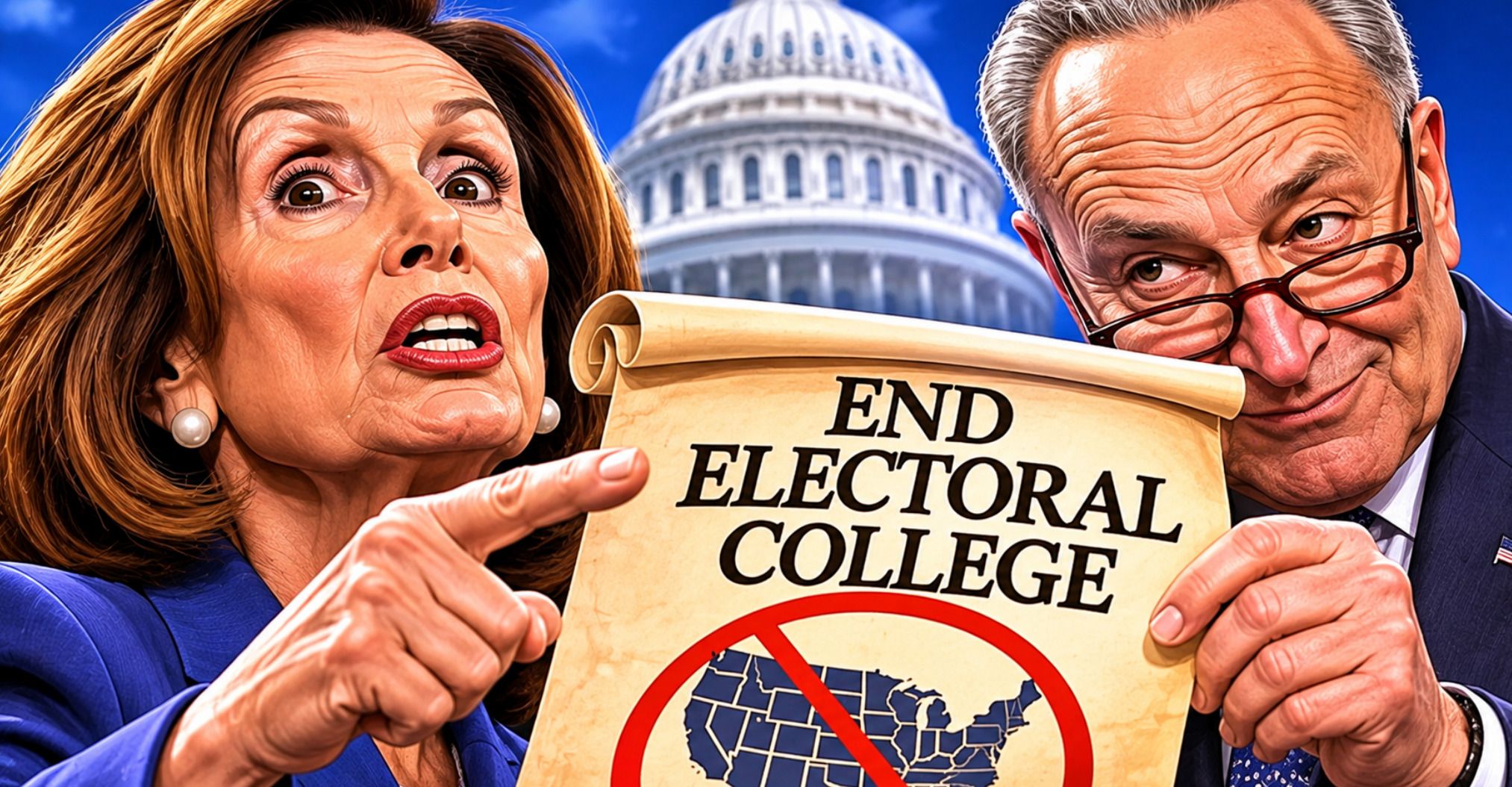
- Democrats’ statehouse victories revive a plan to determine the presidency by national popular vote.
- The agreement already covers 222 electoral votes — just 48 short of activation.
- Five newly Democratic-controlled states could add 61 votes before 2028.
LAY IT ON ME (I’ve got time)
While Republicans are still trying to figure out how they lost last Tuesday’s elections, Democrats have discovered something potentially much bigger than another congressional majority.
They may now have a path to fundamentally change how America’s next president is chosen.
And here’s the remarkable part: they wouldn’t need to amend the Constitution to attempt it.
A little-known agreement among states called the National Popular Vote Interstate Compact is suddenly receiving renewed attention following Democrats’ sweeping victories in state legislatures and governors’ races.
The compact would change how participating states award their Electoral College votes, giving those votes to the presidential candidate who receives the most votes nationwide — even if that candidate loses the popular vote in the individual state.
In other words, a candidate could win a participating state by a substantial margin and still receive none of its electoral votes if another candidate won the national popular vote.
For Republicans accustomed to fighting presidential elections through the traditional Electoral College map, that’s a pretty substantial change to discover just as the party begins planning for 2028.
And the numbers explain why the issue is becoming urgent.
According to the National Conference of State Legislatures, the compact has already been enacted by 18 states and Washington, D.C.
Together, those jurisdictions control 222 electoral votes.
The compact needs 270 to become operational.
That leaves just 48 votes.
Before the midterms, supporters still faced a difficult road to that threshold. But last Tuesday changed the political landscape in several states.
Democrats gained control of the governor’s office and both chambers of the legislature in Michigan, Pennsylvania, Wisconsin, Nevada and Arizona.
Together, those five states possess 61 electoral votes.
If all five enacted the compact, participating states would control 283 electoral votes — more than enough to activate the agreement.
And Democrats wouldn’t even need all five.
Michigan, Pennsylvania, Wisconsin and Nevada alone control 50 electoral votes, which would bring the compact to 272.
That’s two votes above the threshold.
Now, to be clear, none of those five states has automatically joined the compact simply because Democrats won their elections.
State lawmakers would still need to pass legislation, governors would need to approve it, and the plan could face significant constitutional litigation.
But the political opportunity is real enough that organizers are already preparing.
Patrick Rosenstiel, a senior consultant to the National Popular Vote organization, told Fox News Digital that the movement has multiple possible routes to obtaining the remaining 48 electoral votes.
“I am confident we have multiple paths,” Rosenstiel said, expressing optimism that the necessary states could act.
The organization says it has identified legislative sponsors and expects bills to begin moving through state legislatures in 2027.
That’s where this becomes especially interesting.
Most Americans know that presidential elections are decided through the Electoral College rather than a direct nationwide popular vote.
Each state receives electoral votes based on its congressional representation, and nearly every state awards all of those votes to the candidate who wins that state’s popular vote.
Maine and Nebraska use a different allocation system.
The compact would leave the Electoral College formally intact but change how member states use their electoral votes.
Once states representing at least 270 electoral votes joined, those states would collectively award their votes to the candidate who won the national popular vote across all 50 states and Washington, D.C.
The practical effect would be to make the national popular-vote winner the Electoral College winner, assuming the compact operates as designed.
Its supporters say that’s exactly the point.
They argue that every American’s vote should carry equal weight in determining the presidency, regardless of where the voter lives.
They also contend that the existing system encourages presidential campaigns to concentrate their attention on a relatively small number of competitive states while ignoring much of the country.
Critics see a very different problem.
They argue that the compact would weaken the influence of individual states, undermine the traditional federal structure of presidential elections and create legal disputes over whether states can make such an agreement without congressional approval.
And there is a serious legal question.
The Constitution’s Compact Clause restricts certain agreements among states without congressional consent. Legal scholars disagree over whether this particular arrangement would require that approval.
Notre Dame law professor Derek Muller has argued that the compact would be unconstitutional without Congress’s permission.
Supporters counter that the Constitution gives state legislatures broad authority to determine how their presidential electors are appointed.
Nobody has settled that dispute in the context of an activated National Popular Vote Compact, because the agreement has never reached the required 270 electoral votes.
There’s also another complication for Democrats: controlling state government doesn’t guarantee that lawmakers will actually support the legislation.
Michigan previously had unified Democratic control in 2023 and 2024 without successfully enacting the compact.
Nevada’s then-Democratic governor, Steve Sisolak, vetoed a version of the plan in 2019, arguing that it could reduce the state’s influence in presidential elections.
So this is not a done deal. It’s an opening.
But one with potentially enormous consequences.
The 2028 presidential election will occur without Trump on the ballot, assuming the constitutional limit on presidential terms remains unchanged. Both parties will be developing new political coalitions, and Republicans are already confronting questions about the effects of the Iran war, immigration policy and last week’s electoral collapse.
Now they may also have to confront a battle over how presidential elections are decided.
The compact has attracted support from voters and lawmakers who believe the Electoral College can produce results inconsistent with the national popular vote.
That has happened five times in American history, most recently in 2016, when Trump won the presidency despite Hillary Clinton receiving more votes nationwide.
But adopting the compact wouldn’t merely affect Republican candidates. It would change the rules for both parties, and the national popular-vote winner would receive the participating states’ electoral votes regardless of party.
The important development is that Democrats now control enough additional state governments to make the previously theoretical 270-vote threshold a realistic legislative target.
According to Fox News’s November 8 reporting, National Popular Vote organizers are actively exploring that opportunity ahead of the 2027 legislative sessions.
No state has newly enacted the compact as a result of last week’s election.
But the prospect of reaching 270 before the next presidential election has become part of the emerging political agenda.
Whether the effort succeeds will depend on lawmakers, governors, the courts and potentially Congress. The next concrete test will come when those newly elected state legislatures convene and decide whether to introduce and advance the compact.
DBS WIRE SOURCES (I have all day)
- Fox News — Democrats’ midterm sweep opens path to Electoral College changes by 2028
- National Conference of State Legislatures — Current compact status and pledged electoral votes
- National Popular Vote — November 2026 election results and possible path to 270
- Axios — How Democratic election victories could affect the 2028 presidential contest
- National Popular Vote — Explanation of how the compact works