THE DAILY BS: HOW MUCH CAN YOU HANDLE?
SPARE ME THE BS (I’ve got things to do)
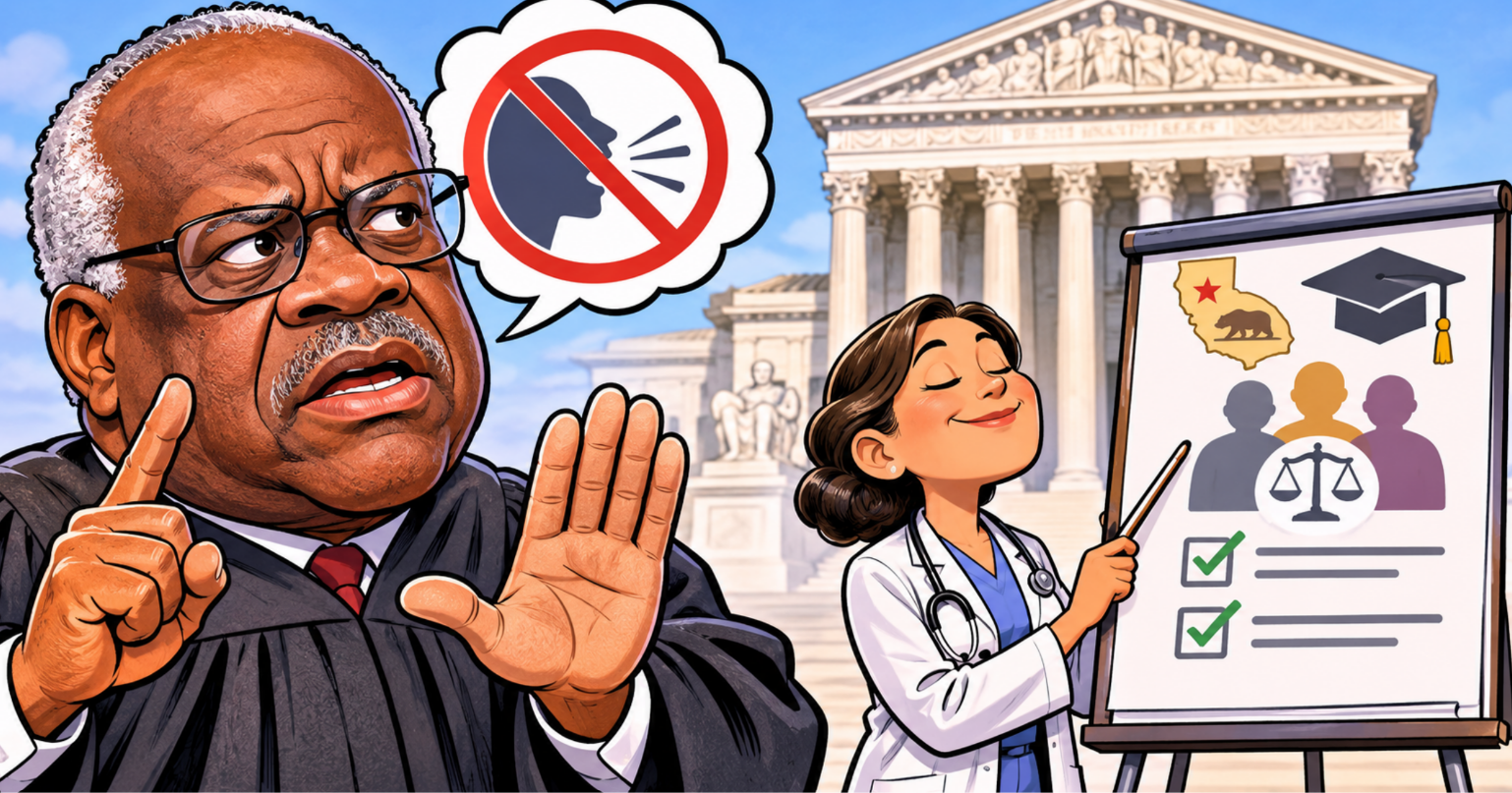
- The Supreme Court declined Monday to hear a challenge to California’s requirement that continuing medical education courses include instruction about implicit bias.
- Justices Clarence Thomas, Samuel Alito and Neil Gorsuch wanted the Court to hear the case. Thomas warned that the lower court’s reasoning could enable government officials to dictate what private medical instructors say.
- California’s mandate remains in effect, but the Supreme Court did not decide whether it violates the First Amendment. The broader constitutional question remains unresolved.
LAY IT ON ME (I’ve got time)
California wants doctors to learn about implicit bias. And if you’re a physician teaching a continuing education course, the state wants you to discuss it whether you believe the material belongs in your class or not.
Three Supreme Court justices think that raises a rather serious constitutional question. But on Monday, the nation’s highest court declined to hear the case.
That leaves California’s controversial medical education requirement in place, along with a federal appeals court ruling that has Justice Clarence Thomas sounding the alarm about government-compelled speech.
The dispute concerns a California law enacted in 2019 and implemented in 2022. Under the law, continuing medical education courses must include material addressing how implicit bias can influence medical decisions and contribute to disparities in healthcare.
California physicians generally must complete 50 hours of approved continuing medical education every two years to maintain their licenses. That means the state has considerable influence over which courses qualify for credit.
And that’s where the constitutional fight begins.
Dr. Azadeh Khatibi, a California ophthalmologist who develops and teaches medical courses, challenged the requirement alongside the nonprofit organization Do No Harm. They argued that California was forcing private medical educators to communicate a government-approved message, even when those instructors disagreed with it.
The state sees things differently. California argues that medical licensing and continuing education are legitimate government responsibilities, and that instruction about unconscious bias can help reduce disparities in patient care.
The state legislature cited research suggesting that patients sometimes receive different treatment depending on factors such as race, sex and other personal characteristics. For example, lawmakers noted disparities in pain treatment and outcomes for certain medical emergencies.
That is the public-health justification behind the requirement. But Khatibi’s lawsuit raised a different question.
Can the government require private instructors to include a particular message in their courses simply because those courses are used to satisfy a state licensing requirement?
A federal district court dismissed the lawsuit. Then, in July 2025, the Ninth Circuit Court of Appeals upheld that dismissal.
The appeals court concluded that California-approved continuing medical education courses qualified as government speech because of the state’s extensive regulation of medical licensing and training. And government speech receives different constitutional treatment from private speech.
In other words, the court concluded that California could require this material without violating the instructors’ First Amendment rights. That reasoning caught Thomas’s attention.
He was joined by Justice Samuel Alito in dissenting from Monday’s decision not to review the case. Justice Neil Gorsuch also indicated that he would have accepted it.
But Supreme Court rules generally require four justices to agree to hear a case. They had three. And that was that.
No oral argument. No definitive Supreme Court ruling on the constitutionality of the law. Just the existing appeals court decision left standing.
Thomas, however, had plenty to say. He argued that the Ninth Circuit had fundamentally confused the government’s authority to regulate medical education with the government’s authority to speak through private individuals.
The First Amendment, he explained, protects Americans against government interference with their speech. The government can express its own opinions, but that doesn’t automatically give it permission to require private citizens to repeat those opinions.
And just because California regulates doctors doesn’t mean every sentence spoken by a private medical instructor suddenly becomes a statement from Sacramento.
Consider the practical implications. Under the appeals court’s logic, Thomas warned, California might someday claim authority to require medical instructors to promote the state’s position on abortion or the ethics of gender-transition surgery.
He also raised the possibility of state licensing boards controlling the content of continuing legal education courses for attorneys. The question becomes where professional regulation ends and government control over private speech begins.
Thomas argued that the lower court had drawn that boundary in the wrong place. He warned that the government-speech doctrine should not become a convenient way to avoid constitutional scrutiny whenever officials want private educators to deliver a preferred message.
The justice also questioned whether the Supreme Court’s existing legal test for identifying government speech needs reconsideration. That’s a significant concern because the issue extends well beyond California.
States regulate doctors, attorneys, teachers and other licensed professionals. If extensive government oversight is enough to transform privately delivered instruction into government speech, the potential implications could reach numerous professions.
But supporters of California’s law argue that medical education requirements are intended to improve patient care, not silence political dissent. They maintain that discussing implicit bias is relevant to clinical decision-making and that the state has a responsibility to establish standards for licensed medical professionals.
Doctors are already required to learn about a wide range of subjects as a condition of maintaining their licenses. California considers implicit bias one of them.
Critics argue that there’s an important distinction between requiring physicians to understand a medical subject and requiring private educators to convey the state’s preferred interpretation of that subject.
Pacific Legal Foundation, which represents the challengers, says the mandate crosses that line. Attorney Caleb Trotter argued that the training communicates damaging assumptions about healthcare professionals and their patients.
“That’s not medicine. It’s compelled speech,” he said.
The controversy also has a personal dimension for Khatibi. According to her attorneys, her family fled Iran when she was a child, seeking freedom from an oppressive government.
Now she’s challenging what she believes is government interference in the content of her medical instruction. California’s supporters reject that characterization and argue that the requirement serves a legitimate public-health goal.
The Supreme Court’s decision does not settle that disagreement. For now, California’s medical education requirement continues.
And the Ninth Circuit’s ruling remains binding within its jurisdiction unless it is overturned or superseded. But three Supreme Court justices have now publicly indicated that the constitutional issues deserve closer attention.
DBS WIRE SOURCES
- The Hill — Supreme Court declines California medical-course bias challenge
- Supreme Court — November 16 order and Justice Thomas’s dissent
- USA Today — Supreme Court won’t weigh in on doctor bias training
- Bloomberg Law — Supreme Court declines review
- Pacific Legal Foundation — Khatibi case
- Ninth Circuit — July 2025 Khatibi ruling
- South Carolina AG — Fifteen-state challenge