THE DAILY BS: HOW MUCH CAN YOU HANDLE?
SPARE ME THE BS (I’ve got things to do)
- Democrats preparing to take control of Congress want to restore Medicaid funding, revive Obamacare subsidies, expand assistance programs and pursue new spending on housing and other priorities.
- President Trump and Vice President JD Vance have signaled openness to some healthcare subsidies and higher taxes on wealthy Americans, potentially giving Democrats an unexpected negotiating partner.
- The spending ambitions arrive as America’s annual deficit approaches $2 trillion and interest on the national debt has exceeded $1 trillion — before Congress approves another dime.
LAY IT ON ME (I’ve got time)
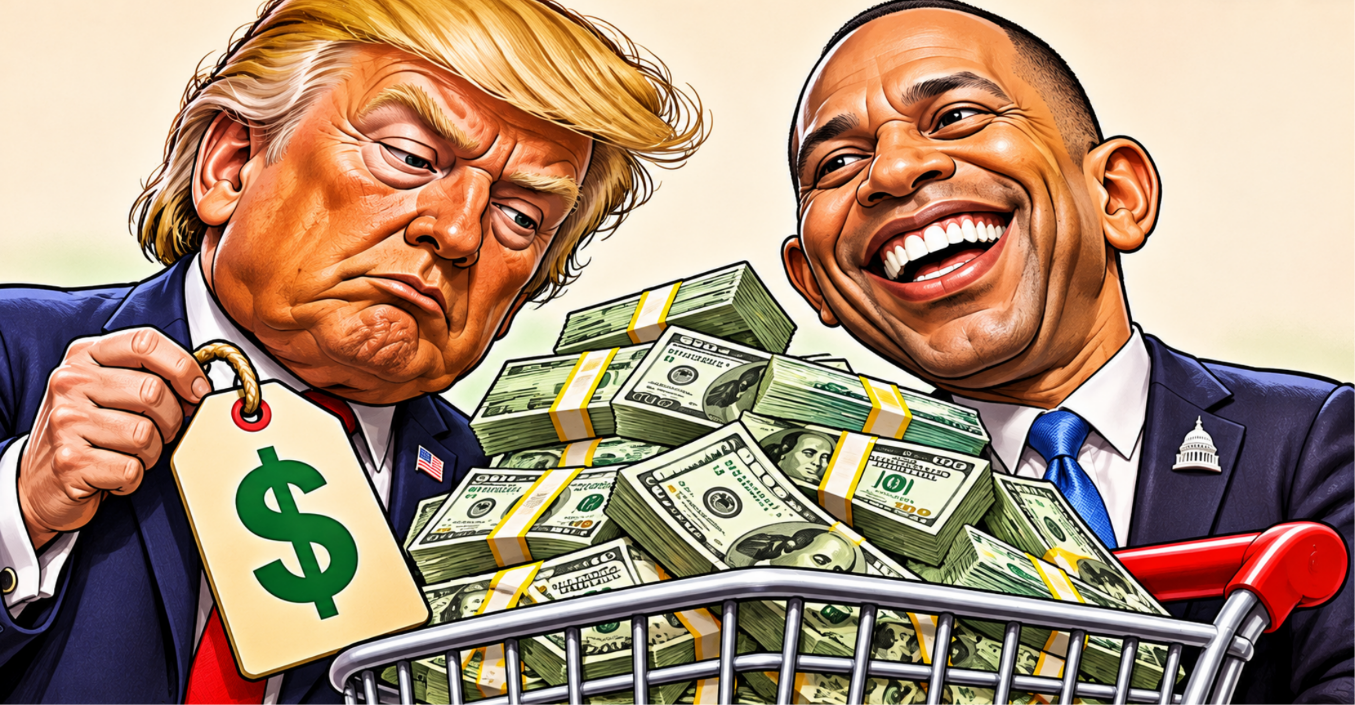
Democrats just won control of Congress, and they’re already shopping for a bigger federal checkbook. The surprise? President Donald Trump might help them open it.
According to a new Fox News investigation, incoming Democratic leaders are preparing an ambitious expansion of federal spending, including billions for healthcare, housing assistance and other government programs.
And while Republicans have traditionally presented themselves as the party of fiscal restraint, Trump and Vice President JD Vance have left the door open to some of the very policies Democrats want.
Welcome to Washington, where the spending arguments are fierce right up until somebody discovers a program both parties would like to fund.
House Democratic leader Hakeem Jeffries has outlined an aggressive agenda for the first 100 days of the new Congress, which takes office January 3.
At the top of his list are reversing Republican Medicaid cuts and restoring enhanced Affordable Care Act tax credits that expired at the end of 2025.
Jeffries has promised Democrats will move quickly. “We’re going to fight to reverse these Medicaid cuts,” he said while discussing his party’s plans.
He also wants Congress to address the cost of groceries, energy, housing and prescription drugs, while rolling back elements of Trump’s tariffs and tax policies.
Other Democrats are proposing direct payments to households, expanded child tax credits, new housing assistance and broader federal healthcare benefits.
Individually, some of those ideas may sound appealing to families struggling with rising expenses. Collectively, they could add trillions to federal obligations over the next decade, depending on what actually becomes law.
And that brings us to the rather awkward matter of the national debt.
The federal government’s fiscal 2026 deficit approached $2 trillion. Interest payments alone exceeded $1 trillion.
That’s not paying down the debt. That’s the financial equivalent of opening your credit card statement and discovering the interest charge has its own mortgage.
Yet the incoming majority is discussing ways to make Washington’s spending commitments even larger.
The Wall Street Journal reports that Democrats are divided over how to finance their agenda, with proposals ranging from increasing taxes on high earners and corporations to imposing new levies on billionaire wealth, unrealized investment gains and artificial intelligence businesses.
Some lawmakers insist new spending should be offset by additional revenue. Others argue that Democrats shouldn’t delay assistance to families while searching for ways to pay for every proposal.
And then there’s Trump. On election night, as Republican losses mounted, the president indicated that he was willing to negotiate with Democrats on issues where common ground exists.
That wasn’t quite the response some conservatives might have expected from a Republican president confronting an incoming Democratic Congress.
Trump and Vance have both expressed some willingness to consider extending Obamacare’s enhanced premium subsidies, provided stronger safeguards are included to prevent improper payments and fraud.
They have also entertained higher taxes on certain wealthy Americans as part of broader budget discussions. Neither position guarantees a deal. But it gives Democrats openings they might not have anticipated.
The White House was careful to emphasize that Trump’s cooperation would have limits.
“President Trump will continue to enact his commonsense, America First agenda,” spokeswoman Olivia Wales told Fox News.
She said the president would work with anyone seeking to lower costs, strengthen the economy and protect American families.
But she warned that Democrats pursuing what the administration considers radical-left policies would be acting against Americans’ interests.
So the White House position is essentially this: We’re willing to negotiate, but don’t mistake the invitation for an unlimited spending account.
Michael Cannon, director of health policy studies at the libertarian Cato Institute, thinks Republicans should be especially cautious about restoring Obamacare subsidies.
“Republicans did not lose seats because of healthcare,” Cannon told Fox News.
He argued that the enhanced subsidies can extend to households with substantial incomes and that Republicans should not feel pressured to reinstate them simply because they lost the election.
That’s a disagreement worth watching. Democrats say the subsidies prevent millions of Americans from facing unaffordable health insurance premiums.
Critics argue that the federal assistance props up an expensive insurance system while creating another long-term obligation for taxpayers.
Both parties will also face the arithmetic of a divided Washington. Democrats won control of the House and Senate, but they do not have enough votes to override a presidential veto.
Most legislation also remains subject to the Senate’s 60-vote procedural threshold unless it qualifies for a special budget process.
That means a sweeping Democratic spending program cannot become law simply because Jeffries puts it on the House calendar.
Trump would have to sign it, or Republicans would have to help Democrats assemble veto-proof support.
For all the talk about a political revolution after the midterms, the next Congress may find itself conducting some surprisingly familiar negotiations.
Democrats want to spend more. Some Republicans are willing to talk. And the Treasury keeps sending Washington reminders that the bill for previous decisions is still outstanding.
The real question is how much of the new Democratic agenda Trump is willing to buy — and what he’ll demand in return.
DBS WIRE SOURCES
- Fox News — Democrats plot massive spending spree
- Fox News — Congress and spending deadline
- Fox News — Republicans after midterms
- House Democratic Leader — Affordability agenda
- Associated Press — Democrats’ 100-day agenda
- Wall Street Journal — New taxes
- The Daily BS — Republicans need concessions to back Democratic healthcare agenda
- The Daily BS — Go big on reconciliation, Congress