THE DAILY BS: HOW MUCH CAN YOU HANDLE?
SPARE ME THE BS (I’ve got things to do)
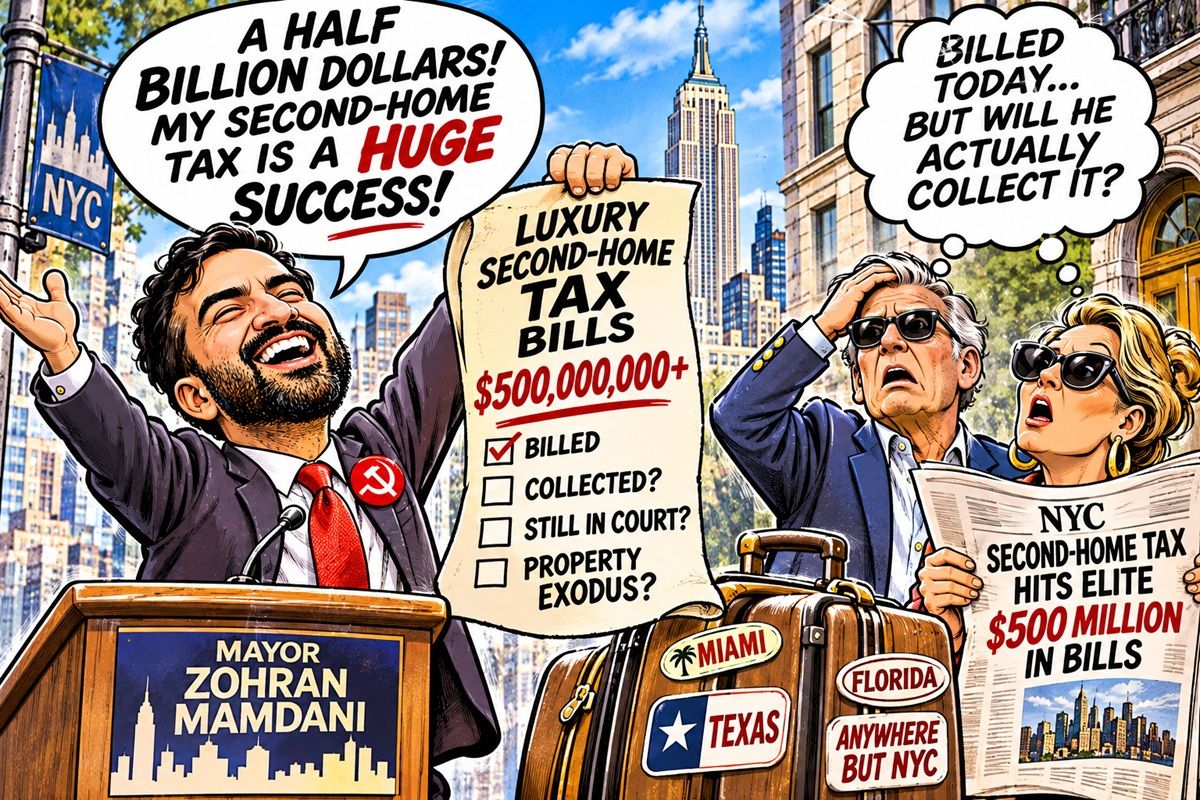
- New York City Mayor Zohran Mamdani announced Tuesday that his luxury second-home tax has generated more than $500 million in bills, reaching the administration’s revenue target despite thousands of exemptions.
- Only about 7,500 property owners received bills, compared with approximately 17,000 initial notices. Another 8,900 exemption applications were approved, and the city has not yet disclosed how much of the money has actually been collected.
- An appeals court recently handed Mamdani a legal victory, although other challenges remain. If the revenue materializes without damaging New York’s property market, the mayor could claim a significant fiscal achievement.
LAY IT ON ME (I’ve got time)
Well, here’s something that might make a few conservatives choke on their morning coffee.
Zohran Mamdani, New York City’s self-described democratic socialist mayor, has just announced that his controversial tax on luxury second homes has generated more than half a billion dollars in bills. Despite thousands of property owners receiving exemptions, the total reached the $500 million target city officials were hoping to hit.
Now, before anybody starts polishing Mamdani’s trophy, there’s a rather important distinction between billing somebody and getting the money into the bank. But there’s also a possibility worth examining: What happens if this particular socialist tax experiment actually produces the revenue its supporters promised?
Yes, we’re going to entertain that possibility, because the objective isn’t to insist that everything a socialist politician proposes must fail. It’s to figure out whether the policy works, what it costs and who ultimately pays the price.
Mamdani was delighted with Tuesday’s numbers.
“We’ve billed more than $500 million to owners of second homes worth more than $5 million,” he announced on X.
“That’s half a billion dollars to invest in a City that works for all New Yorkers.”
The city’s Department of Finance reports that approximately 7,500 property owners received tax bills under the new pied-à-terre surcharge. That is considerably fewer than the roughly 17,000 preliminary notices issued over the summer.
Officials approved approximately 8,900 exemption applications, while another 1,600 extension applications were denied. In other words, more than half the initial pool of properties did not receive final bills, yet the administration says it still reached the headline target.
That is not insignificant, and it’s precisely why the story deserves more than the usual partisan exchange of insults.
The tax was approved by the New York state Legislature in May and applies to qualifying high-value properties that aren’t used as primary residences. The rules cover certain houses as well as condominium and cooperative apartments, with different valuation thresholds and rates.
The idea is straightforward: If somebody can afford an extraordinarily expensive Manhattan apartment that sits largely unused while its owner lives somewhere else, the city believes that person should pay an additional annual surcharge.
You don’t need to embrace socialism to understand the political appeal. New York residents struggling with housing costs may look at a billionaire’s rarely occupied luxury apartment and wonder why that property shouldn’t contribute more to the city’s budget.
And Mamdani has been smart enough to frame the issue in exactly those terms.
Julia Agos, a spokesperson for the city’s Department of Finance, defended the policy by arguing that wealthy second-home owners have a responsibility to contribute to the city that makes their properties valuable. The department says it intends to administer the surcharge fairly while requiring those with substantial resources to contribute more.
That’s the argument from City Hall. But here’s where the economic questions get interesting.
Earlier this year, New York City Comptroller Mark Levine’s office studied the potential revenue from a pied-à-terre tax. Its April report estimated that a version of the proposal could theoretically generate approximately $500 million annually from more than 11,200 properties.
However, the estimate came with a warning. Once exemptions, rental arrangements and changes in property owners’ behavior were considered, the potential revenue fell to approximately $340 million to $380 million.
That’s quite a difference when you’re trying to balance a municipal budget.
The comptroller subsequently examined the version adopted in the state budget, which used a different tax structure. That analysis estimated roughly $1 billion in potential assessments before exemptions and appeals, leaving a substantial margin for the city to reach its $500 million target.
So the latest figure isn’t entirely out of nowhere. The adopted tax was structured to produce substantially more than the original model before taxpayers began claiming exemptions, but 7,500 bills totaling more than $500 million would still represent a meaningful initial assessment if those figures hold up.
Now comes the question Rush Limbaugh would have been asking before the celebration got too far along.
What happens next?
Taxes don’t operate inside a laboratory where people politely remain motionless while politicians calculate how much money they can collect. People react, challenging assessments, changing how they use their buildings, reconsidering investments and sometimes deciding to put their money somewhere else.
A wealthy individual who owns a luxury apartment in Manhattan may have options that ordinary New Yorkers do not. He can sell the apartment, rent it, establish a different qualifying use or reconsider future purchases.
Whether those choices save him money depends on the property and the law. But they illustrate why tax projections can become slippery, particularly when affluent property owners have considerable flexibility.
And this is where Mamdani’s experiment becomes genuinely interesting.
Suppose the city collects most of the money it has billed. Suppose luxury property values remain healthy, wealthy owners continue investing in New York and the anticipated exodus never materializes.
Then the mayor will have a substantial argument that his opponents underestimated the tax’s effectiveness. Conservatives might not enjoy hearing that, but good economic analysis requires acknowledging results when they occur.
The problem for Mamdani is that those results have not yet been established. A bill is a demand for payment, not proof that the money has been received.
The administration has not supplied a detailed public accounting explaining how the approximately 7,500 assessments add up to more than $500 million. Nor does one year’s assessment total tell us what happens to property values, future investment or the city’s tax base.
Those are the measurements that matter if we’re trying to determine whether this is sustainable policy rather than an impressive opening announcement.
There is also the legal battle.
Earlier this month, a New York appeals court unanimously overturned a lower court ruling that had disrupted the tax’s implementation. The appellate judges concluded that the homeowners bringing that particular lawsuit lacked legal standing, allowing the city’s collection process to proceed.
Mamdani could reasonably count that as a victory. But the court did not issue a sweeping endorsement of the tax’s constitutionality, and separate legal challenges remain.
That’s another reason why City Hall’s celebration may be premature.
Still, this isn’t a policy that can be dismissed simply because its architect is a socialist. A tax on expensive second homes is not identical to a general tax increase on every New York homeowner.
The political calculation is that a relatively small group of wealthy property owners can provide significant revenue without directly raising taxes on millions of ordinary residents. The economic argument against it is that wealth doesn’t remain conveniently parked wherever government would like it to stay.
If enough owners change their behavior, the revenue may shrink while the broader property market absorbs the consequences.
Both claims can be tested.
If Mamdani collects $500 million annually for several years without measurable harm to investment or property values, the policy will have a stronger fiscal record than its critics anticipated. If assessments are reduced, collections disappoint, investment slows or property values suffer, the early celebration will look considerably less impressive.
But there’s one more question the mayor shouldn’t escape.
What happens to the money?
New York City’s fiscal problems aren’t solely the result of insufficient taxes. The city has enormous recurring spending commitments, costly services and a persistent need to demonstrate that its government can deliver results efficiently.
Half a billion dollars sounds spectacular, and it is a substantial sum. But it doesn’t magically settle the city’s wider budget problems.
If the new money simply disappears into another round of spending increases, New Yorkers may find themselves being asked for additional revenue before long.
That was a recurring theme on Rush’s program: Government has an extraordinary ability to turn today’s new source of revenue into tomorrow’s baseline expectation. And once politicians become accustomed to collecting a tax, they rarely become enthusiastic about giving it up.
That’s why Mamdani’s next challenge may be more difficult than imposing the surcharge. He’ll have to show that the money is actually collected, that the city uses it effectively and that New York’s economy doesn’t pay a larger price elsewhere.
In the meantime, there’s a telling detail in the mayor’s announcement. Thousands of owners received exemptions, yet the city still sent out bills exceeding its target.
That suggests the tax may be capable of generating substantial revenue from a narrower pool of properties than initially anticipated. It’s a development worth watching rather than waving away.
Mamdani has also been claiming that New York can use the proceeds to build a city that works better for ordinary residents.
DBS WIRE SOURCES
- Fox News — Mamdani’s luxury second-home tax reaches $500 million despite exemptions
- New York City Comptroller — April 30 analysis of the pied-à-terre tax
- New York City Comptroller — Complete fiscal analysis and revenue projections
- New York City Comptroller — May 2026 analysis of the enacted tax structure
- New York Supreme Court Appellate Division — November 4 ruling