THE DAILY BS: HOW MUCH CAN YOU HANDLE?
SPARE ME THE BS (I’ve got things to do)
- The Senate passed the Bipartisan American Affordability and Jobs Act on November 19 by a 62–33 vote, advancing major changes to federal permitting for energy and infrastructure projects.
- Fifteen members of the Democratic caucus supported the legislation, while Republican Sens. Josh Hawley and Mike Rounds voted against it.
- Trump supports the agreement, but the bill faces an uncertain future in the House, where lawmakers from both parties want changes.
LAY IT ON ME (I’ve got time)
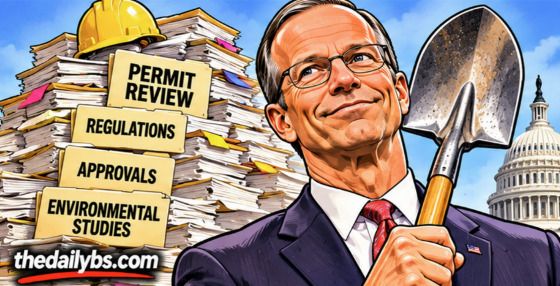
Washington has finally discovered something millions of Americans in construction, manufacturing and energy production have known for years.
It takes too long to build things in America.
The Senate voted 62–33 Thursday evening to approve a sweeping bipartisan permitting-reform bill intended to reduce delays for major energy and infrastructure projects.
And although the legislation attracted substantial support from both parties, the real surprise may be how complicated Congress has managed to make the business of approving construction.
The Bipartisan American Affordability and Jobs Act seeks to streamline federal environmental reviews and permitting processes that can leave major projects tangled in years of administrative procedures and litigation.
The legislation covers a broad range of infrastructure, including traditional energy facilities, renewable-energy developments and electric transmission projects.
It arrives as Americans continue struggling with energy costs and as rapidly expanding data centers place additional demands on the nation’s electrical grid.
Senate Majority Leader John Thune called the vote an important milestone.
“This bill is years in the making,” he said Thursday.
That’s not an exaggeration.
Lawmakers have spent years attempting to reconcile demands for faster project approval with environmental protections, judicial review and disagreements over the proper balance between fossil fuels and renewable energy.
Republican Sen. Shelley Moore Capito of West Virginia has been one of the principal advocates of permitting reform.
When the bipartisan agreement was announced, Capito described it as a rare example of members from both parties working together on a longstanding problem.
“This is a big thing,” she said. “It’s monumental, and it’s legacy-setting.”
Sen. John Barrasso of Wyoming has been equally outspoken about the consequences of federal delays.
“If we want life to be more affordable in America, we need to make it more affordable to build in America,” Barrasso argued during a Senate speech.
He described major projects as getting trapped in a “regulatory penalty box,” leaving equipment, investment and workers waiting for permission to proceed.
There’s a familiar Washington formula at work.
Government demands more energy capacity, more manufacturing, more housing and more infrastructure.
Then government establishes a complicated series of approvals that can make delivering those things significantly more difficult.
Eventually, government holds hearings about why everything is so expensive.
The legislation attempts to address part of that cycle by accelerating reviews and changing certain opportunities for litigation.
Supporters argue that the resulting efficiencies could reduce project costs, strengthen domestic energy production and help modernize the electric grid.
But not everyone is celebrating.
Republican Sens. Josh Hawley of Missouri and Mike Rounds of South Dakota opposed the legislation.
Thirty-one Democratic senators also voted against it, many concerned that the reforms could weaken environmental safeguards or favor fossil-fuel development.
Oregon Democratic Sen. Jeff Merkley questioned whether the legislation would undermine protections involving clean air, water and tribal interests.
“Embedded in this bill is a fundamental question about the direction we go regarding our responsibilities to this planet,” Merkley said.
He acknowledged that the reforms might accelerate renewable projects but argued they could also expand natural-gas development and other fossil-fuel infrastructure.
Other opponents raised concerns about the construction of power-hungry data centers.
The debate illustrates how permitting reform has become more complicated as technology and energy policy increasingly overlap.
Accelerating electricity infrastructure could benefit traditional energy companies, renewable developers, manufacturing operations and the rapidly expanding artificial-intelligence industry.
But bipartisan Senate approval doesn’t settle the matter.
The legislation now heads to the House, where Republicans and Democrats have expressed concerns about different provisions.
A spokesman for House Democratic leader Hakeem Jeffries indicated that Democrats would not simply accept the Senate package without further discussion.
Thune urged the House to pass the measure rather than return it for another extended round of negotiations.
“The best way to get anything done around here is for them to pick up the bill and pass it,” he said.
The Senate’s final vote occurred late Thursday, following amendments and a procedural vote the previous day.
The bill is now awaiting House action, and no final legislation can take effect unless both chambers approve identical language and the president signs it.
DBS WIRE SOURCES
- U.S. Senate — Roll-call record
- Senate Daily Press — November 19 proceedings
- CBS News — Bipartisan permitting bill
- Roll Call — Congressional coverage
- Congress.gov — H.R. 2347