A lead article in last week’s NY Times complained: “Russia strikes another blow to press freedom with move against news site.” The story referred to Russia’s labeling of the independent news website Meduza as an “undesirable organization,” making it fall victim to Kremlin’s efforts to suppress criticism.
But as supporters of free speech, we find that the West has not been kind to pro-Russian expression either.
In February 2022, a few days after Russia invaded Ukraine, Facebook and YouTube restricted access to Russian news outlets RT and Sputnik in Europe. Apple and Google had just removed the news outlets’ apps from the App and Play stores. On March 2, Europe banned Russian news outlets RT and Sputnik from broadcasting and publishing within Europe. A day later, two weeks into the Russian invasion, Twitter banned more than 100 accounts that pushed the pro-Russian hashtag #IStandWithPutin. These accounts were later determined not to be bots but real people who participated in “coordinated inauthentic behavior.” Essentially, numerous western media and technology outlets took a coordinated stand against “undesirable elements,” a position not much different from the Russian government’s.
These days, even an inadvertent expression of pro-Russia symbology can land one in trouble. At the Australian Open tournament, the father of star Serbian tennis player Novak Djokovic was caught in a controversy entirely triggered by the polarizing media. The senior Djokovic was in the stands to celebrate his son’s impressive performance in Melbourne (defeating Russian Andrey Rublev) but was seen celebrating with some fans waving Russian flags. As the clip went viral, the Ukrainian embassy complained.
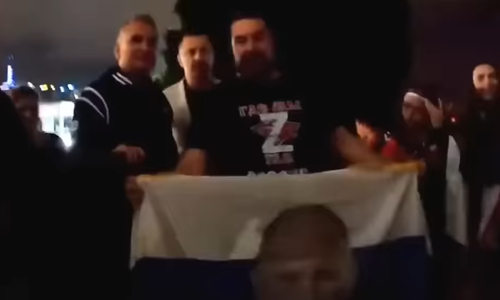
With criticisms in the media mounting, tournament organizers promptly emphasized a rule that bans any Russian and Belarusian flags at Melbourne Park. Police later questioned four spectators. Their crime was that one displayed a flag with Vladimir Putin’s face, and another wore a shirt with the pro-war ‘Z’ symbol. We wonder how the spirit of these actions differed from the Russian government’s act of labeling the independent news website Meduza as an “undesirable organization.”
On the international stage, tennis players from Russia and Belarus already face the ignominy of not having their countries’ flags next to their names when they compete, although all of them have steadfastly avoided any comments about the war. These players face enormous pressure as reporters press them to take sides in the war, knowing well that any public statement could endanger the players and their families in Russia and Belarus.
The decision to ban flags, but not the players, reflects the hypocrisy of the tournament organizers who know the star power of these athletes.
Earlier, Wimbledon had banned all Russian and Belarusian players as if these players had a hand in President Putin’s terrible decision to kill and wound hundreds of thousands in Ukraine mercilessly.
The Australian Open Women’s Singles Finals saw a Belarusian player, Aryna Sabalenka, battle it out with Elena Rybakina, a Russian-born player who migrated to Kazakhstan only for convenience. Rybakina had embarrassed Wimbledon’s organizers in London last summer by lifting the trophy. On Saturday, it was the Belarusian who lifted the Australian Open trophy.

The Western press is as ruthless in criticizing literary works that may be pro-Russian. The Times ran a long story on Swiss-Italian author Giuliano da Empoli’s novel, “The Wizard of the Kremlin,” which has captivated France, winning prizes and selling over 430,000 copies. The book’s crime is that it may present a sympathetic portrait of the Russian leader.
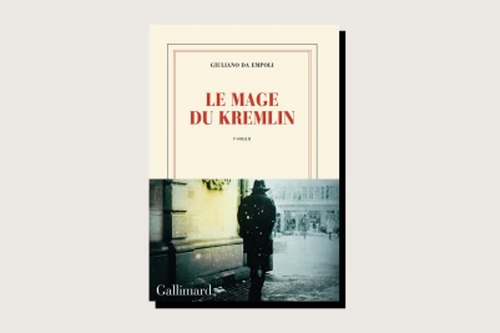
“It conveys the clichés of Russian propaganda with a few small nuances,” said Cécile Vaissié, a political scientist specializing in Russia at Rennes 2 University. “When I see its success, that worries me.” So even a fictional book is fair game for the Western press! Thus far, no one has called for the book, already translated into 30 languages and soon to appear in English, to be pulled from shelves. However, such a development is entirely possible.
We know how adept President Zelenskyy and his team are in skilfully playing the Western media to their advantage using keywords that resonate. Zelenskyy uses the words “freedom” and “democracy” in every speech. Free speech is integral to both values, but the West is forgetting its ideals as it fights an ideology-based battle against Russia.
Please email [email protected]
Republished with permission from TIPP Insights