This week in a press conference, Treasury Secretary Janet Yellen stated that the U.S. economy is doing exceptionally well. “As I mentioned, the United States is doing extremely well economically, with inflation coming down in a strong labor market, and Europe is doing better than was feared at our last meeting.”
Contrast this to what real Americans think. In a recent IBD/TIPP Poll, over one-half (55%) believe the economy is in a recession, and another 56% (57% in March) think the economy is not improving.
We welcome any good news.
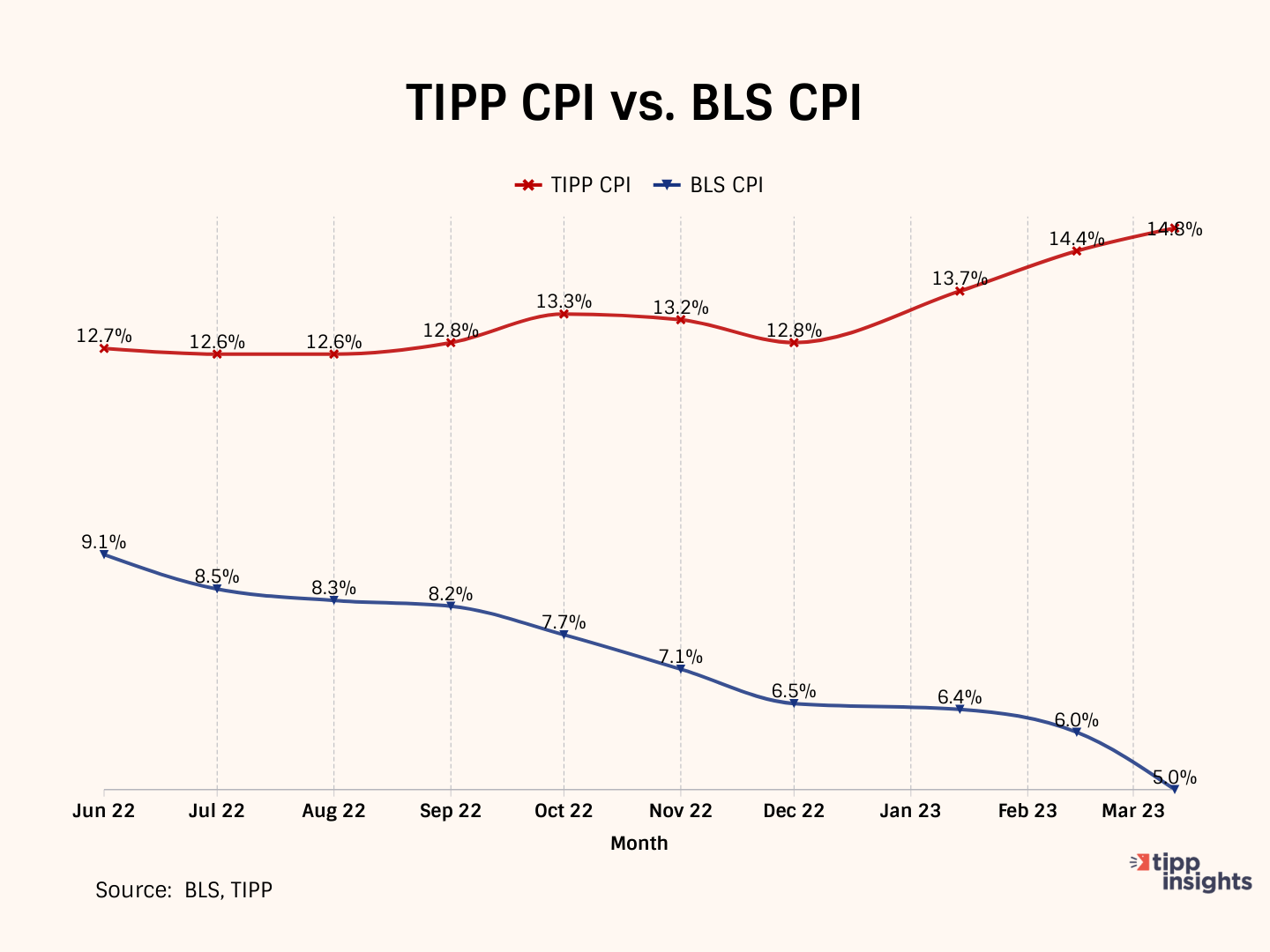
We always take Yellen’s pronouncements with a pinch of salt. Recall that in mid-2021, she double-teamed with Fed Chairman Powell, leading us to believe that U.S. inflation was “transitory,” defying commonsense. Even backbenchers knew inflation was taking a stronghold, which peaked at 9.1%.
Based on our experience, we thought it was appropriate to call her “Janet Yellen – The Modern Nero.” Despite her impressive academic resume, she lacks direct business experience. She can’t relate to the struggles of most Americans. As a team player, she plays a vital role on Biden’s economic team as the go-to person for selling Pollyanna’s ideas to the American public. But she is not very convincing.
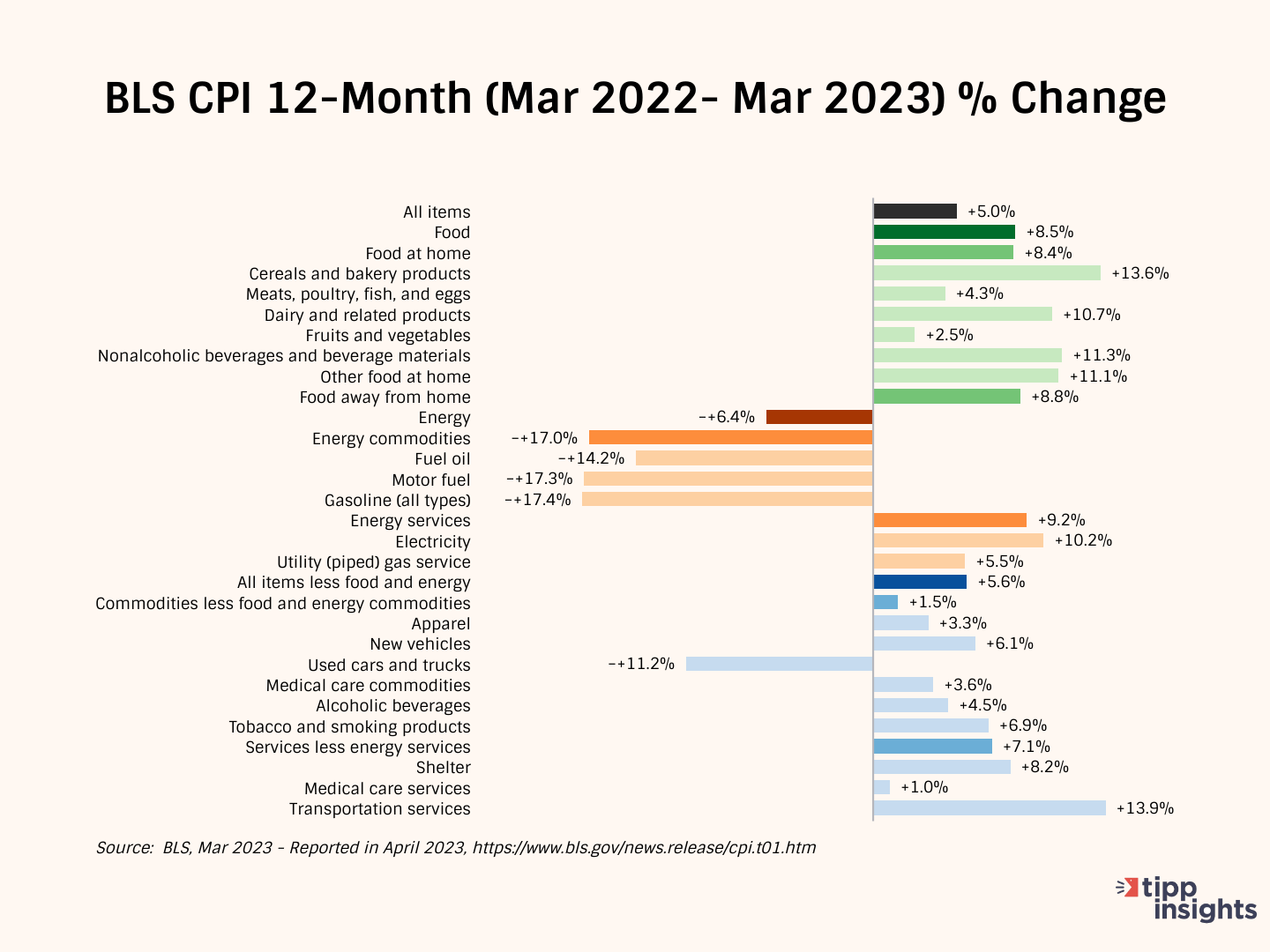
The Consumer Price Index (CPI) released by the government on Wednesday showed a 5.0% year-over-year increase in prices from March 2022 to March 2023, edging down from a rate of 6.0% in February and 6.4% in January. The CPI has declined steadily from a 40-year high of 9.1% in June to 5.0% in March.
The media headlines read:
Inflation slowed to 5% in March, a nearly 2-year low, but core consumer price gains accelerated.
Inflation rose just 0.1% in March and 5% from a year ago as Fed rate hikes took hold.
But few media outlets provided context, partly because doing so would shed the Biden administration in a terrible light. So, we are happy to oblige and fill in the gaps.
The CPI inflation rate measures how much more expensive things are getting over time. The government calculates the increase in the CPI rate over 12 months, so the base for March 2023 is March 2022, and for February 2023 is February 2022.
In March 2023, the CPI index was 301.836, 5.0% higher than its base of 287.504 for March 2022. And in February 2023, the CPI index was 300.840, 6.0% higher than its base of 283.716 for February 2022.
Between February 2022 and March 2022, the base increased sharply by 3.788 points or 1.34%. Even though the CPI index increased by 0.33% between February and March 2023, the headline CPI rate dropped from 6.0% to 5.0% because of the “base effect.”
In other words, the rate seemed lower than it actually was because the base was higher in March 2022. Things were getting more expensive but more expensive at a slower rate than the previous year. Only in Washington is this good news.
TIPP CPI
We developed the TIPP CPI, a metric that uses February 2021, the month after President Biden’s inauguration, as its base. We measure the rate of change in the economy from this base. All TIPP CPI measures are anchored to the base month of February 2021, making it exclusive to the economy under President Biden’s watch.
We use the relevant Bureau of Labor Statistics (BLS) underlying data but recalibrate it to arrive at the TIPP CPI. CPIs are index numbers that give Americans a sense of common understanding about how prices impact their lives, much like the Dow Jones Industrial Average is a bellwether of the stock market.
But we convert index numbers to percent changes when we refer to TIPP CPI and BLS CPI.
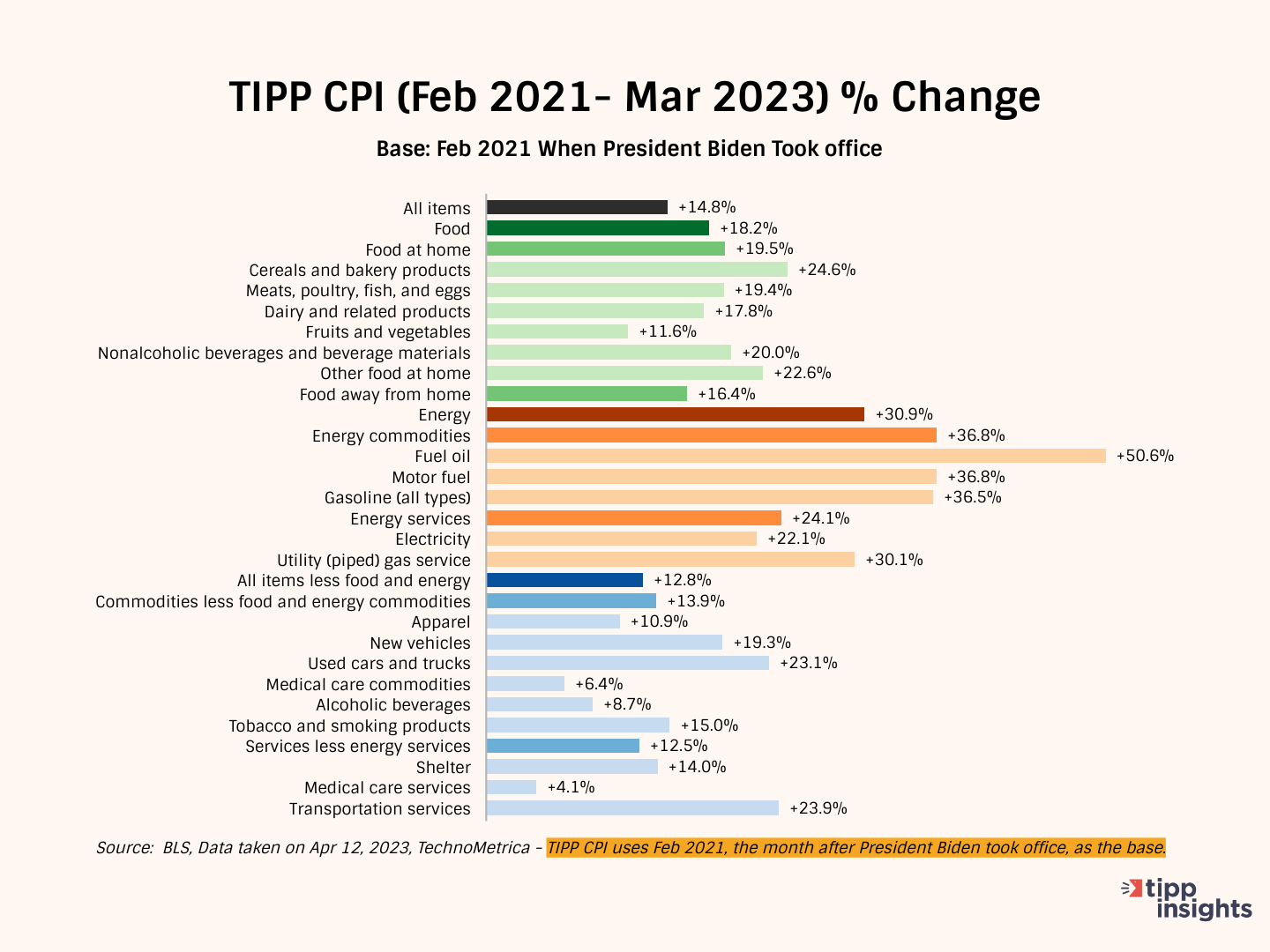
Bidenflation, measured by TIPP CPI using the same underlying data, stood at 14.8% in March. It was 14.4% in February, 13.7% in January, and 12.8% in December.
Significant inflation had already set in by the middle of 2021. In March 2022, CPI inflation was 8.5 percent. The official CPI year-over-year increases will compare prices to inflated bases in the coming months. The year-over-year calculation may moderate the statistics, but you will still feel the pinch of inflation.
TIPP CPI vs. BLS CPI
The following four charts present details about the new metric.
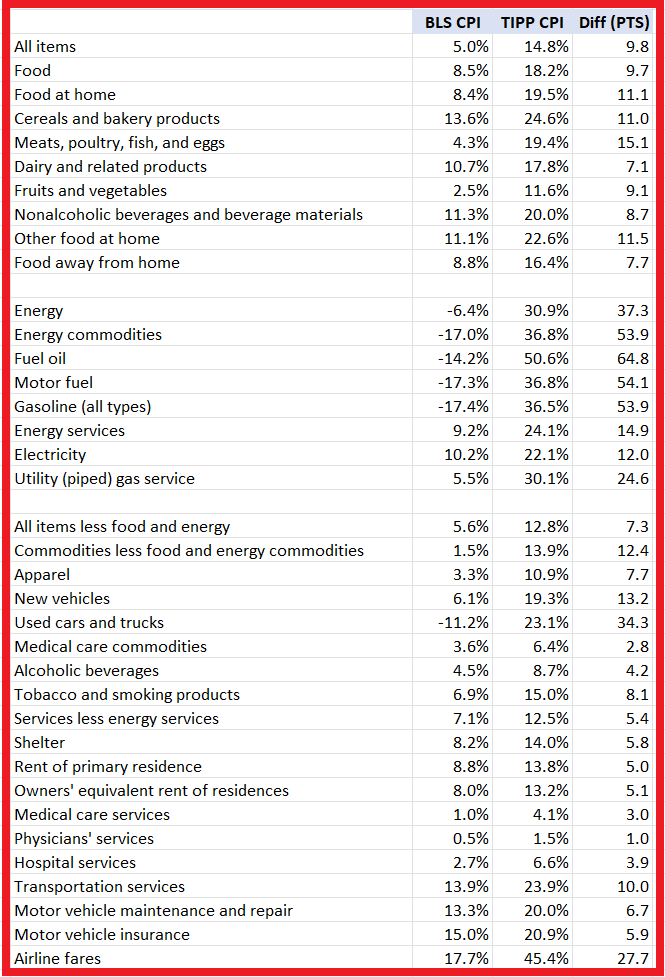
The annual CPI increase reported by BLS is 5.0% for March 2023. Compare this to the TIPP CPI of 14.8%, a 9.8-point difference. Prices have increased by 14.8% since President Biden took office. On an annualized basis, TIPP CPI is 6.83%.
Food prices increased by 18.2% under President Biden’s watch compared to only 8.5% as per BLS CPI, a difference of 9.7 points. The variation is significant and, by design, ignored by Yellen because it would present a more accurate picture of an economy in trouble.
TIPP CPI data show that energy prices increased by 30.9%. But in Yellen’s fantasy world, energy prices declined by 6.4%, according to the BLS CPI. The difference between the two is a whopping 37.3 points.
The Core CPI is the price increase for all items, excluding Food and Energy. The Core TIPP CPI was 12.8% compared to 5.6% BLS CPI in the year-over-year measure, a 7.3-point difference.
Further, gasoline prices have increased by 36.5% since President Biden took office, whereas the BLS CPI shows that gasoline price has improved by 17.4%, a difference of 53.9 points.
Used car prices have risen by 23.1% during President Biden’s term. The BLS CPI shows that the prices have dropped by 11.2%, a difference of 23.1 points.
Inflation for air tickets under President Biden is 45.4% compared to the BLS CPI finding of 17.7%, a difference of 27.7 points.
Americans’ Concerns
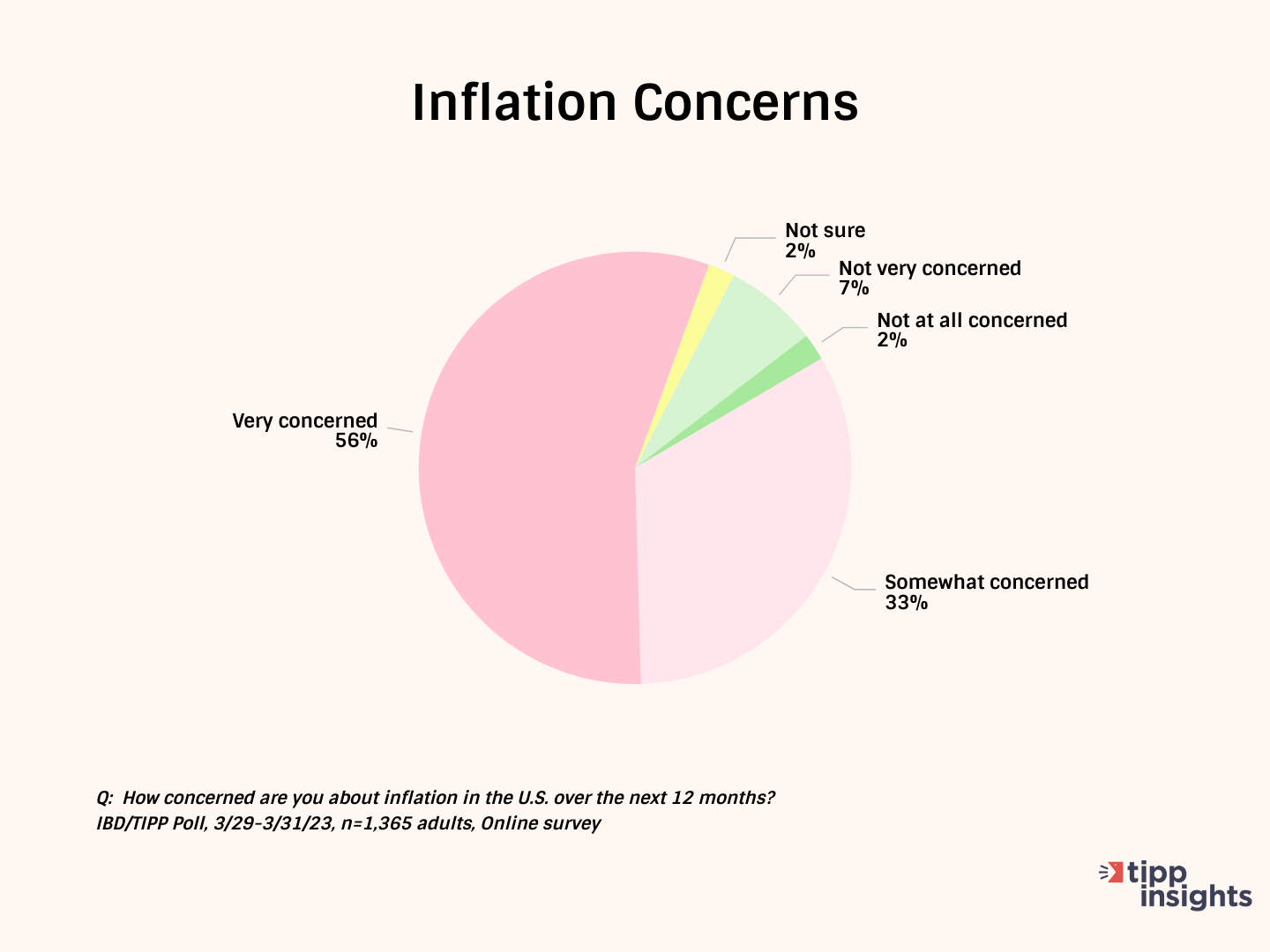
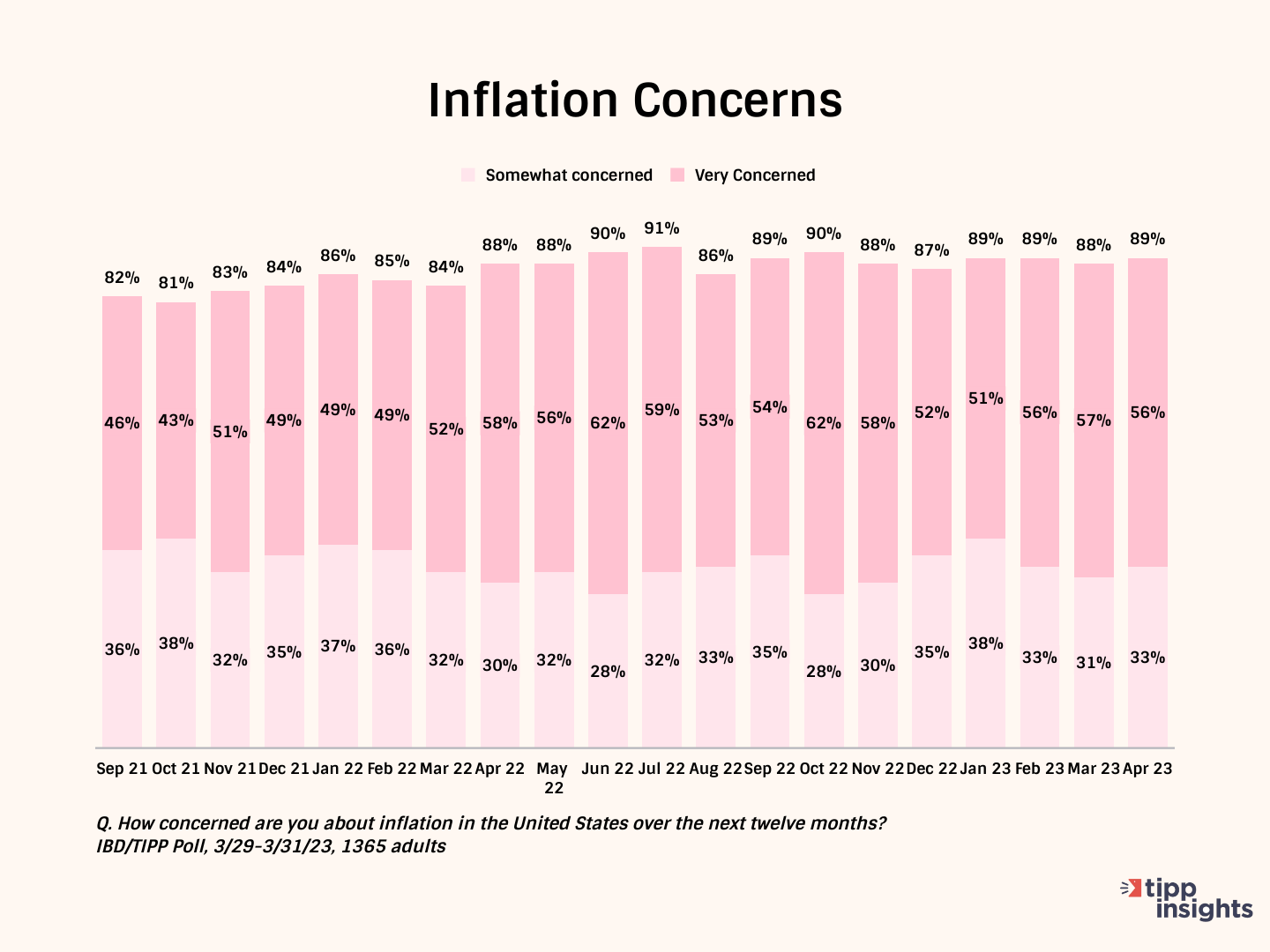
The latest Investor’s Business Daily/TIPP Poll, completed earlier this month, shows that nine in ten (89%; 88% in March) survey respondents are concerned about inflation. Throughout the past year, inflation concerns have stayed above 80%. The share of “very concerned” has been over 50% for twelve consecutive months.
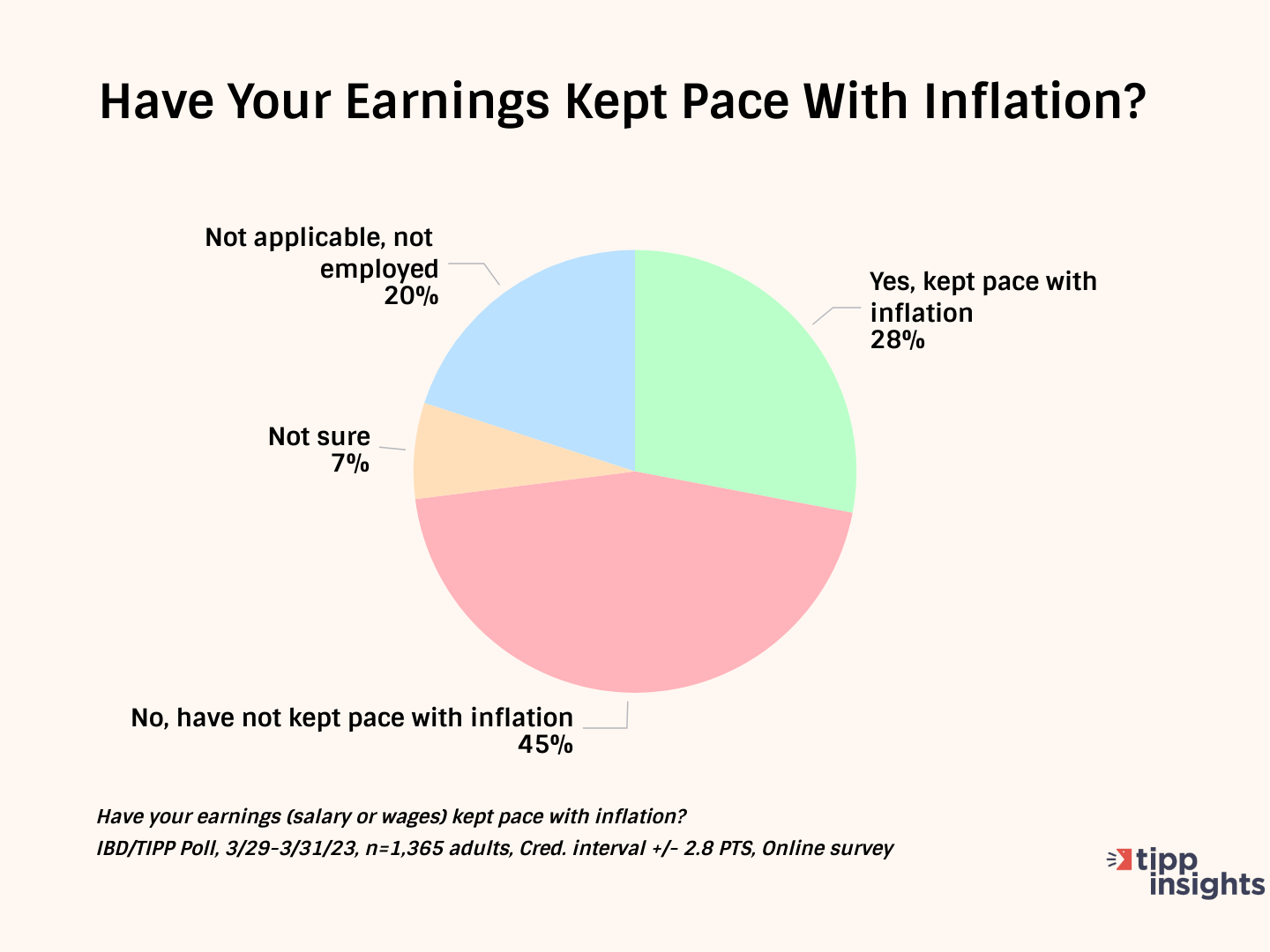
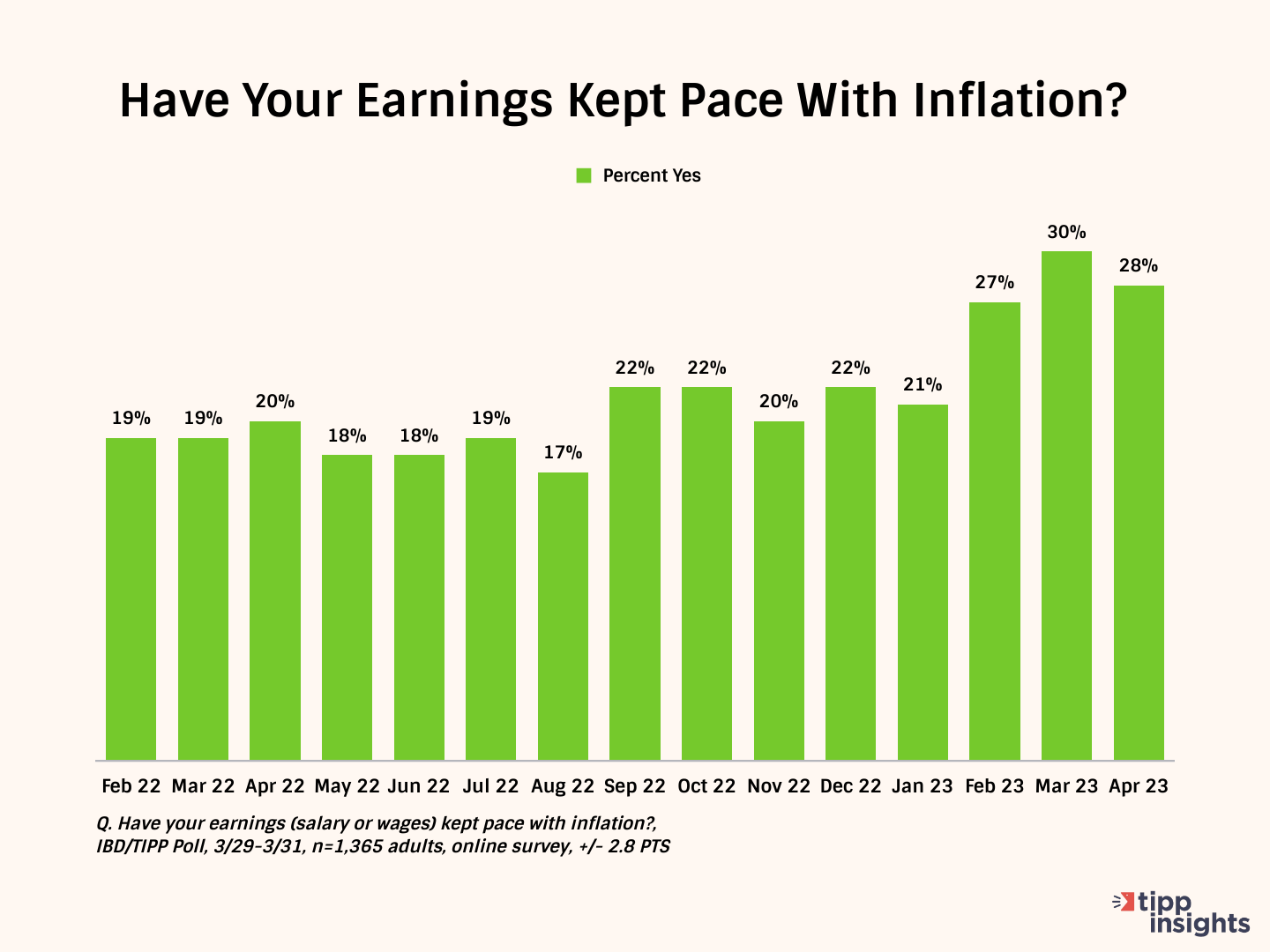
Over two in five ( 45%, 44% in March) say their wages have not kept pace with inflation. Only 28% (30% in March) say their income has kept pace with inflation. This statistic hovered in the low twenties for most of the last year. The positive change in the recent three months may denote the start of a new trend.
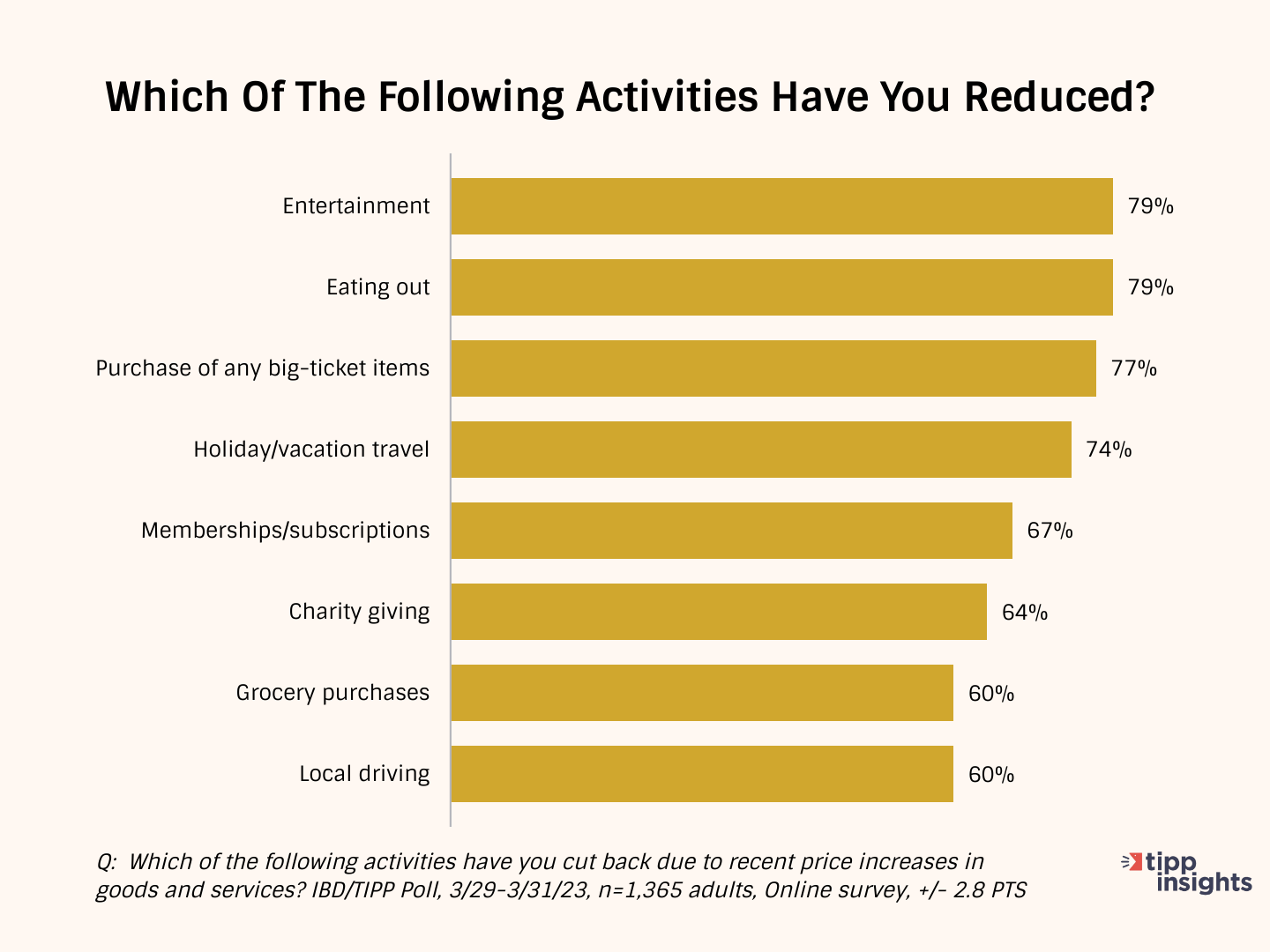
As a result of inflation, Americans are cutting back on household spending – cutting back on entertainment (79%), eating out (79%), purchasing big-ticket items (77%), holiday/vacation travel (74%), and memberships/subscriptions (67%). Many (64%) are cutting back on even good causes such as charity giving. Nearly three out of every five (60%) households spend less on groceries. The high gasoline prices forced 60% to cut back on local driving.
Inflation Direction
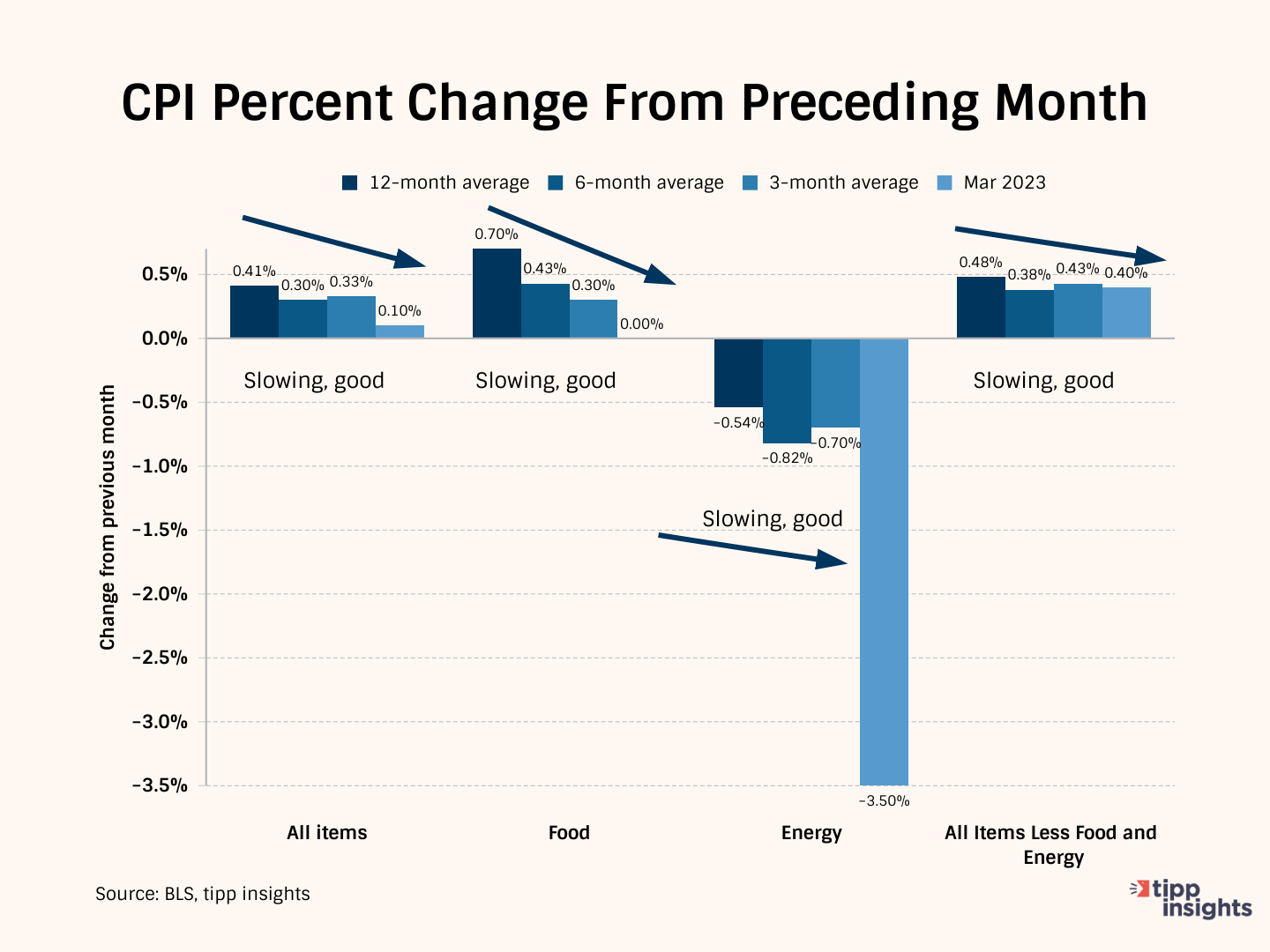
The chart below compares the 12-month average of monthly changes against the 6-month and the 3-month averages. We also show the reading for March 2023.
The 12-month average considers 12 data points and presents a long-term reference, while the six-month and three-month averages consider recent data points.
To better understand, compare the three-month average to March 2023 data. For “all items,” the three-month average was 0.33% vs. 0.1% in March 2023. It is decreasing, and hence it is good.
The March reading for Food (0.00%) is lower than the 3-month average of 0.30%, lower than the 6-month average of 0.43%, and the 12-month average of 0.7%. The downward trend shows improvement.
Similarly, for Energy, the rate is decreasing. The decrease in March 2023 (-3.5%) exceeded the three-month moving average of -0.70%, indicating improvement.
For “all items less food and energy,” the March reading of 0.40% is lesser than the three-month average of 0.43%, indicating improvement relative to the past three months. However, the 3-month average of 0.43% is greater than the 6-month average of 0.38% showing inflation pickup.
We interpret this as a mixed situation.
With an inverted yield curve, short-term U.S. treasuries pay higher interest rates than long-term U.S. treasuries. The closing yields on Wednesday were:
- 5.013% for the 3-month Treasury bill
- 4.956% for the 6-month Treasury bill
- 3.972% for the 2-year Treasury
- 3.421% for the 10-year
- 3.655% for the 30-year
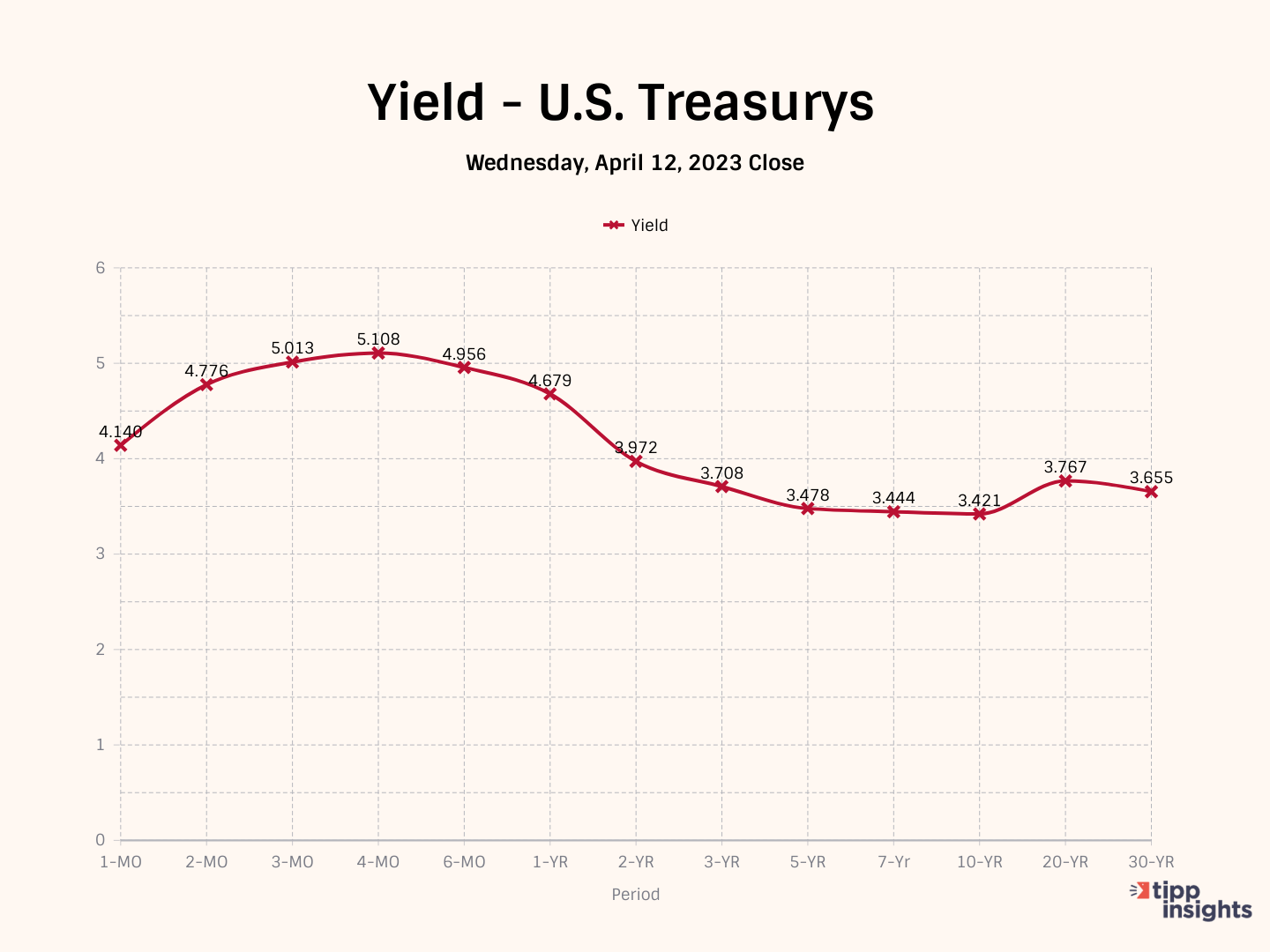
The inverted yield curve is a leading indicator of lower inflation but also a leading indicator of recession.
Most Americans (55% in April, 53% in March) believe the economy is in a recession, and another 56% (57% in March) think the economy is not improving.
To access the TIPP CPI readings each month, you can visit tippinsights.com. We’ll publish the TIPP CPI and our analysis shortly after the release of the official Bureau of Labor Statistics (BLS) report.
The upcoming release of TIPP CPI is on May 11, 2023. We’ll also post a spreadsheet in our store for download.
Hey, want to dig deeper? Download data from our store for a small fee!
Like our insights? Show your support by becoming a paid subscriber!
Want to show your appreciation? Donate
Want to understand better? We recently wrote an explainer that sixth graders could understand. Everyone can benefit from it. Milton Friedman’s Priceless Lessons On Inflation.
TIPP Picks
Must Watch/Read – Selected by tippinsights Editorial Board
 Issues & Insights Editorial Board
Lawrence Kudlow
Daily Caller News Foundation
Daily Caller News Foundation
TIPP Staff
TIPP Takes
Geopolitics And Geoeconomics
#1. Russia Says Black Sea Grain Deal May Be Nearly Over – Reuters
Russia said there would be no UN-brokered Black Sea grain deal extension beyond May 18 unless the West removed a series of obstacles to exporting Russian grain and fertilizer.

“Without progress on solving five systemic problems … there is no need to talk about the further extension of the Black Sea initiative after May 18,” the Russian foreign ministry said in a statement.
The United Nations and Turkey brokered the Ukraine grain Black Sea export deal in July last year to help alleviate a global food crisis worsened by conflict disrupting exports from two of the world’s leading grain suppliers.
#2. Germany Approves Polish Request To Send Ukraine 5 MiG Jets – D.W.
Poland’s formal request to Germany for permission to send five Cold War-era MiG-29 fighter jets to Ukraine has been given the green light, the German Defense Ministry confirmed.

According to German rules, the weapons it sells require approval from Berlin if the receiving country wants to send them to a third country.
Poland had already sent eight of the jets to Ukraine, Polish President Andrzej Duda recently said after first announcing the plan in March, but the ones they want to now deliver come from old East German stocks.
#3. EU Sanctions Russia’s Wagner Group – D.W.
The European Union has added Russia’s Wagner mercenary group to its sanctions list for “actively participating in the Russian war of aggression against Ukraine.”

Wagner, leading Moscow’s battle to capture the Ukrainian towns of Bakhmut and Soledar, had already been placed on another EU sanctions list in February for violating human rights and “destabilizing” African countries.
The European Council, representing the 27 EU member states, said the new sanctions listing “completes” the previous one.
#4. Norway Expels 15 Russian Spies Working Under Diplomatic Cover – UPI
“The 15 intelligence officers have been engaging in activities incompatible with their diplomatic status,” Norway’s Minister of Foreign Affairs Anniken Huitfeldt said in a statement.

According to Norway’s Foreign Affairs ministry, the government decision is a response to “the changed security situation in Europe, which has led to an increased intelligence threat from Russia.”
Huitfeldt stressed that Norway is trying to maintain normal diplomatic relations with Russia.
“But we will not accept that diplomatic missions are misused to carry out covert intelligence activities,” Huitfeldt said in a statement.
#5. Ukraine President Embezzled $400 Million From Fuel Purchase Aid: Report – ANI
President Zelensky and his entourage have embezzled at least $400 million sent to the country to purchase diesel fuel, reported Russian news agency TASS citing U.S. Journalist Seymour Hersh’s website.

Hersh, citing sources on his website, claimed, “The Ukrainian president and many in his entourage have been skimming untold millions from the American dollars earmarked for diesel fuel payments. Analysts from Central Intelligence Agency estimated the embezzled funds at USD 400 million last year, at least.”
#6. China To Ban Ships From Area Near Taiwan – AFP
China will ban ships from entering an area north of Taiwan on Sunday due to “possible falling rocket wreckage,” days after Beijing conducted large-scale military drills around the self-ruling island.

The area, about 100 miles from the Taiwanese capital Taipei, will be closed from 9 a.m. to 3 p.m., the maritime safety administration of China’s southeastern Fujian province said.
The announcement came a day after Taiwan’s Transport Ministry said Beijing planned to impose a no-fly zone north of the island due to “space activities.” According to the ministry, China initially planned a three-day shutdown but relented following objections from Taiwanese authorities.
#7. China Orders AI Chatbots To Stick To Ruling Communist Party Line – RFA
China issued draft regulations requiring chatbots using AI developed by its tech giants to stick to the ruling Communist Party line amid comments that the move will likely be the death of innovation.

“The content generated by generative artificial intelligence should reflect the core values of socialism,” the country’s Cyberspace Administration said in draft rules issued for public feedback and comment.
“Content that may disrupt economic and social order” is also banned, according to the draft rules, which the government wants to implement by the year’s end.
#8. U.S. ‘Disappointed’ In China’s Decision To Uphold Death Sentence For American – UPI
The U.S. State Department expressed disappointment in China’s decision to uphold a death sentence for Mark Swidan, an American first jailed in 2012.

Swidan was arrested from a hotel room in Dongguan in November 2012, according to a 2020 report from the U.N. High Commissioner for Human Rights.
Authorities who arrested Swidan seized his photography equipment, wallet, tablet, passport, and identity card and accused him of being part of a criminal group manufacturing and trafficking drugs.
#9. Countdown To Israel’s ‘Collapse’ Has Begun, Iran’s Military Says Ahead Of Quds Day – Al Arabiya
Israel will cease to exist soon as the country faces an “unprecedented chain of crises,” Iran’s top military body said ahead of the annual Quds (Jerusalem) Day.

In a statement carried by state media, the General Staff of the Armed Forces, responsible for coordinating between Iran’s conventional army and the Islamic Revolutionary Guard Corps (IRGC), said that “Islamic resistance” from outside and internal protests are “challenging the nature of the Zionist regime” – the term used by Tehran to refer to Israel – and that “the countdown to the collapse of Zionism has begun.”
#10. Iran Executed 582 People In 2022, Rights Groups Say – D.W.
Two rights groups said the number of those executed in 2022 was 75% higher than the toll from 2021.

The Norway-based Iran Human Rights (IHR) and Paris-based Together Against the Death Penalty (ECPM) said in a report that four were hanged after participating in the protests ignited late last year.
The two groups condemned what they described as an “execution machine.”
In 2021, Iran executed 333 people. The groups said they had also counted 151 executions so far this year.
#11. North Korea Solid-Fuel ICBM Test: Infographics – tippinsights
North Korea launched what might be a new model intercontinental ballistic missile (ICBM) toward Japan’s northern island of Hokkaido, prompting an evacuation warning for millions of residents.

If this latest missile test is solid-fueled, Pyongyang will have conducted successful flight tests of 10 ICBMs and four different ICBM types since 2017.
Solid-fuel missiles have a crucial advantage over liquid-fuel missiles in being fuelled at the point of manufacture. They allow operators to maintain a high state of readiness and the potential to launch within minutes.
See infographic
Republished with permission from TIPP Insights