Yes, it’s still very early in the nominating process, and both President Joe Biden and former President Donald Trump face daunting legal questions. Even so, both front-runners for the two major parties maintain comfortable, double-digit leads over their potential challengers. But what happens when the number of possible choices inevitably narrows? Then, the race for each party’s nomination changes considerably, the latest I&I/TIPP Poll shows.
As in past months, we asked Democratic voters who among a list of 18 (which includes a choice of “someone else”) they would support for the nomination of their party. The online nationwide poll of 1,230 voters was conducted from May 31-June 2, with the Democratic primary question having a +/-4 percentage point margin of error, vs. +/-4.6 percentage points for the Republican primary question.
Despite all his recent troubles over bribery allegations, shrinking favorability ratings, and accelerating signs of age-related mental difficulties, Biden still receives 37% of Democrats’ support. That’s 27 points greater than the next favorite, former First Lady Michelle Obama, at 10%.
After Obama, no candidate even gets into double figures, with Vermont Sen. Bernie Sanders at 9%, Vice President Kamala Harris at 6%, New York Rep. Alexandria Ocasio-Cortez at 5%, former Secretary of State and New York Sen. Hillary Clinton and California Gov. Gavin Newsom both at 4%, Massachusetts Sen. Elizabeth Warren, environmentalist and author Robert Kennedy Jr. and Transportation Secretary Pete Buttigieg all at 3%.
The remaining candidates all garnered 2% or less.

But an interesting thing happens when you narrow the choices to just Biden and the two newcomers who are often touted in the media as potential outside challengers: Kennedy, and author and politician Marianne Williamson. Then, Biden gets 68% support, compared to 12% for Kennedy and just 4% for Williamson, with 4% saying “someone else” and 12% saying “not sure.”
So, it seems fairly clear that, at least for now, Biden’s main competition will come from the established political names among his challengers, not from the edges or a surprise outside candidacy.

How about the Republicans? Trump, at 55%, maintains what appears to be an insuperable 36-point lead over his nearest bona-fide challenger, Florida Gov. Ron DeSantis, at 19%.
But after DeSantis, there’s a sizable drop-off to the next closest challenger, Trump’s former Vice President Mike Pence, at 6%, followed by former South Carolina Gov. Nikki Haley and current South Carolina U.S. Senator Tim Scott, both at 3%. Just behind them are entrepreneur-author Vivek Ramaswamy and New Hampshire Gov. Chris Sununu, both at 2%. For the record, Sununu announced last week that he has decided not to run.
The remainder of candidates, including former Arkansas Gov. Asa Hutchinson, current Virginia Gov. Glenn Youngkin, former New Jersey Gov. Chris Christie and political commentator and radio host Larry Elder all received 1% or less.

Two sidenotes: Christie announced on June 6 his plans to run, four days after the conclusion of this poll, which could affect his standing in future polls. And Trump was indicted on 37 counts of alleged mishandling of classified documents on June 8.
With those events in mind, given the huge gap between Trump and the field, the I&I/TIPP Poll asked voters of all parties whom would they prefer to see run against Biden in the 2024 election, Trump or DeSantis?
Trump was chosen by 41%, DeSantis 32%, while 27% said they were “unsure.”
The party breakdowns are telling: 30% of Democrats said they would prefer Trump, while 64% of Republicans and 32% of independents picked the former president. DeSantis was supported by 37% of the Democrats, but just 27% of Republicans and 32% of independents, the latter the same as Trump.
So Trump’s edge, when it comes to his own party, again appears insurmountable at this early stage of the nominating process. As it now stands, Republicans show far greater support for Trump than Biden’s Democratic supporters show for him.
This already has proved worrisome to many Democrats. They see potential challenges from the fringes of their party, most recently from radical academic Cornel West and Kennedy, who could eventually siphon enough votes from Biden to deliver the presidency to Trump once more.
As for Republicans, they fear more than anything a rigged election will make it nearly impossible for a GOP candidate, whoever he or she might be, to win a national vote.
Regardless of media and Democratic denials, there were clear improprieties in the 2020 presidential election, ones that shouldn’t be repeated this time around. They included ballot harvesting, “Zuckerbucks” provided by extremely wealthy corporate heads used to help administer local elections, often with the help of leftist NGOs, and efforts by the FBI and others in government to censor conservative content on social media as “misinformation.”
None of this is fanciful or made up.
Indeed, as noted recently by The Federalist, left-leaning investigative journalist Molly Ball of Time Magazine’s “Secret History of the Shadow Campaign That Saved the 2020 Election” revealed, among many other things (in her words), a “well-funded cabal of powerful people, ranging across industries and ideologies, working together behind the scenes to influence perceptions, change rules and laws, steer media coverage and control the flow of information.”
The point is, with the two top candidates facing daunting legal, political and health challenges, both parties have major reasons to be concerned about the outcome of the 2024 election before even the first primary vote is cast.
There are also demographic changes to be reckoned with. Both Medicare and Social Security have again become hotwire issues, especially among older voters. As a recent Pew Research poll noted, “The median age among all registered voters increased from 44 in 1996 to 50 in 2019. It rose from 43 to 52 among Republican registered voters and from 45 to 49 among Democratic registered voters.”
Will older voters, who vote at much higher rates than other groups, decide this election? Or will it be Gen Z voters, those born after 1996, who will call the shots in 2024?
Then there are the 37 federal charges leveled against Trump, which could lead to more than 100 years in prison. They have led to a surge in campaign donations, likely not what Democratic Party officials hoped to see.
Meanwhile, evidence of possible bribery of Biden by both Ukraine and China have mounted, along with the stark fact that, like Trump, he too held onto classified documents at his private office and home.
Yet, as of now, both still comfortably lead polls in their respective parties. Will that last?
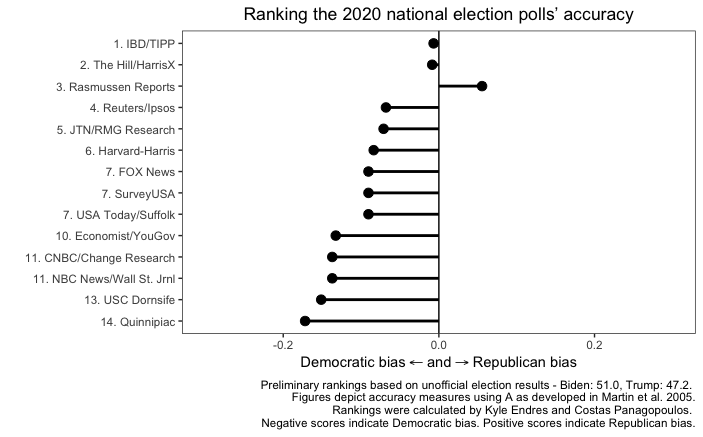
I&I/TIPP publishes timely, unique, and informative data each month on topics of public interest. TIPP’s reputation for polling excellence comes from being the most accurate pollster for the past five presidential elections.
Terry Jones is an editor of Issues & Insights. His four decades of journalism experience include serving as national issues editor, economics editor, and editorial page editor for Investor’s Business Daily.
Hey, want to dig deeper? Download data from our store for a small fee!
Like our insights? Show your support by becoming a paid subscriber!
ICYMI
Our Editorial Yesterday:
Trump Should Attack Smith’s Crime-Fraud Exception Strategy
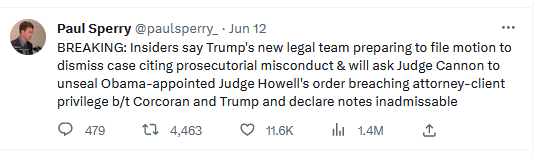
Editor’s note: Our article is a good primer on attorney-client privilege that will be talked about in the coming days.
TIPP Picks
Must Watch/Read – Selected by tippinsights Editorial Board
 Lawrence Kudlow
Daily Caller News Foundation
TIPP Staff
TIPP Staff
TIPP Takes
Geopolitics And Geoeconomics
1. Putin Says Russia Considering Withdrawal From Grain Deal – Reuters
President Vladimir Putin said that Moscow had been “cheated” over implementing the parts of the accord that concerned its exports.

Putin said he would discuss the future of the grain deal with some African leaders who were expected to visit Russia, adding that Moscow was ready to supply grain for free to the world’s poorest countries.
2. ‘Very Concerned’: UN Nuclear Chief About Zaporizhzhia Plant Amid Ukraine’s Counteroffensive – WION
IAEA chief Rafael Grossi also said he is “very concerned” that the nuclear plant could be caught in Ukraine’s long-awaited counteroffensive, which aims to retake Russian-occupied territory.

The IAEA chief also said there were no signs of Russian troops moving heavy military equipment to the Zaporizhzhia Nuclear Power Plant (ZNPP) but can only be confirmed after his visit.
3. Britain-Led Coalition Announces New Air Defense Package For Ukraine – UPI
A Britain-led coalition of 10 European countries has announced a new $116 million air defense package for Ukraine to aid its fight against Russia.

The supplies are to be procured over the coming months with funding from the International Fund for Ukraine, a coffer of monies from international partners set aside with the sole purpose of buying Kyiv lethal and non-lethal military goods.
4. Top Russian Officer Reported Killed In Ukraine Counteroffensive – Al Jazeera
Russian Major-General Sergei Goryachev, Chief of Staff of Russia’s 35th Army, has been reported killed on the Zaporizhia front, where Ukrainian forces have been retaking some territory.

There was no immediate confirmation of the news of Goryachev’s death from the Russian Defence Ministry.
Goryachev, a highly-decorated officer, fought in the Second Chechen War, oversaw a Russian military base in Tajikistan, and led Russian forces in Moldova’s breakaway pro-Russian region of Transdniestria.
5. France Uncovers Sophisticated Russian Disinformation Campaign – UPI
The French government has uncovered a sophisticated Russian disinformation campaign targeting multiple European states to diminish Western support for Ukraine.

The disinformation campaign has focused on four themes — the alleged ineffectiveness of sanctions against Russia, the notion of “Russophobia” in Western states, alleged “barbarity” and Neo-Nazism from Ukrainian forces, and the alleged negative effects of hosting Ukrainian refugees.
6. China Rebukes U.S. In Phone Call Ahead Of Blinken’s Planned Beijing Trip – Reuters
China’s FM Qin Gang urged the U.S. to stop meddling and harming its security in a phone call with his U.S. counterpart, a tense preview to Antony Blinken’s visit to Beijing expected in the coming days.

According to China’s foreign ministry, Qin told Blinken to respect China’s core concerns, such as the Taiwan issue, to arrest declining relations between the superpowers.
7. China Targets ‘Unity In Thought’ With Campaign On Xi’s Philosophy – Al Jazeera
The Chinese Communist Party (CCP) has embarked on a new campaign to educate its members and leaders on Xi Jinping Thought on Socialism with Chinese Characteristics for a New Era.

Such campaigns are often activated after the selection of new party leaders. But there are also signs that the campaign on Xi Jinping Thought is more than just routine.
8. China Witnesses Over 40% Rise In Covid Positive Test Rates In May – ANI
According to government data, China was hit by a Covid-19 wave again in May, which had a nearing positive test rate compared to the peak seen during the pandemic hit at the end of 2022.

The China CDC Covid-19 data for May affirmed anecdotal evidence of a second wave that was reported in local and social media.
9. Arab States Purchased Nearly A Quarter Of Israel’s Record $12.5bn In Arms Exports – Middle East Eye
Arab states that normalized ties with Israel under the Abraham Accords accounted for about 25 percent of Israel’s record $12.5bn in defense exports last year.

According to Israel’s defense ministry, this is a 50 percent jump from the previous three years and a doubling in volume over the previous decade.
The UAE, Morocco, and Bahrain established official relations with Israel in 2020 as part of the U.S.-Backed Abraham Accords.
10. Bahrain, Iran Likely To Restore Diplomatic Ties Soon: U.S. Diplomat – Reuters
Speaking about the possibility of Bahrain restoring diplomatic ties with Iran, U.S. Assistant Secretary of State for Near Eastern Affairs Barbara Leaf told lawmakers, “I think it will happen sometime soon.”

Bahrain cut diplomatic ties with Iran in 2016, a day after Saudi Arabia did so because of attacks on the Saudi embassy in Tehran.
11. U.S., Saudi Efforts To Halt Fighting In Sudan Not Succeeding: State Department – Al Arabiya
Senior State Department officials criticized Sudan’s army and the paramilitary group, which are fighting each other, for not taking advantage of U.S. and Saudi-backed talks in Jeddah.

“It is not succeeding in the way they had originally agreed in terms of this step-by-step process to reach a permanent cessation of hostilities,” an official said.
12. UN Says Some 110 Million People Displaced Around The World – D.W.
The UNHCR report also said poorer countries, rather than wealthy nations, disproportionately bore the responsibility of hosting displaced individuals.

The report indicated that global forced displacement continues to rise unabated in 2023, marking a significant increase of 19.1 million compared to the previous year, driven by conflicts and climate-related upheaval.
13. Sharp Decline In Appetite For News In Recent Years, Reuters Institute Says – BBC
A report by Oxford University’s Reuters Institute says 48% of people worldwide are very or extremely interested in the news – down from 63% in 2017.

More than a third of people (36%) worldwide say they sometimes or often actively avoid the news.
The authors of the institute’s report said there was evidence that audiences “continue to selectively avoid important stories such as the war in Ukraine and the cost-of-living crisis as they cut back on depressing news and look to protect their mental health.”
Please email [email protected]
Republished with permission from TIPP Insights