The German newspaper Bild ran a story this week that was rather unusual: Bundeswehr criticizes the Ukraine army for the first time.
Despite billions of dollars in arms transfers to Ukraine, including Leopard tanks, an internal report from the German armed forces leaked to Bild has summarized that the Ukraine offensive against the Russian attackers is not going as planned.
It is an extraordinary admission by Germany that its unilateral posture of support to Ukraine – repeatedly expressed by Chancellor Olaf Scholz, Foreign Minister Annalena Baerbock, and EU President Ursula von der Leyen, all of whom have crisscrossed the world practically wearing a Ukrainian flag – doesn’t have much to show for progress on the ground.
The Bundeswehr holds the same stature as the American Pentagon. In February, German Defense Minister Boris Pistorius announced an increase in his budget by as much as $10.7 billion. The move surprised everyone, including the military-industrial complex in Germany, because, for decades, Germany’s defense budgets barely kept up with inflation. The Russian invasion of Ukraine had changed the German government’s calculus.
Meanwhile, in Washington, Secretary of State Antony Blinken confessed to CNN’s Fareed Zakaria on Sunday that it was tough going for Ukraine.
These are still relatively early days of the counteroffensive. It is tough. The Russians have put in place strong defenses.
While there was a lot of snake-oil-selling talk, Blinken acknowledged that shipping weapons to Ukraine, including F-16s, alone was insufficient:
It’s the training. It’s the maintenance. It’s the ability to use it in combined arms operations. All of that takes time. If a decision were made to actually move forward on the F-16s tomorrow, it would be months and months before they were actually operational.
Pressed further, Blinken said:
“We believe that what they have and what they’ve been trained on is what they need to be effective, including dealing with the Russian mines. But it is hard going.”
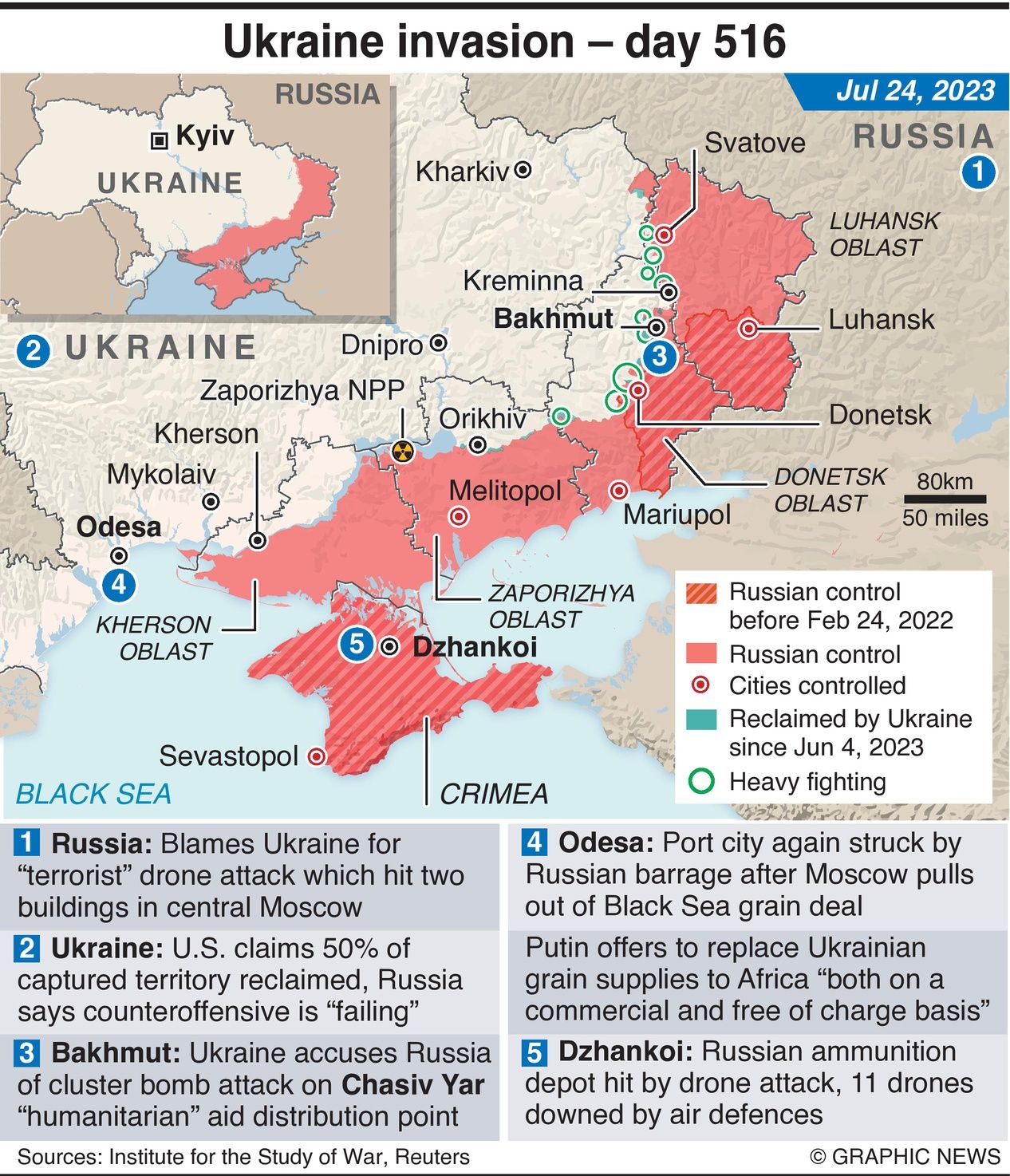
The West has committed to sending over $200 billion in sophisticated arms, but Ukraine’s fabled counteroffensive has barely budged for over six weeks. Thousands of Ukrainian soldiers are dying, many more are wounded, and billions of dollars of Western weaponry are being sacrificed to prolong the war. President Biden continues to stay the course, with another injection of weapons to Ukraine this week. It’s not just President Biden who thinks this way. The entire Republican establishment and Democrats in Congress believe that staying the course and equipping Ukraine is the only sane approach.
In a page-1 piece earlier this week, The Wall Street Journal summed up the Western military strategy this way.
When Ukraine launched its big counteroffensive this spring, Western military officials knew Kyiv didn’t have all the training or weapons—from shells to warplanes—that it needed to dislodge Russian forces. But they hoped Ukrainian courage and resourcefulness would carry the day. They haven’t.
To many in the world that have refused to condemn Russia’s actions in Ukraine, the West looks like it is readily sacrificing Ukrainian lives so that Western blood is not at risk. The West seems to have outsourced its efforts to weaken Russia by splurging Ukraine with weapons, money, and promises to rebuild – so that Russia will be too weak to even consider invading a NATO country. It is a deeply-troubling approach that demonstrates the West’s immorality and hypocrisy because the justification of this support is substantially moral: We should help Ukraine defend its sovereignty.
The costs to Ukraine are more than just the loss of life and limb. According to the United Nations High Commission on Refugees (UNHCR), six million refugees from Ukraine have resettled, mainly in Europe, the largest migration since World War II. Many refugees have reported a severe drop in living standards as their inability to speak the language of their destination country, high inflation, and worsening economic conditions (Germany is in a recession; the UK may enter one) make it impossible to assimilate. Frustrated, several are planning their return to Ukraine, but the continued stalemate on the battlefield is destroying those hopes.
Even if safety is assured, to what will the Ukrainians return? Bakhmut, a sprawling city before the war, was reduced to hopeless rubble in the brutal battles of May. When will life in Bakhmut – schools, churches, parks, hospitals, office buildings – be restored?
President Biden continues prosecuting this war because not doing so would open him to political attacks as America prepares to vote in 2024. Even a friendly press will likely bombard the administration with questions like: If Russia continues to hold more Ukrainian land than before February 2022, did America lose? Is Ukraine a worse chapter than the Afghan withdrawal? What does America have to show for its $120 billion spend? Will Ukraine become part of NATO? If not, did Russia win after all? If yes, does it mean America will send its armed forces to defend Kyiv?
The Biden administration still believes that peace discussions are too premature. It is a head-scratching position until we understand why the President is holding on to it. Biden should not be seen to fail, although Ukrainians are dying. Deja vu Vietnam.
Related
TIPP Takes
Geopolitics And Geoeconomics
1. Ukraine: NATO To Boost Black Sea Surveillance – D.W.
“NATO and Allies are stepping up surveillance and reconnaissance in the Black Sea region, including with maritime patrol aircraft and drones,” NATO said in a statement following a meeting of the Ukraine-NATO Council.

Earlier this month, the council was set up to coordinate cooperation between the Western military alliance and Kyiv.
2. U.S. Urges African Leaders To Confront Russia’s Putin On Grain Crisis – AFP
Secretary of State Antony Blinken pressed African leaders attending a summit with Russia’s Vladimir Putin to demand answers about a grain crisis that has propelled poorer nations towards crisis.

Speaking ahead of a Russia-Africa sit down in Saint Petersburg, Blinken insisted African leaders knew rising food costs and grain and fertilizer shortages directly resulted from Putin’s war in Ukraine.
3. Wagner Spat With Russian Army Began In Syria Years Before Attempted Coup: Experts – Al Arabiya
An article by the Middle East Institute says the strife between Wagner and the Russian government began in 2017 in Syria, when Wagner suffered heavy losses due to a lack of support from the Russian army.

Wagner forces have been in Syria since 2015, fighting alongside forces loyal to Bashar al-Assad’s regime. The private militia played a vital role in pushing the Russian military’s interest in Syria but suffered substantial human casualties over the years due to reported Russian negligence.
4. U.S. Export Controls On China Expected To Impact Companies’ Revenue: Commerce Secretary – Reuters
Commerce Secretary Gina Raimondo said the Biden administration seeks to carefully target U.S. controls on exports to China, but rules will cost firms some revenue.

Rules “will deny some revenue to American companies, but we think it’s worth it,” Raimondo said.
Last week, U.S. chip company executives met with top Biden administration officials to discuss China policy, as the powerful semiconductor lobby group urged a halt to more curbs under consideration.
5. Key Chipmaking Material Prices Soar Ahead Of Chinese Export Curbs – Nikkei Asia
Gallium prices are surging after China said it would start requiring permits to export the key metal and other chipmaking materials in August, signaling a potentially significant impact on the industry.

The benchmark price for gallium in the U.S. and European markets reached $332.50 per kilogram on July 20, up 18% from the end of June, before China announced it on July 3.
6. Huawei To Restart 5G Mobile Chip Output As Early As This Year – Nikkei Asia
Huawei has not made cutting-edge mobile chips since Washington cut off the company’s access to key American technology and vital global suppliers in 2020.

Sources said that Huawei, a one-time smartphone powerhouse, is working with top Chinese chipmaker Semiconductor Manufacturing International Co. (SMIC) to put its in-house designed 5G mobile chipset into mass production in the coming months.
7. Blinken Says Door Open For New Zealand To ‘Engage’ In AUKUS Pact – AFP
Secretary of State Antony Blinken raised the possibility of New Zealand and other nations taking part in the AUKUS defense pact, cooperation that could rile Wellington’s key trade partner China.

New Zealand Prime Minister Chris Hipkins said New Zealand was “open to conversations” about a possible role in AUKUS, so long as it did not relate to developing nuclear-powered submarines.
8. UN Earthquake Rescue System Blocked In Syria And Iran By U.S. Sanctions – Middle East Eye
The ‘Superpower’ system used by the UN’s disaster response network is built on software that the U.S. tech company does not allow to be used in sanctioned countries – including earthquake-prone Iran.

Internet freedom and digital rights campaigners said the issue appeared to be a consequence of “over-compliance” with U.S. sanctions targeting Syria and Iran.
9. Dozens Protest In Front Of Iraq Central Bank After U.S. Blacklist Of Iraqi Banks – A.P.
Dozens of people protested in front of the Central Bank of Iraq in Baghdad, and bank owners called for official action to stem a sharp increase in the dollar exchange rate.

The spike in the exchange rate came after the U.S. listed 14 private Iraqi banks among banks that are banned from dealing with U.S. dollars due to suspicions of money laundering and funneling funds to Iran.
10. North Korea’s Kim Shows Off Banned Missiles To Russian Minister – Reuters
Russia’s defense minister accompanied North Korean leader Kim Jong Un to a defense exhibition featuring North’s banned ballistic missiles as the neighbors pledged to boost ties.

The Russian minister, Sergei Shoigu, and a Chinese delegation led by a Communist Party politburo member arrived in North Korea for the 70th anniversary of the end of the Korean War, celebrated in North Korea as “Victory Day.”
11. U.S. Officials To Meet Taliban To Discuss Security And Human Rights – Middle East Eye
U.S. officials are set to meet with representatives of the Taliban and “technocratic professionals” from Afghan ministries during a visit to Doha this week, the State Department said.

The discussions will include security, narcotics, and women’s rights.
The Biden administration’s special representative for Afghanistan, Thomas West, and special envoy for Afghan Women, Girls, and Human Rights, Rina Amiri, will travel to Astana, Kazakhstan, and Doha, Qatar.
12. Niger Soldiers Declare Coup On National TV – BBC
Soldiers in the West African country of Niger announced on national TV that they had dissolved the constitution, suspended all institutions, and closed the nation’s borders.

Since early Wednesday, troops have held Niger President Mohamed Bazoum from the presidential guard. He was promised Washington’s “unwavering support” in a U.S. Secretary of State Antony Blinken call.
13. Singer Sinead O’Connor Dies Aged 56 – D.W.
The Irish-born musician was best known for her hit single “Nothing Compares 2 U.” O’Connor was outspoken in her social and political views and a lifelong non-conformist.

The artist kept her head shaved in what she said was a response to music company bosses pressurizing her to be conventionally glamorous.
O’Connor was a critic of the Catholic Church and made headlines by tearing up a photo of Pope John Paul II in October 1992 while appearing on live television.
Please email [email protected]
Republished with permission from TIPP Insights