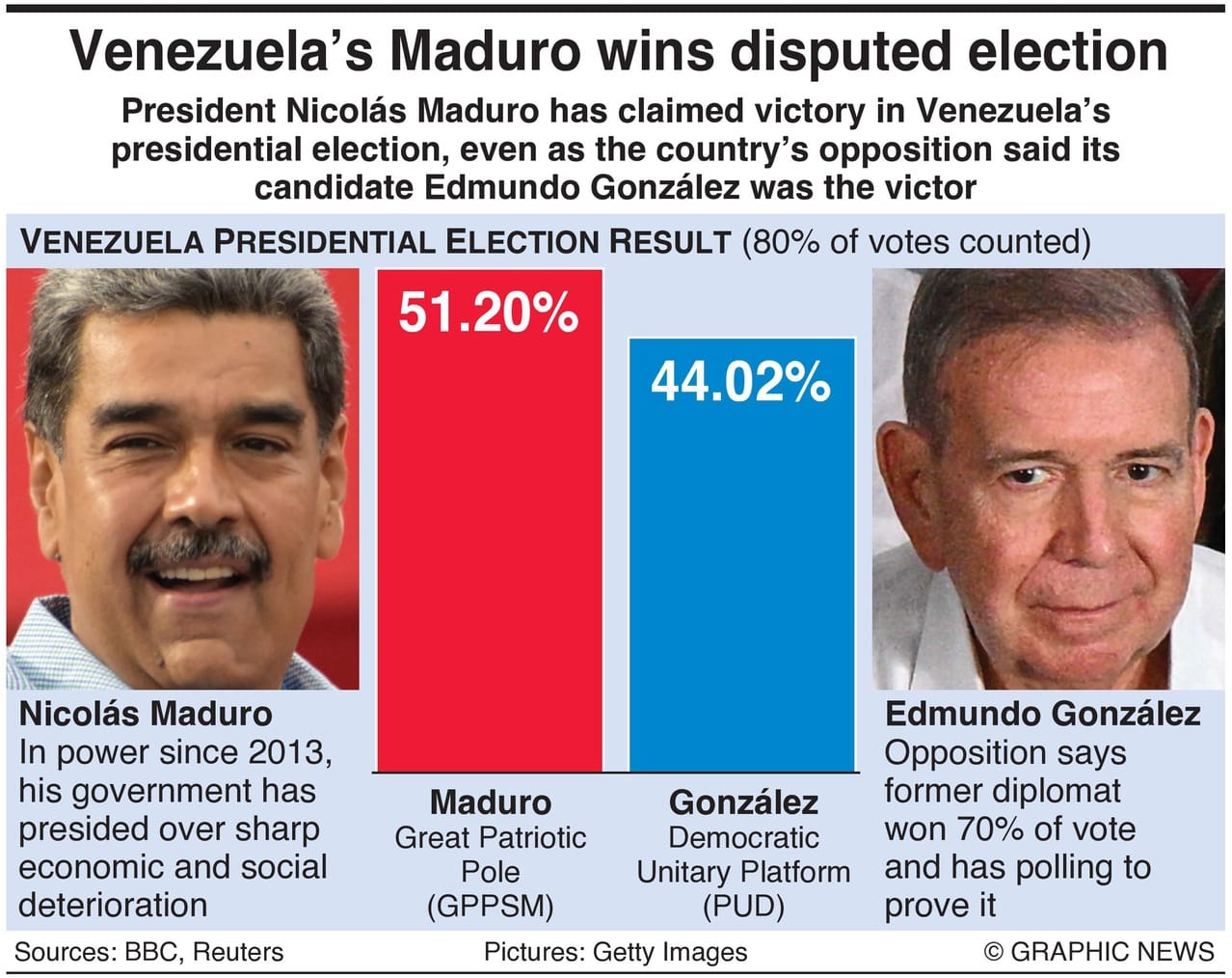
Venezuelans went to vote last Sunday, hoping to unseat President Nicolas Maduro from the office that he has occupied for the past 11 years. But, their hopes were crushed when the incumbent was declared the winner and awarded a third, six-year term.
The loyal National Electoral Council has announced that President Maduro had won 5.15 million votes, while his opposition rival Edmundo Gonzalez polled 4.45 million. Opinion pollsters and independent exit polls claimed the results were implausible, with some citing 65% support for Gonzalez and a mere 14% to 31% backing for Maduro just days before the election.
Even before the first votes were cast, there were fears the election would be “stolen,” unfair, or the results rigged. Earlier, doubts were cast on President Maduro’s re-election in 2018, which also recorded the lowest voter turnout. With both parties claiming victory, Venezuelans are taking to the streets to protest in despair.
After taking over from President Hugo Chavez, President Maduro has brought the country’s economy to its knees. Under the United Socialist Party of Venezuela, since 2007, the country boasting the world’s biggest oil reserve has been reeling under six-digit hyperinflation for about four years. Caracas is grappling with sanctions imposed on the regime, and its oil industry is struggling to operate with outdated infrastructure and trade embargos. A third of the population is estimated to have left the country since he came to power in 2013.
While these problems may seem far removed from U.S. shores, the Venezuelan election results do impact American politics and landscape. In the past decade, more than 7.8 million Venezuelans have fled the country. With President Maduro expected to stay in office until 2031, the exodus is expected to increase.
Some polls suggest a third of the 29.4 million citizens would like to emigrate. The people fleeing the socio-economic and political crisis are coming to other Latin American countries, but many consider America their final destination. According to some estimates, in 2023, more than 262,633 Venezuelans crossed into the U.S. compared to 189,520 in 2022.
However, it is not only the influx of illegal immigrants into the country that is a cause of concern. President Maduro’s government has forged close ties with China, Iran, Russia, and Cuba. While these nations have hailed the incumbent’s victory, other leaders have been skeptical.
U.S. Secretary of State Antony Blinken stated that Washington had “serious concerns that the declared outcome does not reflect the will or the votes of the Venezuelan people.” UK Foreign Office called for the “publication of full, detailed results to ensure that the outcome reflects the votes of the Venezuelan people.” While Chilean President Gabriel Boric found the results “hard to believe.” International criticism prompted Caracas to announce that it would recall its diplomatic personnel from seven South American countries, including Panama, Argentina, and Chile.
President Maduro claimed the result was “a triumph of peace and stability,” even as the opposition leader, Maria Corina Machado, called on the armed forces to uphold the results of the elections. But, the military has long supported the President, and there are no signals of a shift in allegiance. In fact, Defense Minister Vladimir Padrino issued a warning against repeating the terrible history of the previous elections when hundreds were killed in mass anti-government protests.
With Machado claiming that the opposition has 73.2% of the voting tallies from Sunday’s election and evidence of a clear victory, the six-month window between the election and the inauguration could see a tense standoff. It is unlikely that Venezuelans will take the results lying down, and thousands are taking to the streets; neither is President Maduro likely to concede election defeat. Much was riding on ousting the President and ending the socialist rule. Freedom, fundamental human rights, economic and social prosperity, and hopes of reunifying separated families were all on the ballot and now seem farther from Venezuela’s reach.
TIPP Takes
Geopolitics, Geoeconomics, And More
1. Israel vows response to attack on Golan – TIPP Insights
Lebanon is on high alert after Israel vowed a “harsh response” to the rocket strike on Majdal Shams, a Druze town in Israeli-occupied Golan, which killed 12 teenagers and children. Hezbollah said it had fired rockets in the area but denied responsibility.

2. Biden Pressures Israel Not To Respond After Terror Rocket Kills 12 Kids – JNS
The U.S. is leading diplomatic efforts to rein in an anticipated Israeli response.

The Biden administration has its priorities. After the latest Hezbollah rocket strike on a soccer field killed 12 kids in a Druze community in Israel’s Golan Heights, the administration is jumping into action to make sure the Israelis don’t fight back.
3. U.S. Unveils $1.7B In Lethal Assistance For Ukraine – UPI
The United States on Monday unveiled $1.7 billion in lethal assistance for Ukraine as the upcoming U.S. presidential looms large over the future of American assistance for the besieged ally.

The package includes $1.5 billion from the Ukraine Security Assistance Initiative, which sees the United States secure the weaponry and training from partners and companies, and $200 million authorized under the Presidential Drawdown Authority, which sees the weaponry taken from U.S. stockpiles.
4. Dozens Of Russia’s Wagner Mercenaries Massacred In Mali Ambush – Fox News
Top Wagner commander killed in brutal ambush in northeastern Mali.

Russian media reported that at least 20 Wagner soldiers were killed in the ambush, while the Malian army said two of its soldiers had been killed, though some reports have suggested the Russian death toll could be as high as 80.
Fox News Digital could not independently verify the number of killed Russian or Malian soldiers depicted in the footage or whether any fighters were taken prisoner.
5. China’s Top Leaders Vow To Support Consumers And Improve Confidence In Its Slowing Economy – ABC
China’s powerful Politburo has endorsed the ruling Communist Party’s strategy for growing the economy by encouraging more consumer spending and weeding out unproductive companies to promote “survival of the fittest.”

Under President Xi Jinping, China has prioritized developing industries using advanced technologies such as electric vehicles and renewable energy. This strategy has made the country a leader in some areas but has also led to oversupplies that are now squeezing some manufacturers, such as solar panel makers.
6. China’s Third Plenum: Political Control Drives Economic Reforms – The Diplomat
The Third Plenum officially endorsed “Chinese-style modernization” as the updated and “correct” interpretation of China’s “reform and opening up” policy, which started in 1978.

“Chinese-style modernization” affirms the reformist legacy but redefines it to deemphasize the role of economic development in China’s modernization.
7. Taiwan Pres. Urges Democracies To Unite At Largest-Ever Gathering Of Lawmakers- AP
Taiwanese President Lai Ching-te welcomed what he called the “largest-ever” delegation of foreign lawmakers to Taiwan and said Tuesday it showed the importance of democracies uniting, even as Beijing pressured members of the delegation not to visit.

“This demonstrates the support and the value various other countries place on Taiwan,” Lai said. “It also sends an important message to democratic countries around the world. Maintaining democracy requires unity, and we must protect democracy together.”
8. Pezeshkian Set To Be Sworn In As Iran’s New President – RFE
Masud Pezeshkian is due to be sworn in as Iran’s new president in parliament on July 30 after he won a snap presidential election earlier this month.

On July 28, Iran’s Supreme Leader Ayatollah Ali Khamenei formally endorsed Pezeshkian and instructed him to focus on cultivating relations with Iran’s neighbors rather than Western nations after the new president voiced openness to talk with the West.
9. Iran’s Revolutionary Guards Seize Tanker In Gulf, Arrest Crew -AFP
Guards say they captured a Togo-flagged tanker owned by an Iraqi resident of Dubai for smuggling 700,000 liters of fuel.

The oil tanker, along with its nine crew members who are of Indian nationality, have been transferred to Imam Khomeini harbor and are under surveillance.
10. ANC Expels Former South African Leader Jacob Zuma From Party – RFI
On Monday, the African National Congress (ANC) officially severed ties with its former leader, Jacob Zuma, expelling him from the party after he was involved in forming a rival political group.

Zuma, a once-celebrated anti-apartheid hero, has been a prominent figure in the ANC for decades. However, corruption scandals that damaged the party’s reputation marred his presidency and leadership.
11. North Korean Officials Looking To Import Treatment For Kim’s Obesity-Related Health Issues: Seoul – Fox
The infamous NK dictator reportedly weighs about 308 pounds despite standing at only 5’8″.

Kim Jong-un has regained weight and appears to have obesity-related health problems such as high blood pressure and diabetes. On Monday, his officials are looking for new medicines abroad to treat them, South Korea’s spy agency told lawmakers.
The 40-year-old Kim, known for heavy drinking and smoking, comes from a family with a history of heart problems. Both his father and grandfather, who ruled North Korea before his 2011 inheritance of power, died of heart issues.
12. North Korean Leader’s Daughter Being Groomed To Succeed Him: South Korea – Kyodo
South Korean lawmakers said Monday that the daughter of North Korean leader Kim Jong Un is being groomed to succeed him, citing South Korea’s spy agency.

North Korean state media reported that Kim Ju Ae has been seen accompanying her father during public appearances and official duties. However, the official Korean Central News Agency has not mentioned her as a potential successor to Kim.
13. ‘It’s Evil’: Breast Ironing Leaves Long-Term Scars For Women In Nigeria – Al Jazeera
Rights groups say the traditional practice that seeks to protect girls from sexual predators is an underreported form of physical mutilation.

Breast ironing, or “breast flattening,” is a cultural practice whereby young girls’ breasts are ironed or pounded down with brutal or heated objects to delay their development or disguise the onset of puberty, according to the Africa Health Organization.
The AHO says communities who practice breast ironing believe it will make girls less attractive to men, thus protecting them from harassment, rape, abduction, and early forced marriage, and also keeping them in school.
14. Australia To Force Businesses To Reveal Ransom Payments To Cyber Thieves -VOA
The Australian government says quietly paying off ransomware hackers has flourished, so Canberra wants to introduce new laws to force businesses to disclose payments to cybercriminals.

There have been major ransomware attacks on large telecommunications, private healthcare, and financial companies in Australia in the past year.
15. Toyota Retains No. 1 Spot In 1st Half Global Sales For 5th Year – Kyodo
Toyota Motor Corp. said Tuesday that its group sold 5.16 million vehicles worldwide in the first half of 2024, outselling German rival Volkswagen AG to retain the top spot in global sales for the fifth straight year.

But its global sales in the January-June period, including those of its small-car manufacturing unit Daihatsu Motor Co. and truck-making subsidiary Hino Motors Ltd., fell 4.7 percent from a year earlier due to production halts stemming from a series of quality scandals and sluggish sales in China.
According to the German company, Volkswagen sold 4.35 million vehicles in the same period, down from 4.37 million a year earlier.
16. Avoid Added Sugars To Help Keep Cells Young – UPI
A new study warns that added sugar can cause your cells to age prematurely.

Researchers found that each gram of added sugar is associated with an increase in a person’s cellular age, even when they eat healthy food otherwise.
“We knew that high levels of added sugars are linked to worsened metabolic health and early disease, possibly more than any other dietary factor,” said researcher Elissa Epel, a professor of psychiatry and behavioral sciences at the University of California, San Francisco (UCSF).
“Now we know that accelerated epigenetic aging is underlying this relationship, and this is likely one of many ways that excessive sugar intake limits healthy longevity,” Epel added in a UCSF news release.
Republished with permission from TIPP Insights