A Chick-fil-A restaurant in Kettering, Ohio, has implemented a policy requiring minors—anyone 17 and under—to be accompanied by an adult aged 21 or older if they wish to dine inside the restaurant. The announcement was made this past week, just ahead of the back-to-school season and has ignited a lively debate in the community.
The restaurant posted its “teen chaperone policy” on Facebook, stating clearly: “All guests 17 and under must be accompanied by a parent, guardian, or adult chaperone over the age of 21 to dine in. Unaccompanied minors may be asked to leave.” The franchise emphasized that the rule is designed to “ensure a safe and respectful environment for all guests.”
While some residents expressed dismay over the decision, suggesting it punishes well-behaved teens alongside disruptive ones, the policy has also garnered strong support from those who see it as a necessary response to a broader societal issue—an alarming rise in juvenile disorder.
One commenter who supported the decision didn’t mince words: “A lot of places are moving into this direction because your kids are unruly and disrespectful. The teachers keep telling you. The coaches keep telling you. The librarians keep telling you. Law enforcement keeps telling you.” This frank observation echoes a sentiment that many adults, especially those who value order and civility, are increasingly expressing: enough is enough.
The policy isn’t a lone crusade. Other businesses and establishments in the area have adopted similar rules. In fact, the Chick-fil-A is located within the Town & Country Shopping Center, which has had its own chaperone policy in place since January 2022. That center’s rule mandates that minors under 18 must be accompanied by an adult—a response to escalating incidents involving unsupervised youth.
A spokesperson for Chick-fil-A confirmed to Fox Business that all their restaurants are locally owned and operated, giving franchisees the authority to implement policies suited to their communities. In this case, the local operator’s decision is directly aligned with the shopping center’s existing regulations.
“This restaurant has set a policy specific to its location, which mirrors that of the shopping center the restaurant is located in,” the company explained.
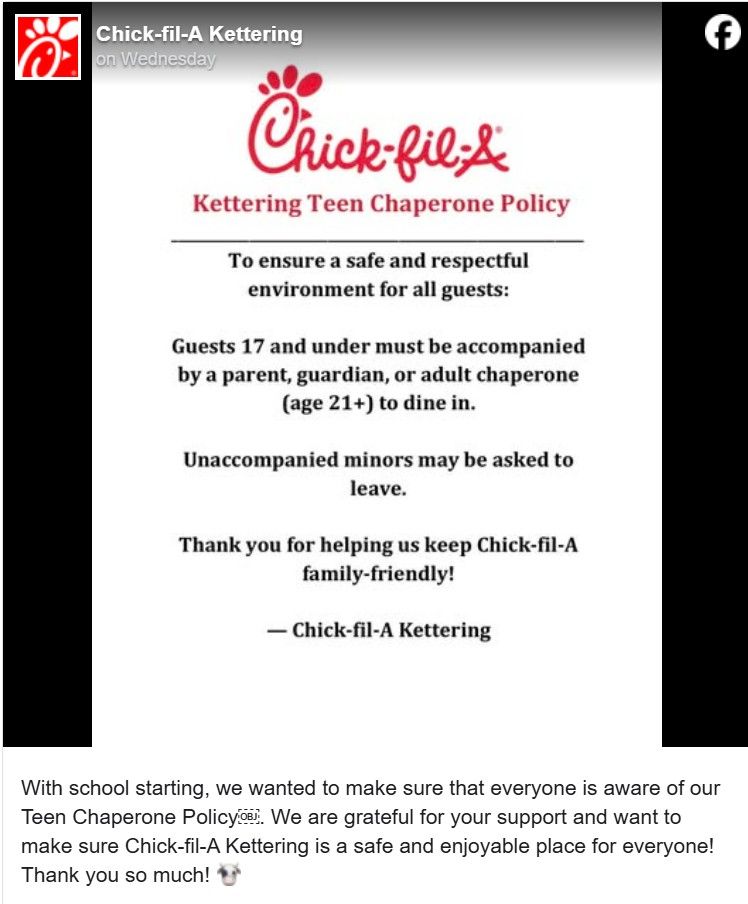
Predictably, not everyone welcomed the change. Critics took to social media to voice concerns. “I guess I won’t be eating Chick-fil-A anymore, at least not the Kettering location,” one disgruntled commenter wrote. Others worried about implications for teen parents or older siblings caring for younger children.
Still, the rationale behind the policy is rooted in a reality many Americans are unwilling to ignore. Across the country, more businesses are putting their foot down. In March, a Target in Brooklyn introduced a similar age restriction, banning anyone under 18 from entering without adult supervision. Security guards now monitor entrances, carding anyone who appears too young. Earlier this year, a McDonald’s in Brooklyn, plagued by juvenile crime, also began requiring customers to show ID or be accompanied by an adult if under 20.
This trend isn’t supposed to be about punishing “good kids” — it’s about protecting environments from bad behavior and restoring respect for shared public spaces. When parents, educators, and law enforcement repeatedly raise the alarm about declining youth discipline, it’s not unreasonable for private businesses to act.
At the same time, the policy does actually punish the innocent and sparks a valid debate. Do you have an opinion? Leave your thoughts in the comments.