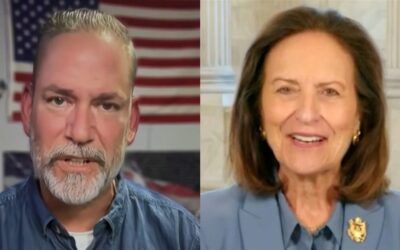
California Democrat Eric Swalwell is facing fresh scrutiny after campaign finance records revealed he’s been dipping deep into donor cash to cover childcare bills—racking up more than $200,000 over several years for what critics say is a plainly personal expense.
Swalwell, a longtime Bay Area congressman first elected in 2013 and a failed 2020 presidential hopeful, is now angling for the governor’s mansion. But before voters hear his pitch for Sacramento, his spending habits are drawing fire.
A Fox News Digital review of Federal Election Commission filings from 2019 through 2025 shows Swalwell repeatedly reimbursed himself using campaign funds for childcare-related costs—expenses most American families pay out of pocket.
The spending didn’t slow down as his political ambitions grew. In just a three-month span—October through December 2025—his most recent House and gubernatorial filings show more than $22,000 spent on childcare alone. Three of those payments, totaling over $6,000, were made directly to his wife, Brittany Swalwell, according to the filings.
Campaign records also show more than $102,000 paid between 2021 and 2025 to a Dublin, California woman named Amanda Barbosa. Her LinkedIn profile lists her as a “childcare provider” in a “private practice” beginning in September 2021—just one month before she started receiving payments from the Swalwell campaign—and notes she is an “aspiring occupational therapist.” Her Facebook page places her in Washington, D.C., and includes photos with the Swalwell family, including snapshots from a Disney World trip last June.
Another $57,324.40 went to Bambini Play & Learn Child Development Center, a Spanish immersion daycare and preschool in Washington, D.C., between 2023 and 2025. According to Bambini’s website, monthly tuition runs between $2,520 and $3,280.
Beyond basic childcare, the filings list a laundry list of reimbursed extras: $9,713.42 for payroll tax tied to campaign childcare, $1,943.35 for “childcare for campaign event,” $1,124.11 for travel expenses, food, beverages and childcare reimbursement, and another $625.91 for childcare, food and beverage reimbursement.
Federal law clearly bars campaigns from paying for personal expenses. But in 2018, the FEC cracked the door open, ruling that childcare costs triggered by campaign activity don’t count as personal use.
Swalwell didn’t stop there. In 2022, with three young children now ages 8, 7 and 4, he went back to the FEC seeking permission to use campaign funds for overnight childcare while traveling for campaign purposes. The commission signed off—giving Swalwell yet another green light to bill donors for family expenses.
That decision has alarmed campaign finance watchdogs.
In an interview with Fox News Digital, Allen Mendenhall, a research fellow at the Heritage Foundation’s Thomas A. Roe Institute for Economic Policy Studies and senior advisor at Capital Markets Initiative, didn’t mince words.
“It’s an expense that candidates with young children will incur regardless of whether they’re in a campaign,” Mendenhall said. “I have childcare costs. Many people have childcare costs, and we can’t just use this other money to subsidize our things.”
Mendenhall warned the FEC’s ruling creates dangerous new territory—one where politicians can increasingly offload everyday life expenses onto donors.
“The danger here,” he explained, “is creating a special class of politicians who are insulated from normal constraints, ordinary constraints that everybody else has to deal with.”
He argued that once childcare is deemed fair game, nearly anything could follow—from wardrobe and grooming to other lifestyle costs—so long as a campaign can cook up a justification.
“Campaign law exists not to underwrite the private lives of politicians, but to ensure that political speech is protected and that public advocacy occurs, that we have electoral competition,” Mendenhall said. “Election laws are in place to try to maintain the integrity of our electoral system, and that decision, I think, undermines the integrity of the system.”