President Donald Trump is doing what he’s always done best — building big — and, predictably, the critics are clutching their pearls.
The proposed $400 million ballroom on the White House grounds, replacing the aging East Wing footprint with something far more fitting for a global superpower is being targeted once again. Trump has been openly proud of the project, calling it a long-overdue upgrade to what’s known as “the People’s House.”
But leave it to The New York Times and a handful of so-called experts to try to tear it down before the first shovel hits the dirt.
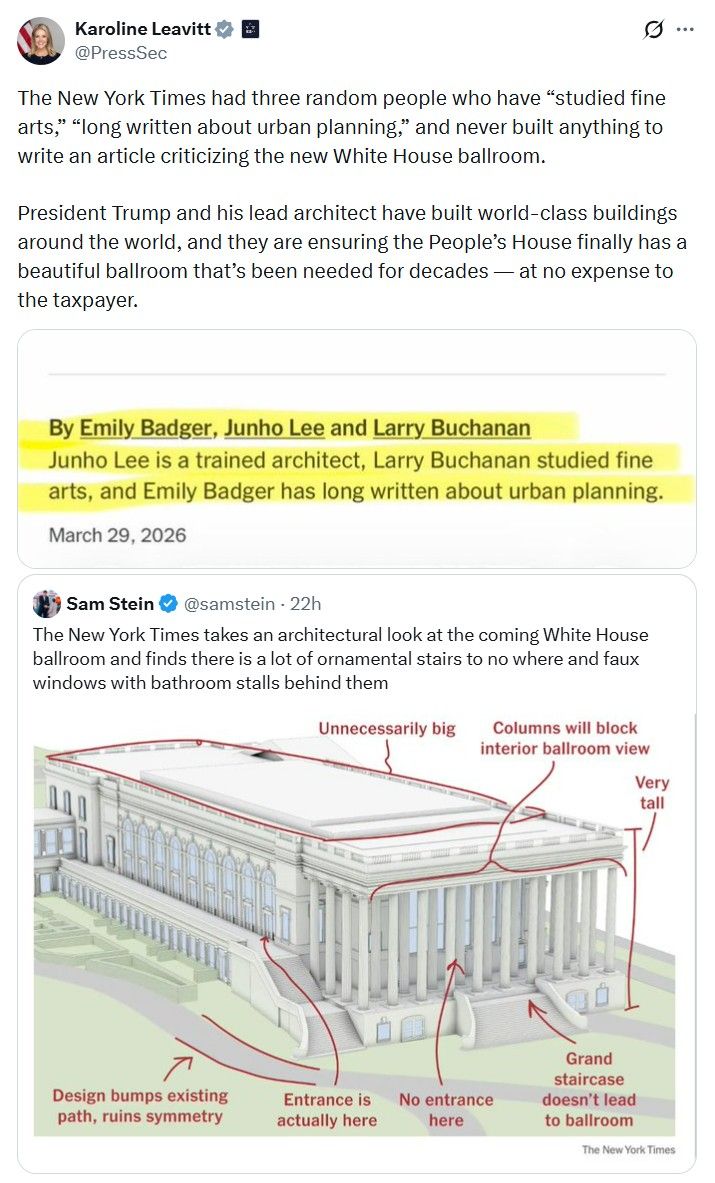
The paper’s deep-dive leans heavily on commentary from academics and critics — not builders — prompting a sharp rebuke from Press Secretary Karoline Leavitt, who didn’t hold back.
“The New York Times had three random people who have ‘studied fine arts,’ ‘long written about urban planning,’ and never built anything to write an article criticizing the new White House ballroom,” she wrote on X.
Leavitt reminded critics of one key fact they’d rather ignore — Trump isn’t just a politician; he’s a developer with a global track record.
“President Trump and his lead architect have built world-class buildings around the world, and they are ensuring the People’s House finally has a beautiful ballroom that’s been needed for decades — at no expense to the taxpayer.”
That last point is crucial — and often buried beneath the noise. While Washington has no problem burning through billions, this project, according to the White House, won’t cost taxpayers a dime.
Still, the Times report tries to manufacture alarm over the timeline, noting that planning details have evolved and suggesting the process is moving too quickly.
But here’s the reality: in the private sector — where Trump made his name — projects move fast. Adjustments happen. Capacity changes. Designs evolve. That’s not dysfunction; that’s efficiency.
The report itself admits, “As recently as October, the president was still increasing the ballroom’s capacity, the kind of decision needed at the concept stage,” while also pointing out that construction could begin in the spring.
To bureaucrats used to endless delays and red tape, that might sound shocking. To anyone who’s actually built something? It sounds like progress.
One architect quoted in the piece, Thomas Gallas, complained, “The timeline never made any sense to me,” adding that projects of this scale typically take “18 months to two years” just to finalize construction documents.
That may be true in a world where government projects drag on forever. But Trump’s entire career has been about defying that sluggish pace — and delivering results.
Then come the aesthetic critiques — and this is where the argument really starts to feel like nitpicking.
Yes, the ballroom would be large — about 60% bigger than the current residence by floor area, and even more imposing in total volume thanks to high ceilings and grand architectural features. Critics warn it could “dominate” the White House complex or disrupt its symmetry.
But let’s be honest: this is the White House — not a museum frozen in time. It’s the seat of American power, hosting world leaders and major events. A grand ballroom isn’t excess; it’s practical.
And the complaints about columns, porticos, and even “fake windows”? That sounds less like serious concern and more like design snobbery.
Even the report notes that features like the south portico were added later — which, again, is entirely normal in large-scale projects. Designs are refined. Adjustments are made. That’s how building works.
What’s really going on here is nothing new: Trump proposes something bold, and the establishment recoils. Not because it can’t be done — but because he’s the one doing it.
At its core, this isn’t just about a ballroom. It’s about two competing visions: one that embraces ambition and action, and another that prefers endless critique from the sidelines.
Trump is betting that Americans would rather see something built — something impressive — than listen to another round of hand-wringing from the same voices who never pick up a hammer.