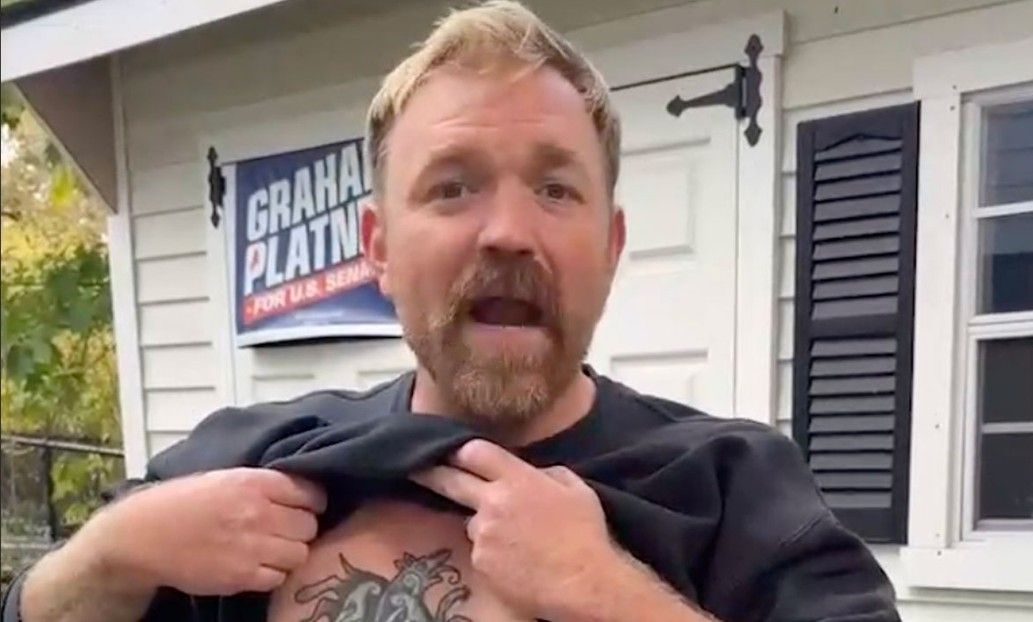
If self-inflicted political wounds were an Olympic sport, Graham Platner would be on the podium — and still apologizing for how he got there.
The progressive Maine Senate hopeful is once again doing damage control, this time over a jaw-dropping choice of words during an interview about — what else — his already infamous tattoo controversy. Because apparently one scandal just isn’t enough in a modern campaign cycle.
During a sit-down with the Maine Monitor, Platner didn’t exactly reach for polished, statesmanlike language when asked about accusations that his skull-and-crossbones tattoo bore an uncomfortable resemblance to the Nazi SS Totenkopf symbol. Instead, he let loose:
“I was like, ‘Well, that’s the f—ing most r——- s— I’ve ever heard in my life,’” Platner said. “‘No, I don’t have a White supremacist tattoo,’ and I never thought about it again. And then it came up later on, and I was like, ‘God f—ing damn it.’”
Classy.
Predictably, the backlash came fast — and not from political opponents, but from disability advocates who have spent years trying to bury that slur for good. Disability Rights Maine didn’t mince words.
CEO Kim Moody called the language out directly:
“For decades, people with disabilities and their allies have fought to eliminate the use of the R-word — an ableist term rooted in discrimination and exclusion. This language is not harmless; it reinforces stigma, diminishes dignity, and undermines the value and contributions of disabled individuals in our communities.”
That’s not exactly the kind of endorsement you want while pitching yourself as a champion of “inclusivity.”
Cue the apology tour.
In a follow-up interview with WMTV, Platner tried to clean up the mess, offering a familiar political refrain:
“I am sorry. I’m sorry that I said it. I am endeavoring to improve every single day. I am not a perfect person, and I continue to try to be better. I will say that my politics is one of inclusivity and one of showing up for everybody, and I will continue every day to represent that in our policies and in our campaign.”
But here’s the bigger problem: this isn’t an isolated slip — it’s a pattern. Since launching his campaign, Platner has been dogged by a string of controversies that read less like opposition research and more like a greatest hits album of bad judgment.
There’s the tattoo itself, which he’s blamed in part on military “culture” — a defense that didn’t exactly win over GOP veterans. Then came the resurfaced Reddit posts, where Platner reportedly described himself as a communist, praised Hamas’ military tactics, and made crude, eyebrow-raising comments about sexual assault.
To his credit, Platner has apologized for those as well, attributing his past remarks to the psychological toll of combat deployments and the struggles that followed. That explanation may resonate with some voters — but politically, repeated apologies can start to sound less like growth and more like a campaign stuck in permanent cleanup mode.
In the end, voters tend to ask a simple question: if this is how a candidate handles the spotlight now, what happens when the stakes are even higher? For Platner, the challenge isn’t just moving past one controversy. It’s convincing people there won’t be another one waiting right around the corner.