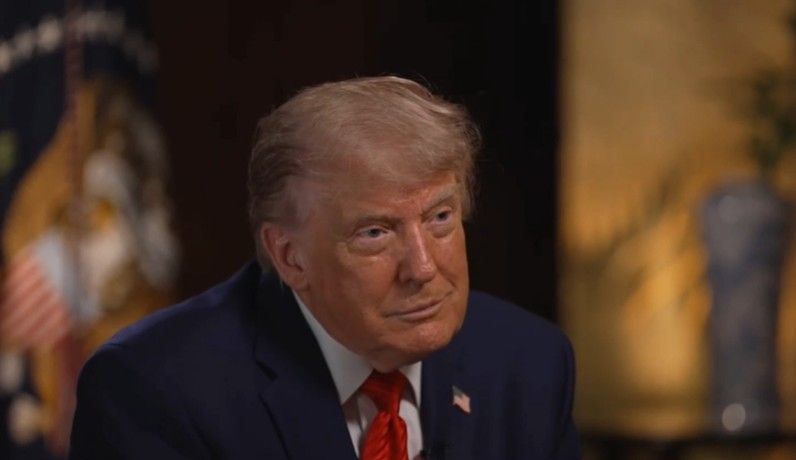
President Trump wrapped up his heavily scrutinized Beijing trip Friday with all the pomp Communist China could muster — red carpets, banquet toasts and carefully staged smiles from President Xi Jinping — but behind the pageantry was a blunt reality: the world’s two biggest powers are still staring each other down over Taiwan, Iran, oil and global muscle-flexing.
As Air Force One lifted off from Beijing, Trump sounded upbeat, calling Xi “an incredible guy,” while making crystal clear he wasn’t about to hand Beijing a freebie on Taiwan.
“Xi feels very strongly” about the island democracy, Trump told reporters aboard the plane. But when Xi pressed him on whether the United States would step in militarily if China moved on Taiwan, Trump said he shut the conversation down fast.
“I said, ‘I don’t talk about that,’” Trump revealed.
Trump also tossed in a dose of old-school America First realism that’s likely to send Beltway hawks into cardiac arrest. “I think the last thing we need right now is a war that’s 9,500 miles away,” he said.
The summit came as the White House remains locked in a dangerous standoff with Iran, including continued pressure on Tehran over the Strait of Hormuz — the narrow waterway that handles a massive chunk of the world’s oil supply. And in a development the administration is already touting as a diplomatic score, Trump said Xi pledged China would not arm Iran. “He said he’s not going to give military equipment. That’s a big statement,” Trump said during an interview with Sean Hannity. “He said that strongly.”
For years, Washington has accused Beijing of playing both sides — cashing in on Iranian oil while pretending to be a neutral global peacemaker. China buys tens of billions of dollars in Iranian crude every year and has repeatedly thumbed its nose at US sanctions. Beijing even ordered Chinese firms earlier this year to ignore American restrictions targeting Iranian oil imports.
So if Xi really is backing away from supplying Tehran militarily, it’s no small thing. Of course, the Chinese strongman also made clear he still wants the oil flowing. According to Trump, Xi pushed hard to keep the Strait of Hormuz open and opposed any attempt to slap tolls or restrictions on shipping through the vital route. “He didn’t like the fact that they’re charging tolls,” Trump said, before riffing on where the money would even go. “Where’s the money going?” Fair question.
Trump, meanwhile, pitched what he clearly sees as the ultimate leverage play: get China hooked on American energy instead of Middle Eastern chaos. “They’re going to go to Texas,” Trump said of Chinese buyers. “We’re going to start sending Chinese ships to Texas and to Louisiana and to Alaska.”
That potential energy agreement reportedly helped send oil markets jumping as traders scrambled to figure out whether Beijing might actually pivot toward American crude.
Not every issue got resolved over tea and banquet glasses.
Trump said he raised the cases of imprisoned Hong Kong publisher Jimmy Lai and jailed Christian pastor Ezra Jin. Xi, according to Trump, called Lai’s possible release “a tough one” but said he would “strongly consider” the pastor’s situation. Whether that translates into action — or just another carefully worded Communist Party brush-off — remains to be seen.
The optics of the trip were classic Beijing theater: ceremonial welcomes, choreographed walks through historic sites and lavish state-dinner diplomacy designed to project stability while the world edges closer to geopolitical chaos.
At one banquet, Trump publicly invited Xi and his wife, Peng Liyuan, to visit the White House later this year. “It’s a very special relationship,” Trump declared in a toast to US-China ties.
Maybe. But nobody should confuse polite dinner talk with trust. This summit unfolded against a backdrop of escalating tensions over Taiwan, trade disputes, Chinese support for Russia, and growing fears that Beijing wants to replace Washington as the dominant global superpower.
The Biden years saw America project weakness abroad while China expanded aggressively across the Pacific and beyond. Trump arrived in Beijing trying to reestablish deterrence without stumbling into another forever conflict — a balancing act easier said than done.
And while the media obsessed over the optics, Trump appeared focused on one thing above all else: keeping America out of another disastrous foreign entanglement while squeezing concessions where he could.
Whether Xi was genuinely making concessions — or simply buying time with flattering words and photo ops — is another question entirely.