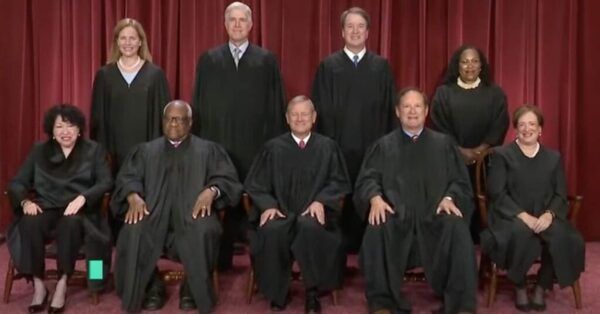
If you ever wanted a snapshot of what’s driving conservatives up the wall about the Supreme Court, Justice Clarence Thomas just handed it to you.
In a blistering dissent joined by Justice Samuel Alito, Thomas accused the nation’s highest court of chasing legal minutiae for a convicted murderer while repeatedly turning a cold shoulder to ordinary Americans with far more consequential grievances.
The spark for Thomas’ frustration was the Court’s decision to revive part of a challenge brought by Florida death row inmate Gary Whitton, who was convicted in the brutal stabbing death of James Maulden in 1991. The majority ordered a lower court to take another look at Whitton’s request for relief after concluding judges improperly considered DNA evidence that was discovered years after his trial.
To Thomas, the Court wasn’t correcting some earth-shattering miscarriage of justice. It was nitpicking.
Justice Thomas blasts the Supreme Court for stepping in to help a convicted murderer’s ‘inconsequential foot fault’ while refusing to hear cases from law-abiding Americans on race discrimination, free speech, and a military widow’s lawsuit.
The 7-2 ruling vacated an Eleventh… pic.twitter.com/4POghbvdK4
— Fox News Politics (@foxnewspolitics) June 1, 2026
“It is unfortunate that the Court chose to intervene at the request of a convicted murderer to correct the Eleventh Circuit’s inconsequential foot fault,” Thomas wrote. “What makes it even worse is that the Court does so even while it refuses to correct far more consequential errors for law-abiding citizens.”
That’s the line likely to echo far beyond the marble halls of Washington.
The underlying facts of the case are ugly. Prosecutors argued Whitton killed Maulden after accompanying him to a bank, where the victim withdrew the balance of his account. Years later, advanced DNA testing linked blood found inside Whitton’s boots to Maulden. The Supreme Court majority said that evidence shouldn’t have factored into evaluating whether Whitton deserved a new trial because jurors in 1991 never saw it.
Thomas wasn’t buying the outrage.
Justice Thomas faults his colleagues for declining to hear cases involving race-based school admissions, military families denied compensation, and campus free speech, while intervening in a death-row case over what he views as a minor error unlikely to affect the outcome. pic.twitter.com/8wUuDcoaV0
— SCOTUS Wire (@scotus_wire) June 1, 2026
“If the Eleventh Circuit erred at all in mentioning the DNA test results, it was harmless for at least two reasons. First, the court thoroughly examined the overwhelming evidence against Whitton, which was more than sufficient to justify its decision,” he wrote. “Second, Whitton had not even exhausted his claim in state court, so the Eleventh Circuit could not have ruled for him anyway.”
In plain English: Even if the lower court made a technical mistake, Thomas argued it changed nothing.
Whitton’s appeal centers on testimony from jailhouse informant Jake Ozio, who claimed Whitton confessed while the two shared a cell. Ozio told jurors he heard Whitton admit he had “stabb[ed] the bastard.” Later, questions emerged about Ozio’s own credibility after it was revealed he falsely testified that he had no prior criminal record.
Thomas argued Whitton never properly pursued that issue through the state court system before trying to leverage it in federal court. As far as Thomas was concerned, the legal pathway was already blocked.
“Whitton does not deny that state-court remedies were available,” Thomas wrote. “Yet, he never sought state remedies for his claim based on Ozio’s characterization of his criminal record.”
But the real target of Thomas’ dissent wasn’t Whitton. It was the Court itself.
For years, Thomas has complained that the justices eagerly jump into certain criminal cases while declining to hear disputes involving constitutional rights, government accountability and alleged discrimination against everyday Americans.
This time, he pointed to several examples he believes deserved the Court’s attention: challenges to university policies accused of discriminating based on race, campus speech rules critics say chill free expression, and a lawsuit brought by the widow of an Air Force service member killed while on duty.
“This Court routinely declines to provide relief to law-abiding Americans when it would actually matter, even after lower courts conspicuously flout this Court’s precedents in ruling against them,” Thomas wrote.
That criticism lands at a moment when public confidence in major institutions remains shaky and debates over free speech, affirmative action and government accountability continue to dominate political discourse. Conservatives have increasingly argued that elite institutions devote enormous energy to procedural protections for criminals while showing far less urgency when families, taxpayers, parents and service members seek relief.
Thomas’ dissent distilled that frustration into a single, uncomfortable question: Why does the Supreme Court always seem to find time for the convicted killer’s technicality, but not for the citizen’s constitutional complaint?
Whether one agrees with him or not, Thomas made sure that question won’t disappear anytime soon.