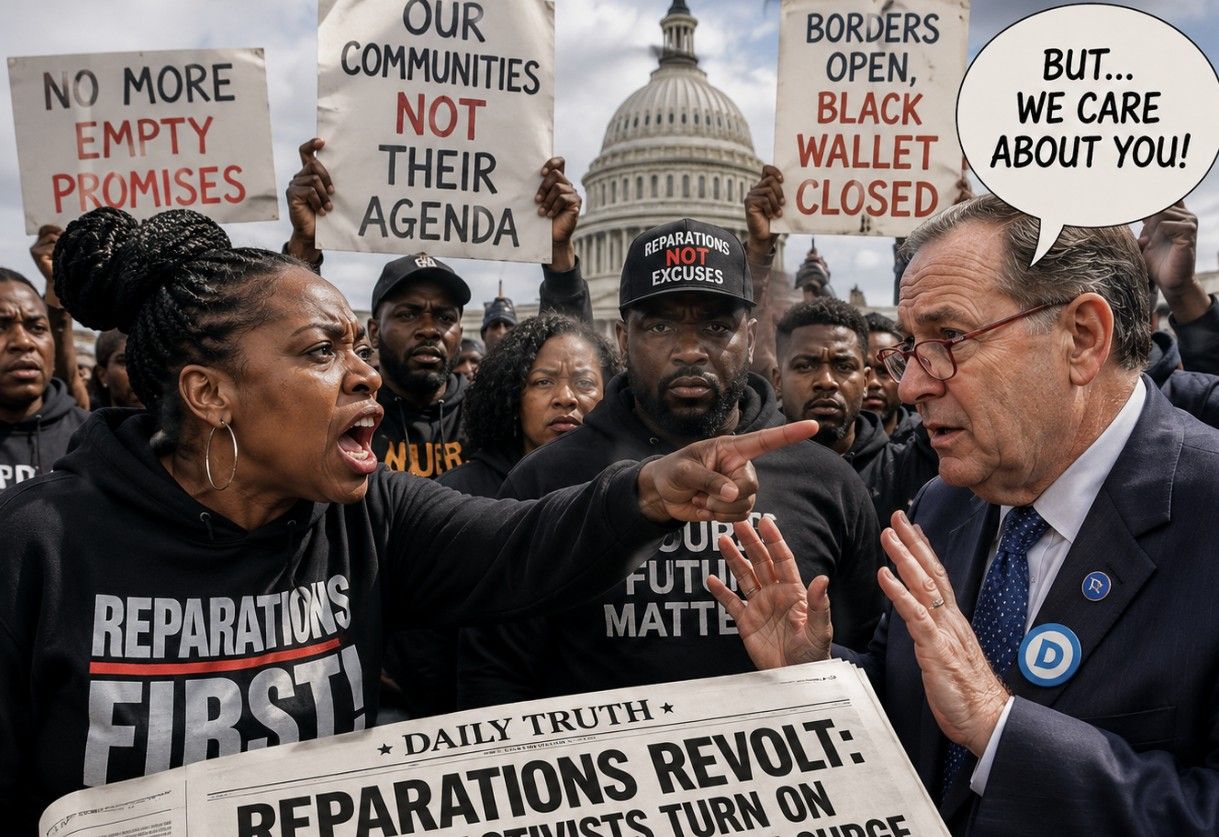
For years, Democrats sold themselves as the party that would address the injustices suffered by the descendants of American slavery. Now, some of the very activists who championed those promises are accusing the party of pulling a bait-and-switch.
At a recent hearing held by New York’s reparations commission on Long Island, frustration boiled over as speakers argued that the conversation has drifted far from its original purpose. Instead of focusing narrowly on descendants of enslaved Americans, critics say the debate is expanding to include broader categories of minorities and Black Americans regardless of lineage — a move they claim risks watering down both the moral case and any eventual benefits.
One of the loudest voices was Aubrey Muhammad, who blasted Democratic immigration policies and argued they have reshaped communities that were once predominantly Black.
“The Democrats, in a sick way, imported 25 million immigrants. And 70 percent of them came into poor Black neighborhoods,” Muhammad told Fox News.
He pointed specifically to Hempstead, saying: “Hempstead, since the 90s, has been flooded with immigrants. That’s taking the resources, putting them towards others.”
The numbers show the community has indeed undergone a dramatic demographic transformation over the past several decades. Census data indicate that the Hispanic population in Hempstead grew substantially between 1990 and 2025, while the village today remains home to a large Black population as well. For activists focused on reparations, that demographic shift has become part of a larger argument about political power, public resources and representation.
What emerged from the hearing was more than a policy disagreement. It was a glimpse into a growing fault line inside the Democratic coalition itself.
Many speakers aligned with the United States Freedman Project, an organization that argues reparations should be tied not simply to race, but to documented ancestry tracing back to people enslaved in the United States. “I think it’s important because as Foundational Black Americans who’ve been here since the founding of the country, coming in as slaves, and also indigenous people who are here, we have a claim to the country,” Muhammad said. “We have our own culture, and we deserve to be compensated for what our ancestors have been put through.”
Supporters of that approach argue that lineage-based standards would be more legally defensible than race-based programs. They point to recent court decisions striking down various race-conscious policies and programs. “If those are based on race, they’re going to be shot down like affirmative action, like the Fearless Fund, like the farmer’s bill,” said project spokesman Divine Prince.
In other words, the activists are asking a question that has become increasingly difficult for progressives to answer: If reparations are intended to compensate specific historical harms, who exactly qualifies?
Not everyone at the hearing agreed. Critics of the lineage-only approach argued that the legacy of slavery, segregation and discriminatory policies affected Black Americans broadly, not just those who can document direct descent from enslaved people in the United States.
Susan Gottehrer of the Nassau County chapter of the New York Civil Liberties Union argued that government policies harmed Black New Yorkers regardless of lineage. “Excluding a subset of Black Americans would leave a significant portion of documented racial injustice completely unexamined,” she said.
New York Assemblymember Michaelle Solages echoed similar concerns, arguing that the consequences of slavery can still be seen in areas ranging from wealth disparities to education and incarceration.
But those arguments landed with a thud among activists who believe the original purpose of reparations is being diluted.
Brooke Lean, another supporter of the project, accused opponents of trying to blur distinctions between descendants of enslaved Americans and more recent arrivals. “They want to erase our story, dilute our story by adding in a bunch of people who just got here, whose ancestors did not build this county,” she said.
Muhammad was even more blunt, accusing advocacy groups of attempting to expand eligibility in ways that could redirect resources away from the descendants of slaves.
For Republicans watching from the sidelines, the spectacle was politically irresistible. Nassau County Executive Bruce Blakeman dismissed the entire reparations effort as a hollow promise.
Black New Yorkers, he argued, are “smart enough to know” the proposals amount to “just another empty political promise that will never materialize.”
After years of championing reparations, party leaders now find themselves trapped between competing constituencies, competing definitions of justice and competing claims on government resources. The coalition that once marched under a single banner increasingly appears divided over who should benefit, who should qualify and who gets left out.