

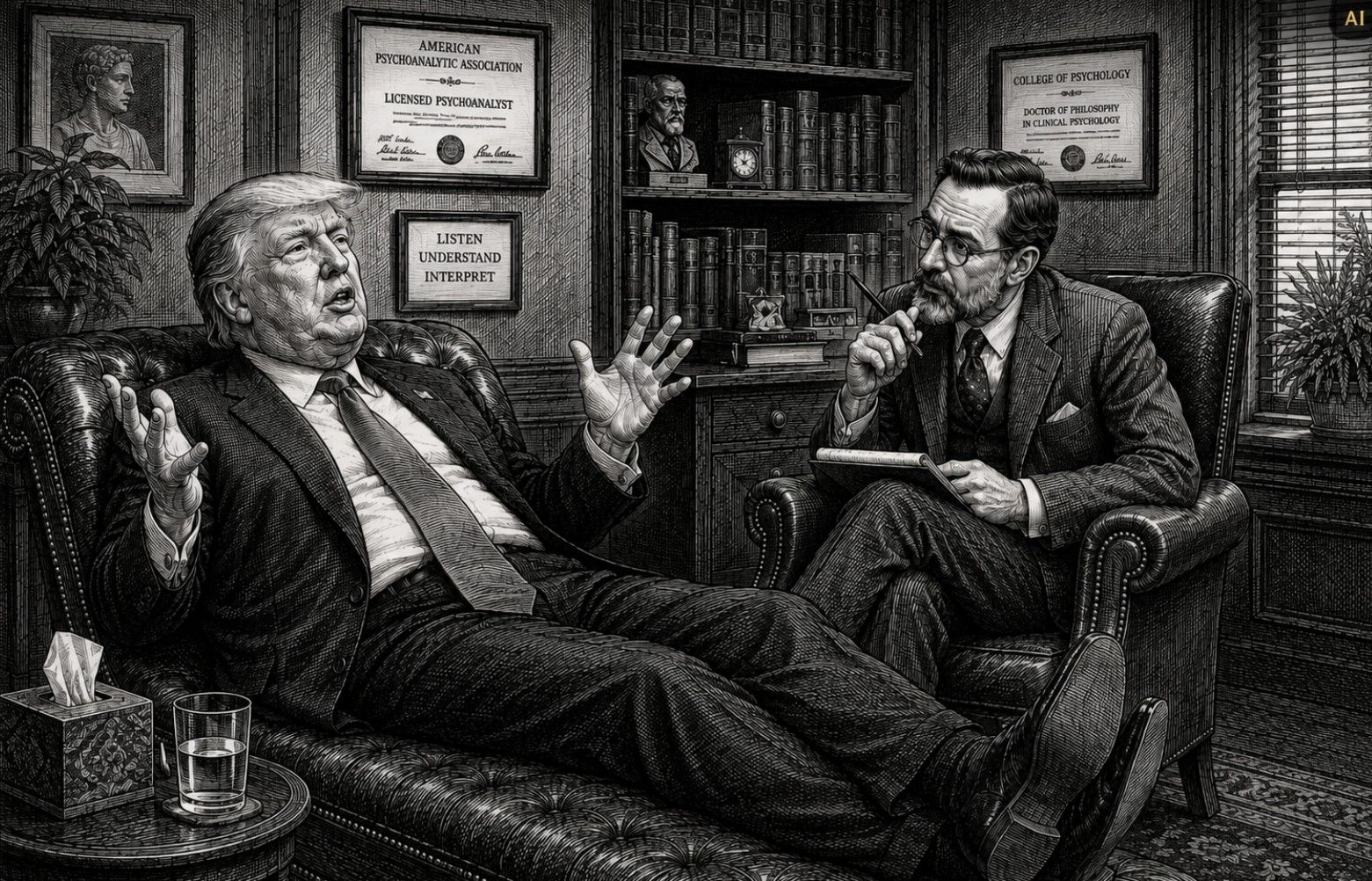
From Progressive juggernaut Raw Story – Headline: “Psychologist shares sobering warning about Trump as his health worsens: ‘Setting us up'”
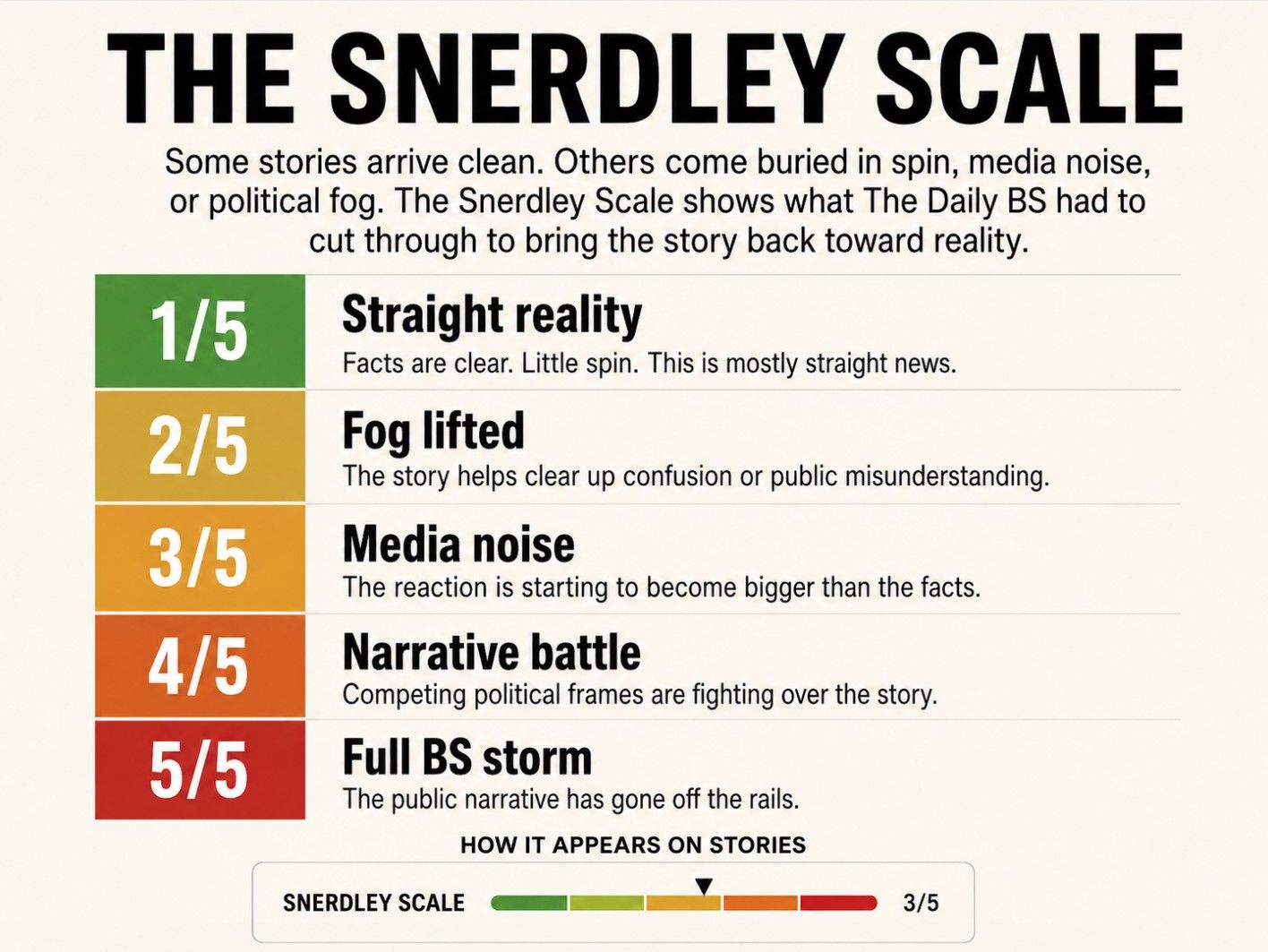
Snerdley Scale: 4.5/5 — Spin zone approaching full BS
The giveaway isn’t buried in the story. It’s right there in the headline.
A reader arriving cold is immediately told that Trump’s health is “worsening” and that a psychologist has issued a “sobering warning.” By the time the article gets around to explaining that the psychologist has never actually examined Donald Trump, the narrative has already done its job. The headline plants the diagnosis first and the caveat later.
Here’s a suggested headline that would be more accurate: Media discovers fresh way to compare Trump to every conqueror in history
The article revolves around psychologist John Gartner, who makes a remarkable series of claims. According to the story, Trump is supposedly the sickest person Gartner has encountered in decades of practice, is allegedly suffering from dementia, is motivated by sadism, seeks historical infamy, and may be “grooming” the public for nuclear war.
That’s quite a journey. The article’s biggest problem isn’t that it quotes a Trump critic.
It’s that it treats some of the most astonishing accusations imaginable as if they deserve serious consideration simply because someone with a credential said them. Consider what readers are asked to accept.
The psychologist declares: “I’ve never encountered a patient as sick as Donald Trump.” Remember, according to the article itself, he has never examined Trump.
Then the rhetoric goes from dramatic to downright apocalyptic. “What I believe, [is that] he is setting us up. He is grooming us for nuclear war.”
Not military escalation. Not a foreign policy miscalculation. Not a strategic disagreement.
Nuclear war.
And it gets even more sensational. “He wants to be the person who pushes the button first, because that would put him in history as the most powerfully destructive military leader in human history.”
Think about that for a moment.
The article presents a source claiming the President of the United States allegedly fantasizes about becoming history’s most destructive war leader and is preparing the public for nuclear conflict.
If a conservative outlet published a psychologist claiming a Democratic president secretly wanted to trigger nuclear war because of a psychological desire for mass destruction, most mainstream journalists would rightly demand extraordinary evidence.
Here, the evidence appears to be little more than conjecture piled atop political hostility. The psychologist goes even further, claiming:
“He actually gets incredible gratification from destroying things and hurting people and feeling powerful through that.”
Again, readers are free to agree or disagree. But this isn’t a policy critique. It’s effectively a declaration that the president derives pleasure from suffering and destruction.
Those aren’t ordinary political observations. Those are among the most extreme character allegations that can be made about a public figure. Yet the article largely treats them as expert insight rather than highly speculative opinion.
The story isn’t merely reporting criticism of Trump. It’s elevating some of the most inflammatory psychological accusations imaginable and wrapping them in the language of expertise, while quietly acknowledging that the expert making them has never personally examined the man he’s describing.
Notice what happens throughout the piece. Assertions are stacked on top of assumptions, which are stacked on top of speculation, which are then treated as evidence for even more speculation.
The article invites readers to believe the following chain of events: Trump attends military-themed events and enjoys displays of American power. Therefore, he sees himself as Napoleon. Therefore, he wants unchecked power. Therefore, he wants to become history’s greatest conqueror. Therefore, he may want to start a nuclear war.
At some point, this stops being analysis and starts resembling political fan fiction.
The story even leans on comparisons to Napoleon, Alexander the Great and Julius Caesar. Apparently every modern political disagreement now requires at least one Roman Empire reference. If Trump signs a trade agreement, he’s Caesar. If he hosts a military parade, he’s Napoleon. If he orders lunch, someone is probably preparing a think piece comparing him to Genghis Khan.
Missing from the article is any serious examination of Trump’s actual record regarding military conflict.
Critics may dislike many of Trump’s policies, but his supporters routinely point out that during his first term the United States did not enter a major new war. His political brand has long included criticism of nation-building projects, skepticism toward foreign interventions, and pressure on allies to shoulder more defense costs. Reasonable people can debate those positions, but they don’t neatly fit the portrait of a man eagerly searching for nuclear Armageddon.
The article also treats polling and economic claims as established facts without much scrutiny. Readers are told Trump’s numbers are supposedly collapsing and the economy is supposedly in terrible shape. Those claims are presented as supporting evidence for the psychologist’s theory that Trump would seek military conflict to compensate for political weakness.
Again, that’s not evidence. That’s a political narrative wrapped inside a psychological narrative.
The most important fact in the entire piece appears almost as an afterthought: Gartner has never medically examined Trump.
That doesn’t automatically invalidate every observation. Public figures can certainly be analyzed and criticized. But when a story’s central premise is built around dramatic medical and psychological conclusions about someone who has never been personally evaluated by the expert making the claims, readers should approach the article with caution.
The result is a familiar media formula:
Start with a frightening headline. Find an expert willing to make the most alarming prediction possible. Connect current events to historical villains. Escalate the rhetoric until ordinary political disagreement becomes an existential threat. Repeat as necessary.
That’s why this lands at 4.5 out of 5 on the Snerdley Scale.
Not because every fact is necessarily wrong.
Not because criticism of Trump is automatically unfair.
But because the piece takes readers from point A to point Z while barely stopping at the alphabet in between.
When a story begins with a psychologist diagnosing a president from afar and ends with warnings about nuclear apocalypse, the spin isn’t hiding anymore.
It’s driving the bus.

Why the 4.5/5 score?
- The article relies heavily on one commentator’s interpretations.
- The headline foregrounds a health conclusion before establishing evidence.
- Speculative claims are escalated into worst-case scenarios.
- Important context (the expert never examined Trump) is present but secondary.
- The piece blends psychology, politics, polling, history, and military fears into a single narrative arc.
That places it firmly in “Spin zone” territory and just shy of “Full BS” because the article is still reporting real statements made by a real source rather than fabricating events outright.










Typically when a “shrink” declares that he’s made some diagnosis about a person he has “seen” it would imply an exchange between minself and that individual in person. This comment is a political and unptofessional quasi-medical hit piece given as personal opinion more as a street protestor than as a professional. If I were to diagnose the good “doctor” I would diagnose him with a severe case of ‘man on the street TDS’ equal to any other average lunatic No Kings sign carrier.
Every profession has its share of idiots including the psychiatric profession.