The entire story hangs on commentary from one activist commentator who argues that because Democrats might investigate the Court if they win Congress, the justices therefore have an incentive to engineer Republican victories. That’s not a legal analysis. That’s basically a cable-news version of the old playground defense: “I know what you’re thinking because I can read minds.”
Notice how the headline starts with a conclusion and works backward.
The actual facts involve two complicated legal fights. One concerns congressional maps and racial gerrymandering. In Louisiana v. Callais, the Supreme Court ruled that Louisiana’s map violated constitutional limits on race-based redistricting and narrowed how Section 2 of the Voting Rights Act can be applied. The majority argued that race cannot be the dominant factor in drawing districts absent sufficient constitutional justification.
Reasonable people can disagree with that decision.
What the ruling does not automatically prove is that John Roberts woke up one morning and decided to become chairman of the Republican National Committee.
The second dispute involves whether ballots arriving after Election Day should count in federal elections. The Mississippi case asks whether federal law requires ballots to be received by Election Day rather than merely postmarked by then. Republican plaintiffs argue they’re enforcing the election date established by federal law, while opponents argue states should have flexibility in handling mailed ballots.
Again, that’s a legal argument.
But in today’s media ecosystem, every disagreement over election procedures gets converted into a Marvel movie where one side is defending democracy and the other side is plotting its destruction from a secret volcano lair.
The article’s biggest tell comes when it shifts from discussing election law to listing ethics investigations some Democrats would like to pursue against Clarence Thomas and Samuel Alito. Suddenly the real thesis emerges: if Democrats want investigations and Republicans don’t, then the Court supposedly benefits from Republican victories.
By that logic, every federal agency, congressional committee, and prosecutor’s office has a “self-serving” interest in influencing elections whenever a new majority might investigate them.
That’s a standard so broad it turns virtually every government institution into a suspected election conspirator.
The story also quietly ignores another possibility: perhaps the justices are ruling based on how they interpret statutes and the Constitution. Radical concept, apparently.
The modern progressive media playbook increasingly treats conservative legal outcomes as proof of corruption while treating progressive legal outcomes as proof of principle. When the Court rules in a way activists like, it’s judicial independence. When it doesn’t, it’s an elaborate plot.
The result is a headline that sounds less like reporting and more like an opposition-research memo searching desperately for a smoking gun.
Readers are left with the impression that the Supreme Court is actively coordinating with Republicans to preserve its own power. The evidence presented for this extraordinary claim is essentially: Republicans might benefit from some rulings, and Democrats might investigate the Court if they win.
That’s not evidence of a conspiracy. That’s evidence that politics exists.
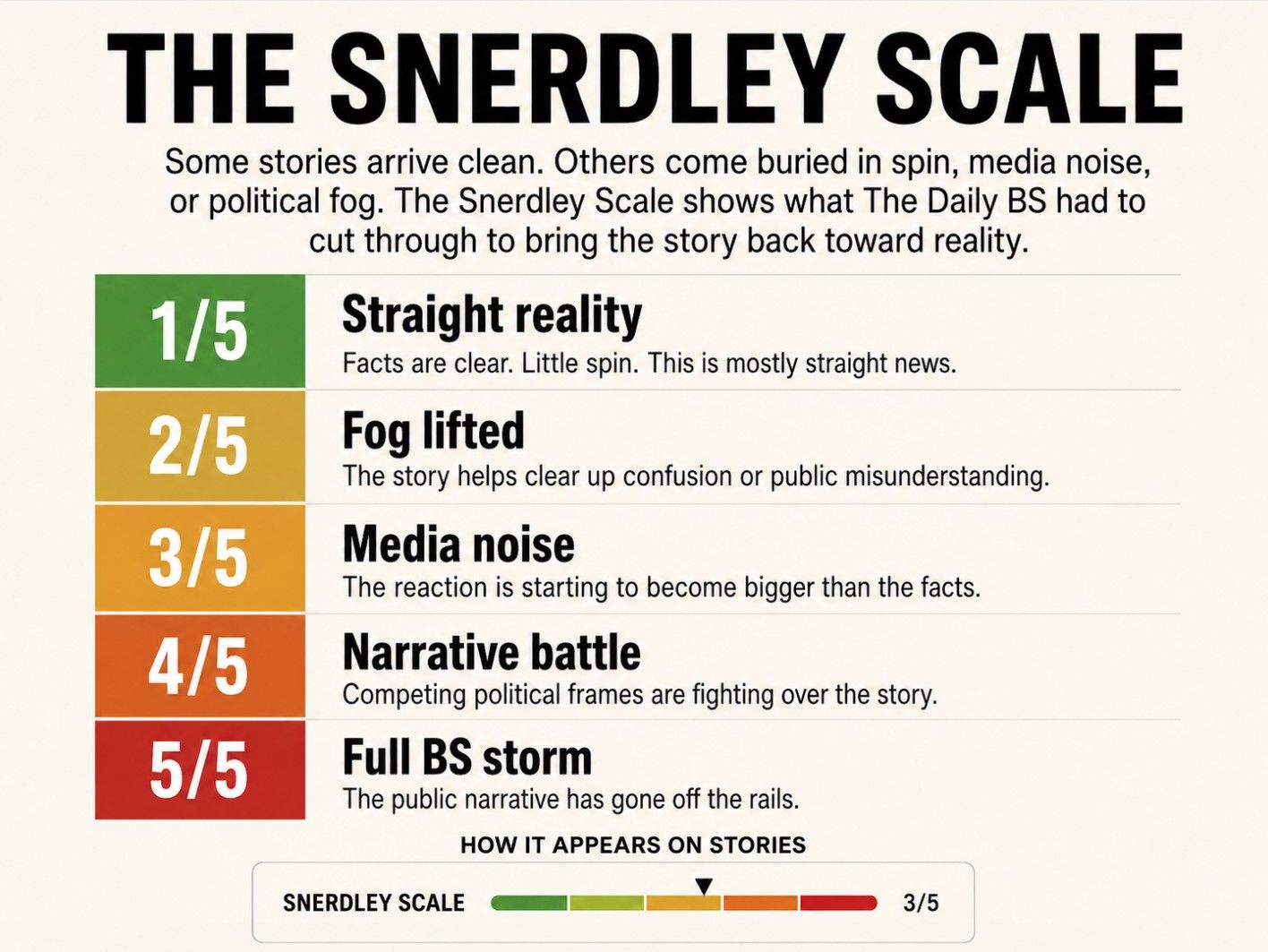
And that’s why this story lands squarely in Full BS territory on the Snerdley Scale. Real legal disputes are transformed into a grand narrative of judicial self-preservation, partisan scheming, and election manipulation—without ever producing the receipts necessary to support the accusation.
If every court decision you dislike becomes proof of a hidden political plot, you’ve stopped analyzing law and started writing political astrology.

Why it scores 5/5 on the Snerdley Scale
- Fact base exists: There are real cases and real controversies.
- Headline overreach: The headline asserts motive and intent that are speculative.
- Mind-reading journalism: The central claim depends on attributing internal political motives to justices.
- Partisan framing dominates: Legal questions become secondary to the narrative that Republicans are being helped.
- Conspiracy logic: The evidence offered doesn’t come close to proving the sweeping accusation implied by the headline.
Final Snerdley score: 5/5 — Full BS. The article starts with a political conclusion, sprinkles in some genuine legal disputes, and then asks readers to assume the rest.