The Iran showdown may have rattled the Middle East, but it also detonated a political explosive much closer to home: right inside the MAGA movement.
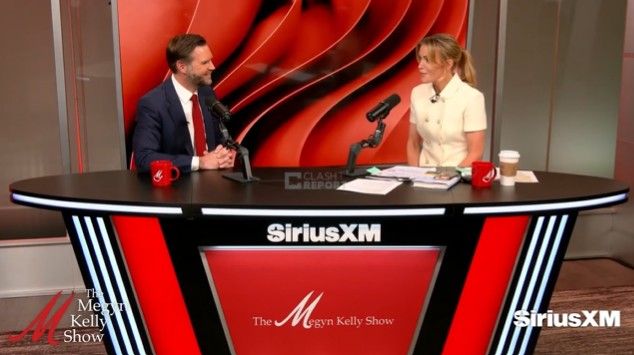
That uncomfortable reality was on full display when Vice President JD Vance sat down with Megyn Kelly, who has emerged as one of the most vocal critics on the right of the administration’s Iran policy. What began as a conversation about Vance’s latest book quickly morphed into something far more revealing — a public airing of grievances from a conservative coalition suddenly discovering it doesn’t agree on everything.
Kelly described a Republican base that has spent months fighting among itself instead of battling Democrats, calling the atmosphere “sad,” “tumultuous,” and increasingly like a political civil war. For many non-interventionist conservatives, she argued, the administration’s actions in Iran felt like a direct violation of the promises that helped power Donald Trump back into the White House.
“The non-interventionist right feels very betrayed by it,” Kelly told Vance, challenging him to explain why disappointed supporters shouldn’t feel abandoned.
Vance’s answer was straightforward: judge the results, not the drama. “What I’d say to them is, one, I think you can walk through all the ways in which this has led to a good place for the United States of America,” he said.
The vice president argued that critics should evaluate the strategic outcome rather than the online warfare surrounding it. According to Vance, Iran’s military capabilities have been severely degraded, its nuclear ambitions dealt a major blow, and fears of another endless Middle Eastern occupation never materialized. “I think you can make the best argument that the nuclear program is destroyed. The Iranian conventional military is destroyed,” Vance said.
He also dismissed warnings that the operation would evolve into another Iraq-style disaster. “We were never going to get the quagmire that a lot of people were warning about, because Donald Trump is just not George W. Bush.”
Kelly, clearly unconvinced that results alone would calm angry voters, pushed for more. “What else you got?” she shot back.
Vance then pivoted to a broader argument about political loyalty and coalition-building. Even conservatives who hated the Iran decision, he said, shouldn’t storm off the field because of a single disagreement. “Even if you disagree with this particular action, it’s completely ridiculous to pick up your marbles and go home. That’s not how politics works.”
That’s where the conversation became particularly revealing.
Kelly complained that critics of the administration’s Iran policy weren’t merely being debated — they were being branded as disloyal. At one point, she said she had been confronted with the message: “Those who speak ill of Mark Levin are not MAGA.”
The remark referencing a bitter feud between Kelly and conservative radio host Mark Levin, one of the strongest advocates of confronting Iran and a longtime hawk on foreign policy.
Vance rushed to smooth things over, insisting Trump’s criticism was less about enforcing ideological purity and more about the president’s habit of personally engaging in political arguments. “Well, the president, as he does, is pushing back at a criticism of yours that he thought was unfair,” Vance said.
According to Vance, Trump remains exactly what supporters elected: a political brawler who jumps into debates rather than watching from the sidelines. “He’s going to criticize you when he disagrees with you. He’s going to say nice things about you when he agrees with you.
“But that’s what I actually love about the president. He’s not viewing these debates from the outside. He’s participating in them himself.”
Throughout the exchange, Vance repeatedly returned to one central theme, disagreement is fine, abandonment is not. “The attitude seems to be: we disagree with the president on this policy,” Vance said. “But fine. You disagree with the president on this particular policy, that doesn’t mean you can give up on the entire enterprise.”
Vance argued that interventionist conservatives — often derided by populists as “neocons” — have historically been more successful politically because they keep showing up even when they lose policy fights.“The reason why neocons are so much more effective in politics than the people on the other side in our coalition is because they play the game.
“They get disappointed, they make their criticisms, and they go back and live to fight another day.”
His message to disillusioned conservatives was blunt. “I don’t like this idea of, ‘The president did something I didn’t like, so I’m out.’ I think it’s a very immature way to approach the political process.”
Kelly surprisingly agreed. “I’ve been saying the same thing,” she responded, noting that many frustrated voters had become “black-pilled” and were talking about walking away from politics entirely.
Still, Kelly wasn’t about to let the administration’s newer allies off the hook.
She pointed out that several prominent pro-intervention conservatives now embraced Trump after spending years in the Never Trump camp. In her view, many suddenly discovered an affection for Trump once he adopted a tougher posture toward Iran and aligned more closely with their foreign-policy priorities.
“Podhoretz and Levin and all those guys — that’s the original Never Trump crew. They hated him. Hated him,” Kelly said.
“And then they embraced him like a bear hug just as soon as he decided he was going to attack Iran and was cozying up with Israel.”
Kelly even suggested some of those newfound alliances may already be showing signs of strain, wondering aloud whether Trump’s latest political friends are proving less loyal than advertised.
Vance declined to take the bait. Instead, he broadened his argument beyond any one faction, insisting that every wing of the Republican coalition must learn to coexist.
“The coalition that made Donald Trump the President of the United States and JD Vance the Vice President of the United States,” he said, “was Megyn Kelly and Tucker Carlson and Joe Rogan. It was also Mark Levin. It was also a lot of people like John Podhoretz who want a more aggressive foreign policy.”
For Vance, that reality means nobody gets everything they want. “Nobody is going to agree with the administration 100 percent of the time.”
And whether the criticism comes from anti-war populists or foreign-policy hawks, his advice remains the same: “Disagree with it. We have the First Amendment in the United States of America. I’m not saying be a patsy. I’m not saying be a person who always falls in line. Make your viewpoint understood.”
The vice president’s larger warning was that political movements rarely collapse because of their opponents. More often, they fracture because supporters convince themselves every disagreement is a betrayal.
JD Vance on the Iran War and some people:
It is kind of ironic that they’re really, really worried about stopping this thing, but they were completely gung-ho about starting this thing.
Source: Megyn Kelly pic.twitter.com/4Q7RiHB1gE
— Clash Report (@clashreport) June 16, 2026