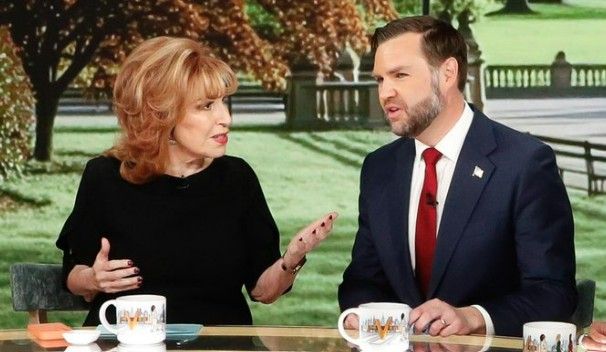
For years, Joy Behar has been one of the loudest anti-Trump voices on daytime television. So when the longtime co-host of The View started handing out compliments to Vice President JD Vance this week, it was enough to make political observers do a double take.
Fresh off Vance’s appearance at the famously combative ABC talk show, Behar revealed she privately encouraged the vice president to consider a future White House run — a remarkable admission given her history of criticizing both Vance and the Trump administration.
Speaking on The View’s companion podcast with executive producer Brian Teta, Behar acknowledged she had a surprisingly favorable impression of the vice president after meeting him face-to-face.
Teta reminded listeners that Behar had apparently told Vance during a commercial break that he should think about running for president because he projected what she described as a “good vibe.”
In reality, politicians who are demonized on television sometimes come across very differently when they actually sit down across the table from their critics.
Behar quickly clarified that she remains firmly on the left and has no plans to join the GOP. While discussing her political views, she argued that Democrats are more focused on helping struggling Americans, while Republicans prioritize lower taxes and economic policies favored by wealthier earners.
Still, her comments about Vance stood out. “Truthfully, as I said to you at the beginning of this conversation, I don’t think that he’s a bad guy,” Behar said.
She even floated a hypothetical 2028 showdown between Vance and California Gov. Gavin Newsom, suggesting the matchup would be compelling because “they’re both intelligent.”
That’s not exactly the kind of language viewers are used to hearing on The View when Republican leaders are involved.
The exchange came after Vance’s appearance at the show’s table, where he sparred with the hosts on several issues but managed to keep the conversation notably civil. At one point, the vice president jokingly revealed that Behar had complimented him backstage.
“Joy said when we were off air that I’m fine, which I think is about the best endorsement I’m gonna get out of Joy Behar,” Vance quipped.
“For a Republican,” Behar shot back.
“Graded on a curve here at The View,” Vance replied, drawing laughs.
Not everything went smoothly. Behar later said she took issue with Vance’s explanation for his past criticism of Donald Trump before eventually joining the president’s political movement. According to Behar, she wasn’t buying the suggestion that media portrayals played a major role in shaping his earlier views.
“Don’t give me that. That’s where I draw the line on the guy. Don’t blame me for the fact — you went to Yale law school, you can’t read between the lines? You can’t watch something and discern what’s going on? Come on,” she said.
Even so, the bigger story may be that one of television’s most reliable Republican critics walked away from the encounter offering praise instead of outrage.
Following his appearance on ABC’s “The View,” Vice President Vance later said he was struck by how the exchange played out behind the scenes and on air, noting he expected a far more hostile reception. Speaking afterward, he said, “I expected them to be absolutely vicious, and they were only a little bit vicious. It wasn’t as bad as I thought it was going to be.”
One moment that stood out came from co-host Joy Behar herself, who reportedly made an unexpected remark during a commercial break that Vance later described publicly. As he recounted it, “Joy Behar even said during the break, not joking, she said, ‘You know what? You’re, like, pretty good for a Republican.’” Vance added that he viewed it as a surprisingly candid acknowledgment from a long-time critic of Republican politics, calling it “a way better compliment than I expected from Joy Behar.”
The vice president also said the overall tone of the discussion, while combative at times, ultimately proved more civil than anticipated, remarking, “We’re going to go and try to have a good conversation,” and noting his hope that even ideological opponents could “meet me halfway.”