BS BULLETIN
- California has approved the nation’s first efficiency standards for replacement tires, with the first requirements taking effect in 2029 and tougher standards arriving in 2033.
- State regulators say the rule could eventually save drivers nearly $1 billion a year in fuel and electricity costs.
- Tire makers warn the regulation could reduce consumer choices, raise costs and create enforcement problems — especially with imported tires.
Just when you thought Sacramento had run out of things on your automobile to regulate, congratulations.
They found the tires.
California has become the first state in America to approve mandatory energy-efficiency standards for replacement tires sold for passenger vehicles and light-duty trucks, meaning that when your current tires finally wear out, the state intends to have something to say about what kind of rubber can replace them.
The California Energy Commission voted unanimously Monday to adopt its Replacement Tire Efficiency Program, an idea that has been lingering around Sacramento for more than two decades. Yes, two decades.
The Legislature ordered the commission back in 2003 to devise a program ensuring that replacement tires would be at least as energy-efficient, on average, as the tires installed on new vehicles. The commission is finally putting that mandate into action. The theory is straightforward enough. Tires create something called “rolling resistance” as they flex against the road. The more energy lost through that resistance, the more gasoline — or electricity, for an EV — the vehicle needs to keep moving.
New cars tend to arrive with lower-rolling-resistance tires. Replacement tires, according to the commission’s testing, are generally less efficient.
So California’s answer is: Make the replacement tires more efficient by law.
And because this is California, there will naturally be standards, classifications, exemptions, compliance dates, testing requirements and government-approved numerical limits determining whether the thing between your car and the pavement is sufficiently virtuous.
The first phase begins in 2029. A tougher standard arrives in 2033. State officials are selling the rule primarily as a consumer benefit.
California Energy Commission Chairman David Hochschild said the regulation was about protecting motorists from long-term costs at a time when working people are under financial pressure. The commission estimates the regulations could eventually save California drivers roughly $979 million annually in fuel costs by 2035. For a typical gasoline passenger vehicle, the commission projects about $179 in fuel savings over the roughly four-year life of a set of qualifying tires.
Of course, the tires themselves aren’t expected to become cheaper. The state estimates complying with the 2029 standard will add roughly $6 to the cost of a set, eventually climbing to about $26 per set under the 2033 requirements. Regulators argue that motorists will more than recover the difference through reduced fuel or electricity consumption.
The commission also estimates that the efficiency gains will reduce greenhouse-gas emissions by an amount comparable to taking approximately 400,000 vehicles off California roads each year.
You knew we would eventually get to that part.
The tire industry isn’t exactly standing in formation saluting Sacramento. While several manufacturers support the broad goal of improving efficiency — and companies including Michelin and Bridgestone have worked with regulators as the proposal evolved — other industry representatives warn that California may be underestimating the tradeoffs and costs.
Goodyear representative Bret Gladfelty challenged the commission’s cost calculations and warned during the rulemaking process that consumers could face substantially higher costs than regulators predict.
The San Francisco Chronicle reported that industry representatives also raised concerns about an “enforcement gap” involving imported tires. One provision exempts companies producing or importing fewer than 15,000 tires annually. Continental Tire representative Jay Spears warned that the exemption could allow cheaper, less-efficient imports to compete against major manufacturers forced to shoulder the compliance burden.
So, California creates a rule designed to control what tires Californians buy. American and major international manufacturers spend the money required to comply. Then somebody wonders whether smaller foreign importers might simply skate around portions of the regulatory structure.
Government planning. It’s a beautiful thing.
The United States Tire Manufacturers Association submitted detailed objections before the final vote, and they’re more substantive than simply saying, “We don’t like regulation.”
The trade group warned that there are genuine engineering tradeoffs between rolling resistance, tire lifespan and wet-weather traction. In other words, designing the most energy-efficient tire possible isn’t the only consideration when you’re manufacturing something expected to keep a two-ton vehicle attached to the pavement in a rainstorm. USTMA warned that improvements in one performance category can come at the expense of another and urged California to conduct a formal review after the first phase before imposing the more aggressive 2033 requirements.
The association was especially concerned about light-truck tires, arguing that the commission’s testing sample was too limited to justify imposing the proposed performance limits across the entire market. Only 16 light-truck tires were included in the studies USTMA discussed in its comments, and the group argued that light trucks operate under different loads, speeds and durability demands than ordinary passenger cars. USTMA warned that imposing standards before collecting a more robust data set risks creating requirements that may prove technically unrealistic or reduce product availability.
Regulators disagree. The Energy Commission says its own analysis shows the rule is technically feasible and will not compromise safety, shorten tire life or increase tire waste.
So there you have it. Industry engineers say there are tradeoffs worth watching. California says don’t worry. Choose your comfort level accordingly.
To its credit, the commission modified the original proposal after receiving complaints from tire manufacturers and car enthusiasts. Competition tires received an exemption under specified criteria. Winter and certain all-season snow-performance tires received special treatment.
There are also provisions dealing with run-flat tires, long-life tires, large off-road tires and other specialty applications. The changes were significant enough that some industry resistance softened.
Commissioner Nancy Skinner said about 70% of replacement tires currently available already satisfy the 2029 requirement and roughly 30% meet the tougher 2033 standard. “California consumers are not being asked to wait for new technology,” Skinner said. “They are simply being given access to technology the rest of the world has.”
Of course, there’s a slight difference between “being given access” to something and being told that eventually you may only buy something meeting the government’s specifications.
But perhaps I’m being old-fashioned.
MY QUICK TAKE
I knew this day was coming.
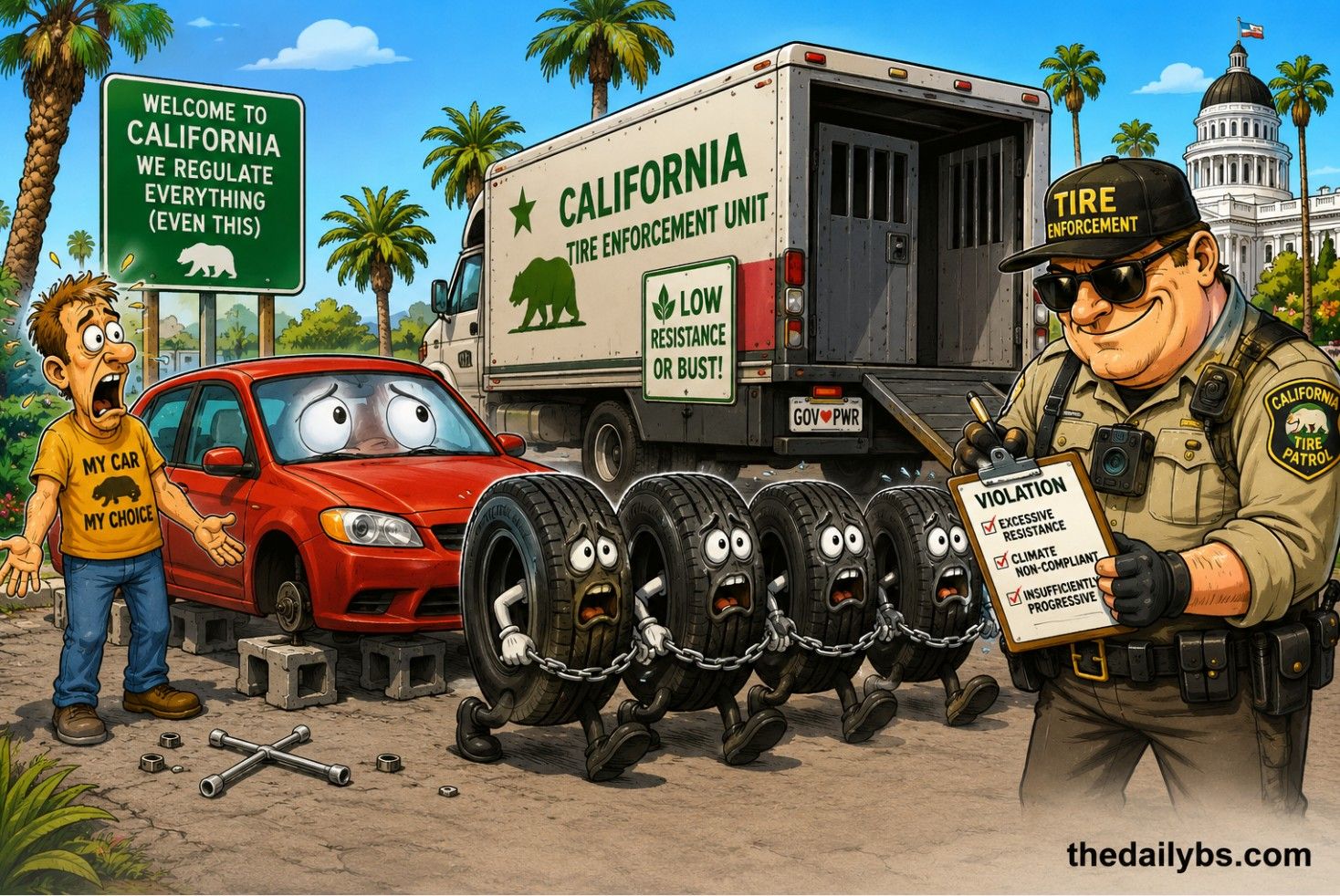
Ladies and gentlemen, your rubber has been insufficiently progressive.
The government assures you this is for your own good because the new tires may cost more up front but will theoretically save you money later.
Ah yes.
My favorite sentence in the English language: “The government says this will save you money.” Nothing gives a taxpayer confidence quite like hearing that.
And look, the physics are real. Lower rolling resistance can improve fuel economy. Nobody needs to pretend otherwise.
But we’re talking about tires.
Drivers choose tires for snow. Rain. Performance. Longevity. Truck loads. Off-roading. Price. Noise. Handling. And that old-fashioned little consideration called “stopping the automobile before it hits something.”
California’s response is essentially: Don’t worry. We studied it. Wonderful.
Then comes my favorite part. The commission says 30% of today’s available tires already meet the standard that takes effect in 2033.
That’s being presented as reassuring. I hear something else. What happens to the other 70%? I’m sure California will explain.
Probably in a 96-page document.
Gavin Comes for the Tires … https://t.co/9Otv8SMpMm
— thedailybs w/ Snerdley (@thedailybs_Bo) August 19, 2026
DBS WIRE SOURCES:
- Los Angeles Times — Your car may not be fuel efficient, but your tires have to be now
- California Energy Commission — California’s Proposed Replacement Tire Efficiency Program
- San Francisco Chronicle — Californians will have to buy more energy-efficient tires under new rules
- KCRA — California approves new rules for replacement tires
- U.S. Tire Manufacturers Association — Comments on California Replacement Tire Efficiency Program
- Road & Track — California tire efficiency program carves out exemptions for enthusiasts