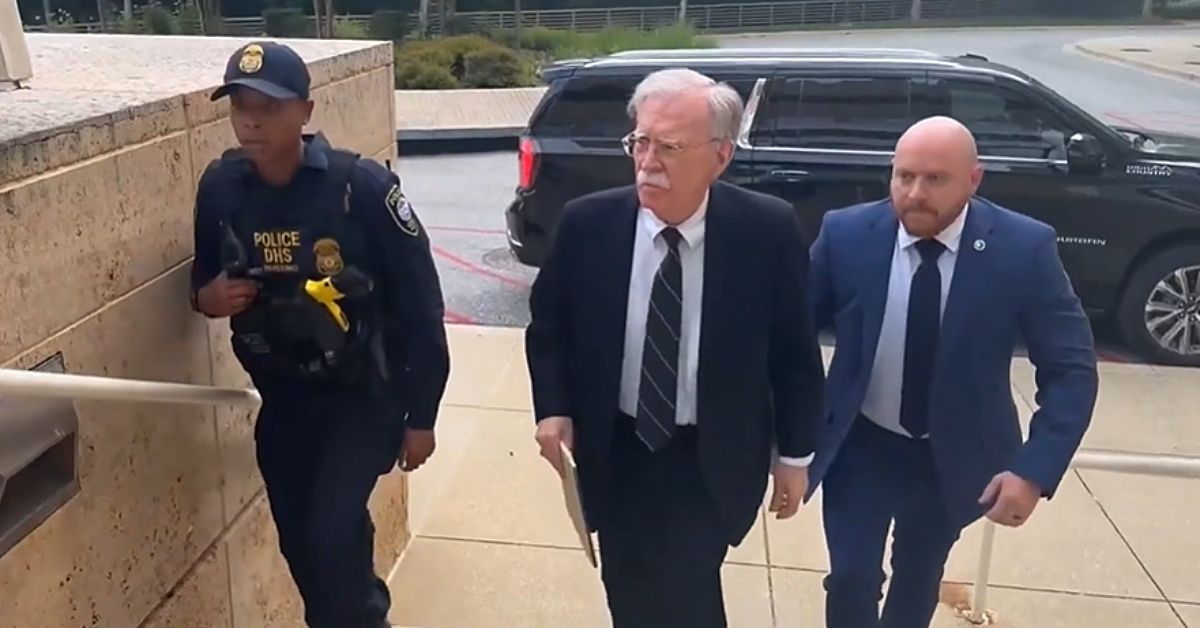
For years, John Bolton built his reputation as one of Washington’s toughest national security hawks. Whether serving in Republican administrations or making the rounds on cable news, Bolton rarely missed an opportunity to lecture America—and sometimes the rest of the world—about protecting classified information and safeguarding the country’s interests.
On Friday, he stood in federal court and admitted he failed to follow those same rules.
The former National Security Adviser pleaded guilty to a felony charge of unlawfully retaining sensitive national security information.
According to reports from inside the courtroom, U.S. District Judge Theodore Chuang asked Bolton directly whether he committed the offense outlined in the plea agreement. Bolton’s response was simple.
“I did, your honor.”
The judge followed with the obvious question. Was he guilty?
“I am, your honor. I’m sorry for it.”
That’s about as close as Washington gets to saying, “Well… this is awkward.”
According to the plea agreement announced by federal prosecutors, Bolton now faces up to five years in prison, although his ultimate sentence won’t be determined until a later hearing. He also agreed to pay a $2.25 million fine and forfeit his federal pension under the Hiss Act, a law designed to strip retirement benefits from certain federal officials convicted of crimes involving national security or public trust.
Outside the courthouse, U.S. Attorney Kelly Hayes made a statement.
“As national security advisor to the president of the United States, Mr. Bolton had access to and was responsible for safeguarding the most sensitive national defense information, including classified material.”
Hayes continued:
“Mr. Bolton knew how to handle classified information, where it should be stored, how it should be stored and with whom he could share that information.”
Then came the government’s central allegation.
“Nevertheless, as Mr. Bolton just admitted, he put our national security at grave risk in violation of the law.”
Whatever sentence Bolton ultimately receives, the political fallout is almost guaranteed to outlast it.
Bolton has spent years as one of Donald Trump’s fiercest Republican critics after leaving the administration in 2019. Their relationship deteriorated into an extended public feud that included books, television interviews and plenty of pointed insults traveling in both directions.
Now, Bolton finds himself in an uncomfortable position that conservatives will almost certainly point out.
John Bolton once called for Edward Snowden’s execution. He even fantasized how, saying Snowden “ought to swing from a tall oak tree.”
Bolton is now a convicted felon for mishandling classified information: not to inform the public but to profit off a book. Get the noose. https://t.co/vGUP1xVD21
— Glenn Greenwald (@ggreenwald) June 26, 2026
For years, Americans have endured endless political arguments over classified documents, secure storage and who knew what when. Politicians and pundits alike have insisted that mishandling classified material is either an unforgivable threat to national security—or an overblown political weapon—depending largely on whose name appears in the indictment.
This case serves as another reminder that classified information isn’t just another stack of government paperwork.
The rules exist for a reason. One lesson from this saga should be universal, regardless of party. If you’re entrusted with America’s secrets, the expectation isn’t complicated: keep them secret.
It’s a standard Bolton spent much of his career defending. Now he’ll be sentenced for violating it himself.