

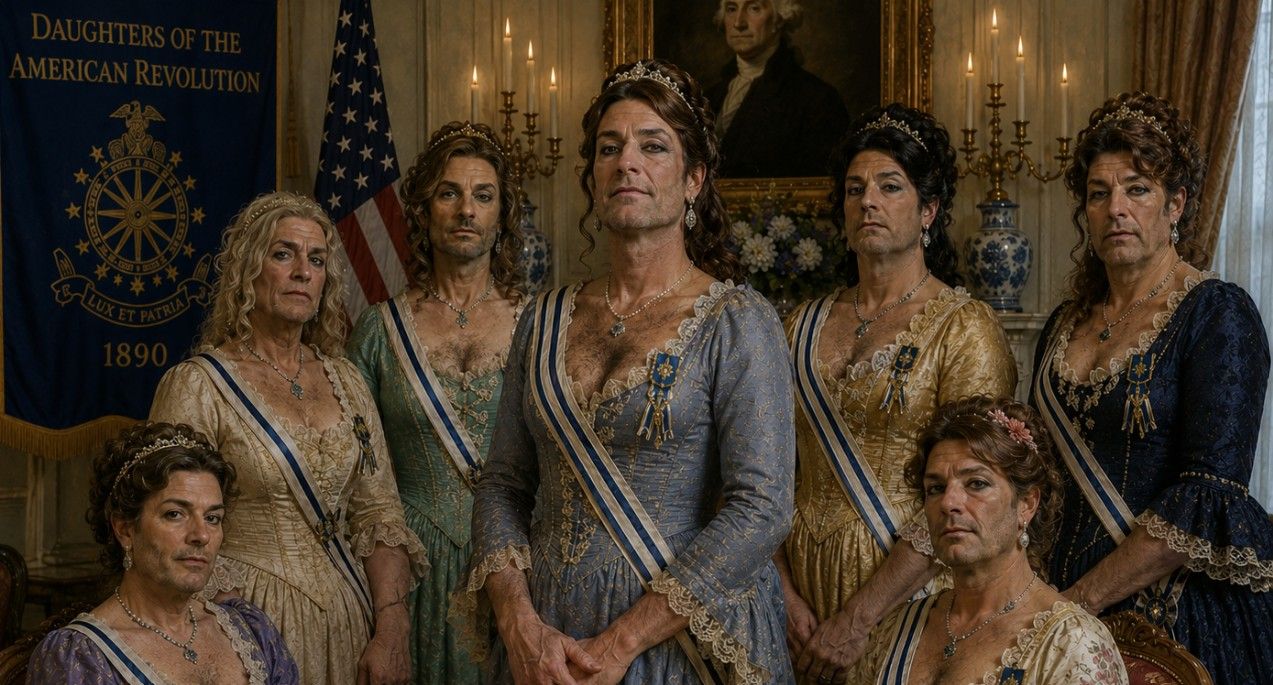
There are few institutions in America that carry the weight of history quite like the Daughters of the American Revolution.
Founded in 1890, the organization built its identity around preserving the memory of the American Revolution, honoring ancestors who contributed to the nation’s founding, and maintaining a tradition of female membership.
Now, that tradition is at the center of a very modern American argument.
A dispute has erupted within the DAR after members challenged a decision by national leadership regarding transgender membership. The controversy intensified after leadership urged members to accept the change and move forward, a message critics interpreted as dismissive toward longtime members who believe the organization’s historic mission is tied specifically to women’s heritage.
Yesterday, at the 135th Continental Congress of the Daughters of the American Revolution (DAR), tradition was defeated by a vote of 1,481 to 984.
Delegates were voting on a resolution that sought to clarify the bylaws by defining “woman” explicitly as a person born female. It… pic.twitter.com/VaDxyrTD0p
— Beacon News West Virginia (@BeaconNewsWV) June 27, 2026
And that’s where the fireworks started.
Because nothing says “quiet historical society meeting” quite like a full-blown cultural earthquake. Conservative commentator Mollie Hemingway weighed in, arguing that the core question was not simply about politics but about the purpose and definition of the organization itself.
Ginnie Sebastian Storage, Daughters of the American Revolution President General — and a strong supporter of transing DAR — sent a note to members telling them that the vote against transing DAR failed, and everybody needs to accept it and move on. Many chapters are enraged.
— Mollie (@MZHemingway) June 29, 2026
The argument from critics is straightforward: if a group’s founding purpose was built around women’s lineage and women’s civic participation, changing the definition of membership represents a major philosophical shift — not just an administrative adjustment.
Supporters of the policy change argue the opposite: that historic organizations survive by adapting, and that inclusion allows them to remain relevant in a changing society.
This is the kind of debate America has become very familiar with.
How destructive for DAR that it is marginalizing ACTUAL daughters of the revolution in favor of men who assert they are women. Institutionally catastrophic.
— Mollie (@MZHemingway) June 27, 2026
A decades-old membership organization can become a national headline overnight because every institution is now viewed through the lens of America’s larger cultural divide.
The question facing the DAR — and countless groups like it — is not just who belongs.
It is whether an organization can redefine itself without alienating the very people who built it.
For members who see the DAR as a living connection to the nation’s founding story, this feels like a fight over preservation.
It’s still going strong. Just now with more press releases and fewer quiet tea meetings.
Wow 😳
So apparently the DAR—Daughters of the American Revolution— is being run by liberal nutcases now.
The women’s organization is based on your hereditary ancestry — direct lineage to a Revolutionary War soldier. My grandmother was a member of the DAR therefore, I… pic.twitter.com/WpIOZaTaIE
— Rachel Lane (@Sober_In_Dublin) June 28, 2026









ANOTHER DELIBERATE SICK MOVE BY COMMUNISTS INTENT ON DESTROYING AMERICAN CIVILIZED CULTURE. “DAUGHTERS” MEANS WOMEN: FRMALE. FOR THOSE WHO MAY NOT KNOW, WOMEN HAVE A VAGINA AND GIVE BIRTH. MEN HAVE A PENIS AND DO NOT GIVE BIRTH.
IF GOD HAD INTENDED FOR ANY OTHER (ALLEGED) SEX FOR FEMALE, IT WOULD HAVE BEEN STATED SO IN THE BIBLE, ACCLAIMED BY ALL RELIGIONS AND RECOGNIZED IN ALL MEDICAL TEXT BOOKS. MEN ARE NOT “DAUGHTERS” NO MATTER WHAT SOME MISGUIDED MALCONTENTS SAY.
The leadership should be dissolved. This is how inch by inch the socialists and wacky Democrats are killing our founding father’s purity; they would never have dreamed that men would be accepted as a woman under any circumstance. I hope and pray that we will see these very Woke decisions some leftists ARE PUSHING.
These leaders should be brought up before whomever submits names for leadership positions. It is a very WOKE position to allow men into this body, transvestites need to be put in mental facilities to get help. This is an affront to this body; the rank and file should stand up and vote them out.
And when the first swingin’ you-know-what shows up in the bathroom or other changing area what will be the consequences?
Progressive mindlessness is spreading like cancer. Women complain of unequal treatment, then do something like this. It is cultural suicide.
Isn’t a transvestite a man who dresses like a woman, but not necessarily claims to be one? It seems the wrong word was used instead of using transgender. All that aside, it’s still wrong, no matter what they choose to call it. Daughter’s means actual people born a woman, not someone twisting language for nefarious purposes.
Changing historical definition of daughter to now include men playing at being women is not something we should “just get over”. What’s the percentage of transgender women in the population in general and that in the DAR itself? Changing policy for 1/2 of 1% is silly.
Bylaws state only Female direct descendants of revolutionary soldiers or participants in revolutionary causes are allowed to join. Seems cut and dried. Time to throw out those who refuse to follow the bylaws.
What a travesty that these, undoubtedly, progressive-indoctrinated AWFUL women would come to this decision based on their belief in a concocted agenda. History will apologize for this temporary mania and castigate them for failing to think logically and scientifically on this. What had been a fine institution has tarnished their heritage beyond redemption at this point. They have made themselves irrelevant and a joke.
And another American group dies by a thousand cuts. The Boy Scouts are dead for intents and purposes. Women have fewer and fewer spaces they can call their own.
Then again it was women that pushed for decades to destroy the male only places. They demanded the right to go where they wanted. Then their own friends who fought along side of them demanded that people can just choose their gender on how they feel today. Well done you have just about won it all.
My sons are sons of the revolution, sons of the confederacy and sons of tapas. I hope those organizations are not going to do this bullshit. Why can’t these perverted freaks just go away? Better yet, how about open season and no bag limit. My late wife is a daughter of these organizations which is where my sones got their certifications from. She is rolling in her grave.
I suggest a separate class of membership. Say, daughters with a penis. Problem solved!
What a shame!
Now glad I never joined. Am eligible.
I got over it alright, I turned in my resignation. So sad.
NSDAR 804705
Elizabeth Horn
So homosexuals who want to PRETEND TO BE WOMEN have bullied their way into acceptance by the D.A.R.?
RESIGN AND BOYCOTT LEFTISM AND FALSEHOOD WILL NOT BE FORCED ON US
Another institution polluted by leftist anti-Americans who think only of injecting their agenda into the institution and nothing of how sacred that institution is. A national vote to remove the “leadership” or separate from the polluted portion should be taken immediately to show them that they need to “get over it”. These are the same kind of ogres who destroyed the Boy Scouts and turned them into some arm of the Girls League of Scouting.