

Seattle’s annual Pride celebration is drawing national attention for reasons that have little to do with politics and a great deal to do with public decency.
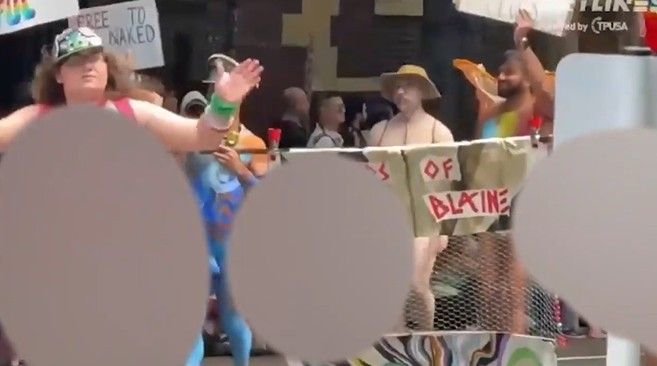
Videos circulating online from Sunday’s Pride festivities appear to show nude participants marching in portions of the event and gathering near public areas where families and children were present. The footage generated immediate backlash from critics who questioned why explicit displays were occurring in spaces accessible to minors.
One video showed members of a group known as “Friends of Denny Blaine” participating in the festivities while nude. The organization has long advocated for preserving the clothing-optional culture associated with Seattle’s Denny Blaine Park.
Signs visible in the footage included slogans such as “Nude ≠ Lewd,” “Free to be Naked,” and “Nude is Nourishing.”
Additional videos shared online appeared to show nude adults near a public fountain where children were playing. Other clips showed nude cyclists participating in portions of the event.
The controversy quickly spread across social media, with critics arguing that whatever one’s views on Pride celebrations, the presence of children changes the discussion.
Several online commenters questioned whether the displays crossed legal boundaries under Washington law. Seattle’s municipal code does not specifically prohibit simple public nudity. However, Washington State law addresses indecent exposure under circumstances likely to cause reasonable alarm or offense.
According to Washington statute, “A person is guilty of indecent exposure if he or she intentionally makes any open and obscene exposure … knowing that such conduct is likely to cause reasonable affront or alarm.” Whether any conduct observed during the event meets that legal threshold would ultimately be determined by law enforcement and prosecutors.
When the most modest faction at your parade are the furry’s your ideology needs to be wiped off planet earth https://t.co/TJ15qXZnuF
— Postman (@postmanShmerg) June 29, 2026
As of Monday, Seattle police had not publicly announced arrests connected to the videos that circulated online.
Supporters of public nudity advocates argue that nudity alone should not automatically be treated as sexual conduct and point to Seattle’s longstanding tolerance for clothing-optional gatherings.
Critics counter that public events attended by families should maintain standards that allow parents to bring children without concern over exposure to explicit displays.
Let me make this very simple.
Most parents are not legal scholars.
They are not walking around with copies of municipal code in their back pockets trying to determine the precise legal distinction between “public nudity” and “indecent exposure.” They’re asking a much simpler question:
“Should my kid have to see this?” That’s it.
The political class and activist crowd often complicate issues that ordinary Americans see with crystal clarity.
If a public event is marketed as a community celebration and families are encouraged to attend, parents reasonably expect a basic standard of public decorum.
What fascinates me is how quickly the conversation changes when the subject is anything else. Schools, libraries, sports leagues, youth programs—everywhere else we hear endless lectures about creating age-appropriate environments. Suddenly, when this issue comes up, some people act as though parents are unreasonable for asking where the line is.
That’s why stories like this resonate far beyond Seattle.
The debate isn’t really about one parade. It’s about whether average Americans are still allowed to trust their own common sense. And common sense has a funny way of surviving even when entire institutions try to explain it away.
Parents know what they saw. The only remaining argument is whether public officials are willing to acknowledge what everybody else already understands. I’m not going to include too many visuals in this post, but it is way worse than you imagine. A few tiny examples below. And I do mean tiny.













One the one hand, the LGBTQ+ community wants to be accepted as a regular, normal part of society. Then they go and do something deviant like this. It’s good that they “expose” their true selves. (No pun intended).