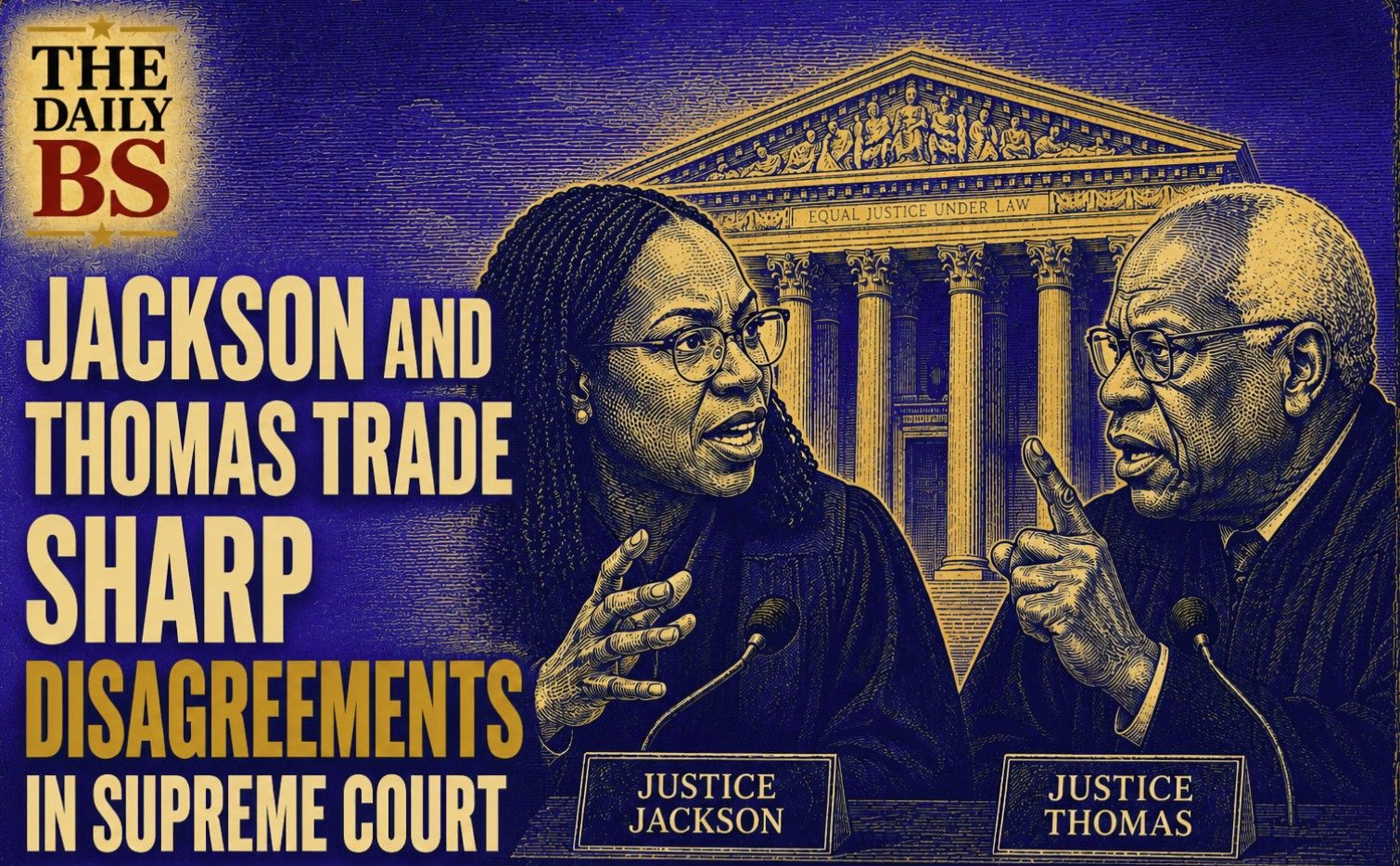
A major Supreme Court ruling on birthright citizenship produced one of the most pointed exchanges of the term, with Justice Ketanji Brown Jackson accusing Justice Clarence Thomas of advancing an interpretation that echoes a central premise of the Court’s infamous 1857 Dred Scott decision.
The dispute emerged in separate opinions filed in Trump v. Barbara, a closely watched case involving the scope of birthright citizenship under the Fourteenth Amendment.
Writing in support of the majority’s position, Jackson argued that the Citizenship Clause was intended to establish a broad principle of citizenship for those born in the United States.
“Freed Blacks fought for the shared humanity of all people,” Jackson wrote. “Of course, the ultimate irony is that for all the talk about the detestable Dred Scott decision, the Government and [Justice Thomas] propose a return to its core tenet. Their bottom line is that, for certain people, being born on American soil will not suffice to confer citizenship.”
The reference to Dred Scott v. Sandford invoked one of the most controversial decisions in Supreme Court history, in which the Court held that people of African descent could not be considered citizens under the Constitution.
Thomas forcefully rejected Jackson’s historical interpretation.
In his opinion, Thomas argued that the Fourteenth Amendment was adopted to overturn Dred Scott and guarantee citizenship to formerly enslaved Americans and others born and domiciled in the United States, regardless of race.
“After the Civil War, the Reconstruction Congress overruled Dred Scott, first with the Civil Rights Act of 1866, then with the Citizenship Clause of the Fourteenth Amendment,” Thomas wrote. “Neither guaranteed citizenship to persons who were not domiciled in the United States.”
Thomas emphasized what he described as a critical distinction between citizenship, residence, and allegiance.
“Blacks were entitled to citizenship because they were Americans,” Thomas wrote. “They had no other homeland, owed no allegiance to any foreign power, and were subject to no other authority.”
He argued that children born to temporary foreign visitors present a different constitutional question because their parents remain connected to another sovereign nation.
Jackson responded directly to that reasoning.
“Despite his longstanding endorsement of a ‘colorblind’ Constitution, Justice Thomas now surprisingly suggests that the Citizenship Clause was a race-conscious remedial measure,” Jackson wrote.
She described that interpretation as “myopic” and argued that the Reconstruction Amendments were intended to create a broader constitutional framework protecting equality and citizenship.
“The Reconstruction Amendments were an anticaste, antisubordination reset for the Nation, not a mere spot treatment for the dark stain of slavery,” Jackson wrote.
The exchange highlighted a deep divide among the justices over the original meaning of the Fourteenth Amendment and the historical circumstances surrounding its adoption following the Civil War.
Legal scholars have long debated the scope of the Citizenship Clause, particularly the meaning of the phrase “subject to the jurisdiction” of the United States. That language remains at the center of modern disputes over birthright citizenship and immigration policy.
While the Court’s ruling resolved the case before it, the sharp disagreement between Jackson and Thomas underscored how fundamental constitutional questions about citizenship, history, and national identity continue to generate intense debate nearly 160 years after the Fourteenth Amendment was ratified.
Supreme Court opinions are often written in the careful, measured language of legal analysis. This exchange was different.
When one justice invokes Dred Scott and another responds with a lengthy historical defense of Reconstruction-era citizenship, you know the disagreement runs far deeper than ordinary legal interpretation.
The striking thing here is not simply that Jackson and Thomas disagree. Supreme Court justices disagree all the time. It’s that they appear to be reading the same constitutional text through dramatically different historical lenses.
Thomas sees the Fourteenth Amendment through the specific context of Reconstruction and the aftermath of slavery. Jackson sees it as establishing a broader principle that extends beyond the circumstances that produced it.