President Donald Trump’s push for a nationwide voter ID and citizenship verification law remains stuck in the Senate, but one of its most persistent Republican opponents is suddenly off the field.
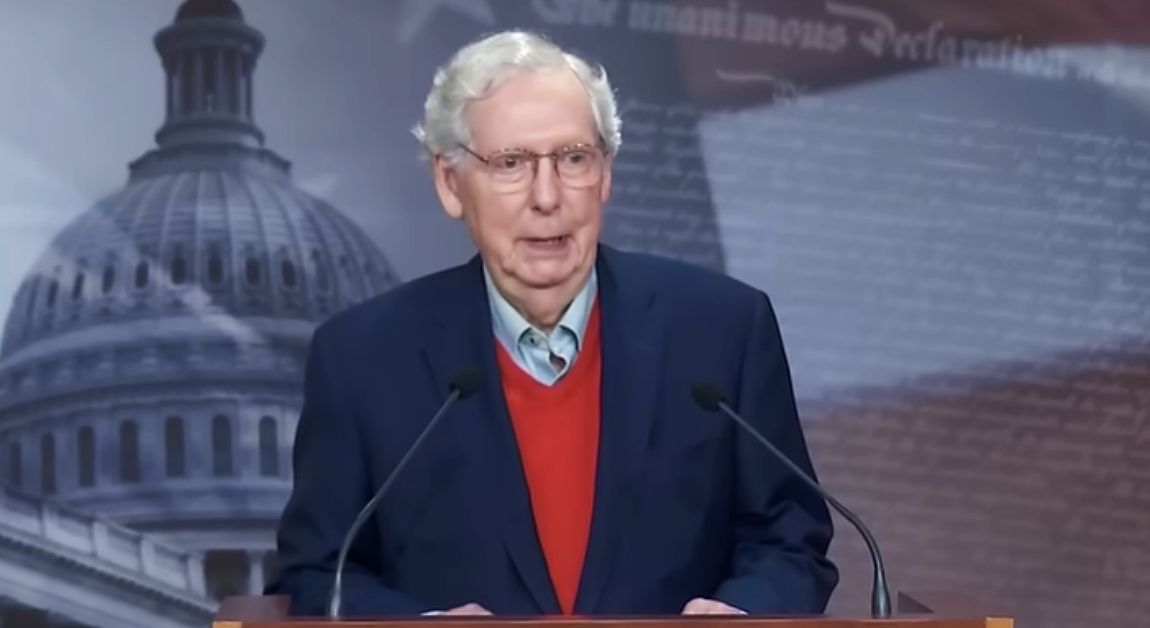
Sen. Mitch McConnell’s extended absence due to health issues has temporarily removed a reliable “no” vote from the equation, offering a small but politically significant break for supporters of the SAVE America Act. The Kentucky Republican has repeatedly bucked both Trump and much of the GOP conference on the legislation, helping stall one of the president’s signature election-security priorities.
The development does not solve the bill’s larger problem: Senate Democrats remain unanimously opposed, and Republicans still lack the 60 votes needed to overcome a filibuster. Senate Majority Leader John Thune has made clear that he has no intention of detonating the chamber’s legislative filibuster to get the bill across the finish line.
“The only way you could get there is to undo or get rid of the legislative filibuster,” Thune said previously. “There aren’t even close to the votes here in the United States Senate in order to achieve that.”
That reality has frustrated Trump, who has spent months pressuring Republicans to find a path forward. The SAVE America Act would require proof of citizenship for voter registration, strengthen voter ID requirements, and impose new election-integrity standards nationwide. Supporters argue those measures would restore public confidence in elections and close loopholes that critics say leave the system vulnerable. Opponents contend the legislation could create new barriers for some voters.
Trump has not hidden his frustration with McConnell.
“Mitch McConnell,” Trump said last month. “He’s very disloyal to John Thune. You know, John Thune was a very good person for him. I mean, he’s a very loyal person, and Mitch McConnell’s against him almost all the time because he’s angry, I guess. Probably at me.”
The president’s allies have increasingly argued that the Senate’s modern filibuster has become less a tool for debate and more a mechanism for permanent gridlock. Utah Sen. Mike Lee has floated a “talking filibuster” approach that would force opponents to physically hold the floor, but Senate Republicans have shown little appetite for a procedural war that could consume weeks of valuable floor time.
Another possibility being discussed is budget reconciliation, the process that allows certain legislation to pass with a simple majority. House Speaker Mike Johnson has signaled interest in exploring that route, though even some of the bill’s strongest supporters acknowledge major portions of the SAVE Act are unlikely to qualify under Senate rules because they are policy provisions rather than budgetary measures.
Sen. Mike Lee recently summed up the challenge bluntly, noting that the legislation is fundamentally “policy” and therefore difficult to move through reconciliation procedures.
Meanwhile, McConnell’s prolonged absence continues to generate speculation throughout Washington. Republican leaders insist the former Senate leader remains engaged and is recovering, while questions about his timetable for returning to the Capitol remain unanswered.
For now, Trump’s election-security agenda finds itself in a familiar place, popular with much of the Republican base, supported by House leadership, but trapped in a Senate where procedure often matters more than passion.
The SAVE Act debate has become the perfect illustration of why Americans get so frustrated with Washington.
You can have a president demanding action. You can have a House willing to pass legislation. You can have voters screaming that election integrity matters. Then the bill arrives in the Senate and immediately runs face-first into a procedural brick wall built sometime around the invention of the telegraph.
The filibuster is apparently sacred when Republicans want something and an outdated relic when Democrats want something.
The other fascinating part of this story is watching Mitch McConnell continue influencing events even when he isn’t physically there. The man has become the Senate equivalent of a ghost at a family reunion. Nobody sees him, but everybody’s still talking about him.
And let’s be honest, if requiring proof of citizenship to vote is somehow considered controversial, perhaps we’ve wandered into a very strange chapter of American politics.
You need identification to board a plane, cash a check, buy certain medicines, rent a car, and in some places practically borrow a library book.
But voting? Apparently that’s where some politicians suddenly discover their libertarian streak.
The Senate may eventually kill this bill. It may delay it. It may proceduralize it to death. Washington has an endless supply of ways to avoid making decisions.
But every time that happens, voters get another reminder of why Congress polls somewhere between root canals and airline baggage fees.