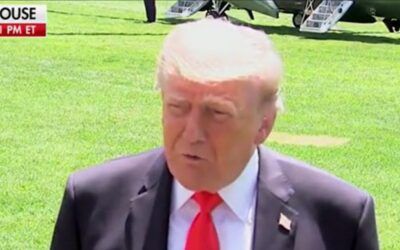
President Donald Trump is urging the U.S. Supreme Court to revisit its recent ruling on birthright citizenship, escalating a legal and political battle that has been at the center of immigration debates for years.
In a social media post Wednesday, Trump criticized the Court’s decision in Trump v. Barbara and called for a rehearing of the case, arguing that the ruling could encourage what he described as “birth tourism” and misuse of U.S. citizenship laws.
“In fact, that is a crime, and therefore, the Supreme Court’s ruling is wrong,” Trump wrote. “I will be asking for a Rehearing by the United States Supreme Court, IMMEDIATELY.”
The dispute stems from an executive order issued during Trump’s second term directing federal agencies not to automatically recognize citizenship for certain children born in the United States to undocumented immigrants or temporary visa holders.
Last week, the Supreme Court rejected that approach. Chief Justice John Roberts, writing for the majority, pointed to the language of the 14th Amendment, which states that “All persons born or naturalized in the United States, and subject to the jurisdiction thereof, are citizens of the United States and of the State wherein they reside.”
The Court’s ruling represented a significant setback for the administration’s effort to reinterpret longstanding citizenship policy.
However, the decision also revealed divisions among the justices regarding the legal framework underlying the issue. While the majority rejected Trump’s position, Justice Brett Kavanaugh argued in dissent that the executive order conflicted with federal statute rather than being foreclosed solely by the Constitution.
That distinction has drawn attention from supporters of the administration, who argue that the Court did not completely settle every legal question surrounding birthright citizenship.
Trump’s latest comments focused heavily on claims that some foreign nationals travel to the United States specifically to give birth so their children can obtain U.S. citizenship. Immigration critics have long referred to the practice as “birth tourism,” while supporters of current law argue that constitutional protections should not depend on the immigration status of a child’s parents.
The president also renewed his call for congressional action, arguing that lawmakers should revisit the issue legislatively if the courts remain unwilling to adopt the administration’s interpretation.
Legal scholars caution that rehearings by the Supreme Court are uncommon, particularly in major constitutional cases. While parties can request reconsideration, such requests are rarely granted absent extraordinary circumstances.
For now, the Court’s ruling remains in effect, but the administration’s latest response signals that the fight over the meaning of the 14th Amendment—and who qualifies for automatic U.S. citizenship—is unlikely to end anytime soon.
DBS WIRE SOURCES:
- Associated Press: Supreme Court rules on Trump administration birthright citizenship challenge
- SCOTUSblog: Analysis of the Court’s birthright citizenship ruling