

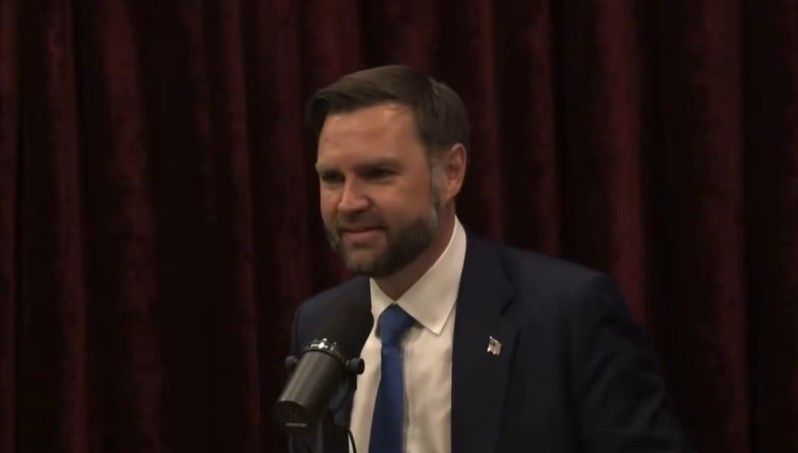
The biggest surprise from Joe Rogan’s latest conversation with Vice President JD Vance wasn’t Jeffrey Epstein, foreign policy, or even Donald Trump.
It was a spirited debate over Moses.
During a lengthy episode of “The Joe Rogan Experience,” Rogan challenged Vance over Texas’ law requiring public school classrooms to display the Ten Commandments, a measure that has become a rallying point in the battle over faith, culture, and America’s historical identity.
Rogan referenced Texas State Rep. James Talarico, a Democrat who identifies as a devout Christian and has become one of the most visible opponents of the law. Talarico has argued that government-mandated religious displays ultimately weaken rather than strengthen Christianity.
“One of the things that I think he has a really good point about,” Rogan told Vance, “putting the Ten Commandments in schools, I don’t think is the right way to do.”
Rogan continued by summarizing Talarico’s argument.
“He just thinks that even though he believes in the Ten Commandments, if you’re just only representing the Christian faith in these schools, you’re forcing your religion into other people’s lives and that this is going to push people away from Christianity rather than encourage them to pursue it.”
Vance wasn’t buying it.
“I don’t think putting the Ten Commandments up in school is like forcing things on anybody,” the vice president responded.
The exchange quickly evolved into a larger conversation about American history, Western civilization, religion, and whether acknowledging Christianity’s influence on the nation is the same thing as imposing religious belief.
Vance argued that the Ten Commandments occupy a unique place in the legal and cultural traditions that shaped the West.
“Our founders were people who were very much influenced — even if they weren’t Christians, a lot of them of course were — but were very influenced by Christian culture and articulating American law,” Vance said.
He also rejected the notion that merely viewing the Ten Commandments amounts to religious coercion.
“Does seeing the Ten Commandments force religion on a non-Christian child?” Vance asked. “My argument would be no.”
Rogan countered that the issue wasn’t whether the commandments themselves contained valuable moral teachings. His concern was that government schools were elevating one religious tradition above others.
“If you’re going to do that, why not put Buddhist scripture? Why not put Muslim stuff?” Rogan asked. Later in the conversation, Rogan made it clear where he landed.
“I kind of agree with him,” he said, referring to Talarico’s opposition to the mandate.
NEW: JD Vance pushes back after Joe Rogan argues that the 10 Commandments shouldn't be mandated in public schools.
Rogan sided with "very Christian" James Talarico, who does *not* want the 10 Commandments in schools.
"[Christianity] is an important cultural element of Western… pic.twitter.com/chGXvJnXAs
— Collin Rugg (@CollinRugg) July 15, 2026
Earlier this year, the Fifth Circuit Court of Appeals ruled that Texas can enforce its law requiring public school classrooms to display the Ten Commandments, finding that the requirement does not compel students to believe, recite, or practice any religion.
Supporters of the law argue that the commandments are inseparable from the moral and legal foundations that helped shape Western civilization and American constitutional government. Critics counter that public schools should avoid government-sponsored religious messaging altogether.
What’s notable politically is that this was a debate between two figures who agree on many of the biggest issues facing the country. Rogan has often been sympathetic to criticism of progressive excesses, while Vance has emerged as one of the intellectual leaders of the America First movement.
Yet when the conversation turned to religion in public schools, the two found themselves on opposite sides. By the end, neither man had moved. As Vance put it, they would simply have to agree to disagree.
My take…
Joe Rogan’s argument wasn’t the usual left-wing “ban all religion from public life” routine. His concern was that government involvement can actually weaken faith by making it look compulsory.
JD Vance came at it from a different angle. His point was straightforward, recognizing the role Christianity played in building Western civilization isn’t the same thing as establishing a state church.
And here’s where I think many Americans probably land – the Ten Commandments contain a lot of advice that has aged remarkably well.
Don’t kill people.
Don’t steal.
Don’t lie.
Honor your parents.
Considering some of the things modern public schools have been experimenting with over the past decade, those seem like fairly safe starting points.
America spent years watching activists demand that schools display every imaginable social and political message on classroom walls. Yet suddenly a plaque saying “Thou shalt not steal” is treated like a constitutional emergency.
Whatever side you take, it was refreshing to hear two adults disagree for twenty minutes without screaming, cancelling each other, or demanding federal investigations. In 2026, that’s practically a miracle.
~
DBS WIRE SOURCES:
- Mediaite — Joe Rogan and JD Vance Clash Over Mandating Ten Commandments in Public Schools: ‘Agree to Disagree’
- Associated Press — Texas can require public schools to display Ten Commandments in classrooms, court rules












10 Of the very best rules to live by