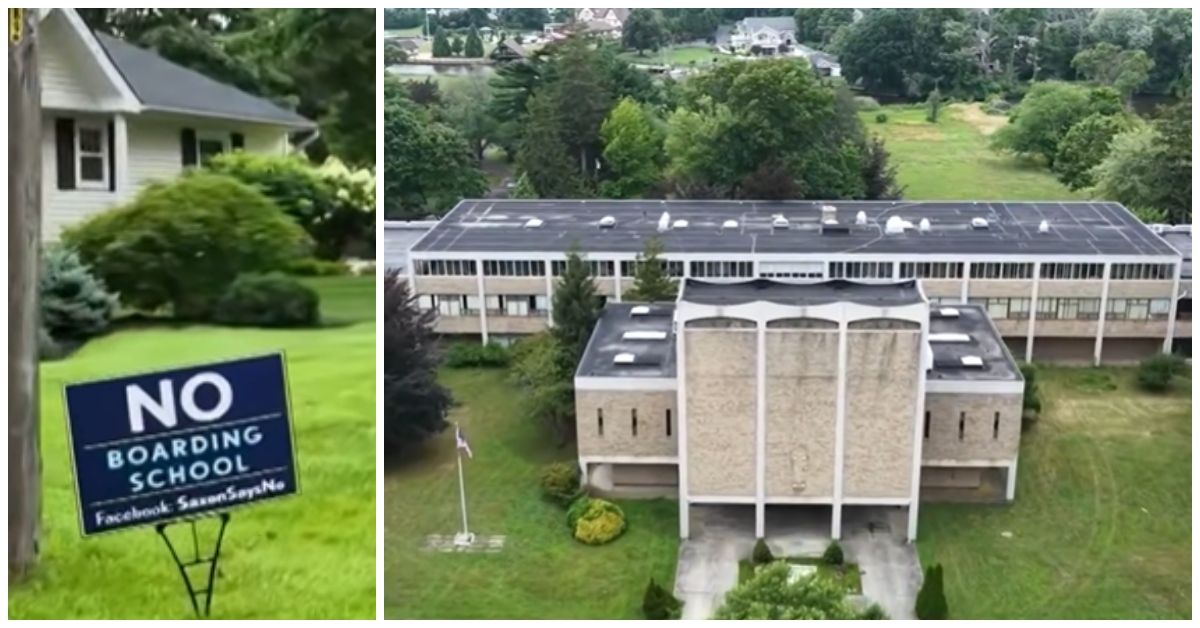
A waterfront property in Bay Shore that once housed a Catholic seminary has become the center of a furious zoning battle after a Muslim nonprofit purchased the sprawling campus and announced plans for an all-boys religious boarding school.
Hundreds of residents and supporters crowded into an Islip Town Zoning Board of Appeals hearing this week, where testimony continued for more than five hours over the proposed conversion of the former Montfort Spiritual Center at 26 South Saxon Avenue.
The United American Muslim Association purchased the roughly 73,000-square-foot building and surrounding property for approximately $5.2 million. The site spans between 13 and 14.6 acres, depending on the source, and previously operated as a Catholic boarding school before that program closed in 1972. It later served as a residence and retreat for Catholic priests.
MUST WATCH: Residents of Islip, Long Island, are SPEAKING OUT against a proposal to place an all-boys Muslim boarding school right in the middle of a residential neighborhood.
“The Muslim call-to-prayer is five times a day… It’s VERY VERY disturbing.” pic.twitter.com/iZ9yZSiLEn
— Libs of TikTok (@libsoftiktok) July 24, 2026
The association is promoting the property as the future home of Bayshore Academy.
According to the academy’s website, the campus is intended to offer:
“Full-time Islamic schooling”
It also lists:
“Qur’an education and memorization programs,” “Aleem and boarding programs,” “early childhood education / Islamic daycare,” “academic enrichment and STEM learning,” and “community programs, events, and youth development.”
The group describes the campus as:
“A hub where academic excellence meets a strong Islamic environment.”
Its plans also include dormitories, residential quarters, a mosque and prayer hall, large gathering areas, outdoor youth activities and space for community events. The organization says preparations are beginning “as soon as possible” so the property can become operational “without delay.”
That expansive description is precisely what has alarmed nearby homeowners.
Residents organized under the name Saxon Says No insist their opposition is rooted in land use rather than religion. They contend that housing approximately 120 middle- and high-school-aged boys, along with a daycare and community programming, would transform the intensity of activity on a quiet residential road.
Kevin Colgan, one of the residents leading the opposition, said:
“The proposed use by the new property owner is far more intensive than what is appropriate for a quiet residential neighborhood.”
Colgan stressed:
“This is about protecting the integrity of our zoning laws—not opposing any individual or organization.”
He added that zoning rules exist to preserve:
“The character, integrity, and quality of life within our neighborhoods while ensuring that land uses are appropriate for their surroundings.”
One resident, Anna Chan, told the zoning board that her family depended upon those protections when it bought a home across the street.
“When my family chose to purchase this home 10 years ago, we relied on the zoning protections when making one of the largest investments of our lives.”
She said they believed they were buying into:
“A community of single-family homes where the zoning was intended to preserve its residential character.”
Others focused on the practical realities of placing a large residential school in the neighborhood.
Isla Belkitis asked:
“A boarding school with the noise that 120 teenage boys can generate in a recreational area—would you want that in your backyard?”
CBS New York reported similar concerns from residents who fear students could be moving through the neighborhood and traffic could overwhelm Saxon Avenue.
“We don’t want 120 high school kids living here, roaming the area,” one opponent said.
Resident John Elmonuc warned:
“It’s gonna be too much traffic right here on the main road.”
David Cerpone compared the proposal with an earlier effort to build an assisted-living facility on the property—another plan residents opposed.
“They wanted to put a senior center here, and we didn’t want that due to the density and the more traffic and all the problems that came with it,” Cerpone said. “This is a boarding school. It has the same problems.”
That earlier assisted-living proposal envisioned 90 units on part of the parcel but collapsed following neighborhood opposition and a dispute with the town. Some portions of the former seminary property had already been sold decades ago for a 43-unit senior condominium community.
Supporters argue that the property’s history makes the academy a logical continuation of its longstanding religious and educational use.
UAMA member Erol Akyurek said the organization has helped teach children about their faith.
“Everything my kids know about their religion is because of them,” he told CBS New York. “They trained them.”
Akyurek dismissed suggestions that the proposed complex should frighten surrounding residents.
“They don’t need to be afraid of nothing. People come here to pray.”
He added:
“This is for our future generations. It’s good for kids.”
The Bay Shore Historical Society also told CBS New York that, in its view, the principal change would be the faith practiced at a site already associated with religious education.
The applicant’s attorney, Samuel Bifulco, has argued that the proposal is permissible under town law and that students would live under rules designed to prevent disruption. He described the organization’s goal as providing:
“Comprehensive spiritual and academic training of its students.”
The plan includes Islamic-centered schooling, early-childhood education and community programs.
Some zoning board members reportedly signaled during the hearing that the dormitory use could be legal because the property previously operated as a religious boarding school. But the board has not issued its final decision, leaving both sides waiting for the next step.
MY TAKE:
There are two extremely predictable ways this story will be distorted.
One side will scream, “Islamophobia!”
The other will see the word “Muslim” and stop reading before reaching the words “zoning application.”
Both reactions are intellectually lazy.
The people living around this property have every right to demand straight answers about traffic, noise, student supervision, daycare drop-offs, buses, parking, outdoor recreation, large religious gatherings and how 120 teenage boys will be managed on a campus planted in the middle of a residential neighborhood.
That is not bigotry. That is called owning a home.
These families paid Long Island prices—which means they probably surrendered several internal organs and their firstborn child to the mortgage company—because they believed zoning rules offered some assurance about what could suddenly appear across the street.
Then along comes a proposal featuring a boarding school, a daycare, a mosque, dormitories, community events, large gathering areas and youth programs.
That is not a minor change of scenery. That is a campus.
And the school’s own promotional material is not exactly whispering, “Don’t worry, nobody will notice us.” It boasts of a permanent educational center, expanded programs and long-term growth. They are already discussing fences, dormitories, classrooms, gathering spaces and getting the operation running “without delay.”
Without delay? The neighbors might appreciate a little delay. Perhaps enough time to answer a few questions before the bunk beds arrive.
Now, the applicants also have a serious argument. This property was once a Catholic boarding school. It has a long religious history. If the law permits one faith to operate a school there, the town obviously cannot decide a Muslim organization is disqualified simply because some residents dislike Islam. Religious liberty does not come with a denominational asterisk.
But prior use is not a magic wand.
A Catholic boarding school that closed in 1972 does not automatically establish that every proposed feature of a much larger 2026 operation must be approved without conditions. Long Island has changed just a little over the past 54 years. There may be a few more cars.
Does this specific proposal, at this scale, comply with the same zoning, traffic, safety and quality-of-life standards that would apply to a Catholic school, a Jewish school, an evangelical academy or the International Brotherhood of Tap-Dancing Atheists?
Same rules. Same scrutiny. Same rights. That is how this should work.
What residents should not accept is the familiar political trick in which legitimate zoning concerns are smothered under accusations of intolerance until everyone becomes too frightened to ask whether 120 teenage boys might create slightly more neighborhood activity than three retired priests tending roses by the waterfront.
And what opponents must not do is turn their zoning fight into a referendum on a religion.
Keep it on the facts.
How many students? How many employees? How many vehicles? What hours? What outdoor facilities? What supervision? What security? What events? What expansion plans? What guarantees will be legally enforceable after the school opens?
Put every answer in writing. Because once the first bus pulls in, the neighbors will discover that promises made at a zoning hearing are much easier to remember than they are to enforce.
DBS WIRE SOURCES:
- New York Post — Long Island residents fume over all-boy, Muslim boarding school in residential neighborhood
- CBS News New York — Proposed Islamic boarding school divides Long Island community
- News 12 Long Island — Future of proposed Islamic boarding school in Bay Shore remains uncertain after public hearing
- Long Island Business News — Muslim nonprofit acquires former Catholic seminary in Bay Shore
- Bayshore Academy — Bayshore Academy campus plans and proposed programs
- The Tide of Moriches & Manorville — United American Muslim Association proposes Islamic parochial school