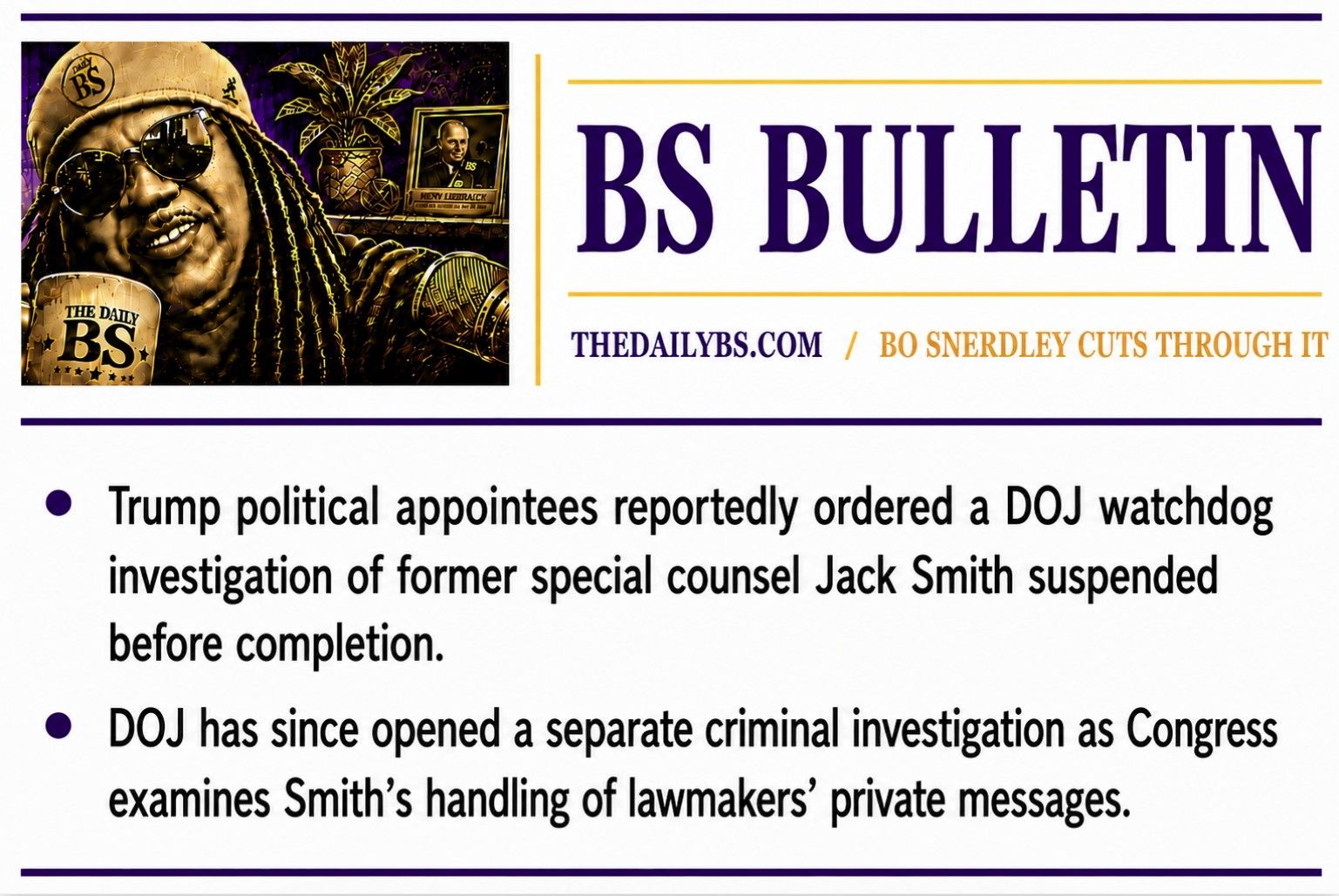
A long-running Justice Department watchdog investigation into former special counsel Jack Smith was reportedly suspended at the request of Trump administration political appointees—even as the department launched a separate criminal investigation into the prosecutor who brought two federal cases against President Donald Trump.
That is the central revelation in a new Reuters investigation examining severe staffing losses and declining investigative activity inside the Justice Department’s internal watchdog offices.
The Office of Professional Responsibility, known as OPR, began examining Smith’s conduct following allegations from Republican lawmakers that his prosecution of Trump was timed to affect the 2024 election and that his team improperly pressured a Trump aide to cooperate.
According to Reuters, OPR investigators interviewed Smith by the spring of 2025 and expected to finish their work that summer. More than a year later, there is still no completed report.
One person familiar with the investigation told Reuters that Trump administration political appointees asked for the inquiry to be suspended. Neither the Justice Department nor Smith’s spokesman would comment on the status of that investigation.
The precise reason for the suspension remains unknown. Reuters did not identify the officials who allegedly requested it, when the request was made or whether the decision was connected to the separate criminal investigation.
Suspending an administrative review while a criminal investigation proceeds could be intended to prevent the two inquiries from interfering with one another. But DOJ has not offered that explanation—or any explanation.
The unfinished OPR case is not the only investigation hanging over Smith. Reuters reported that the Justice Department has opened a separate criminal investigation into the former special counsel. Smith denies wrongdoing.
That criminal inquiry follows a July referral from House Judiciary Committee Chairman Jim Jordan, who accused Smith of making false statements to Congress about his office’s acquisition of communications involving members of Congress.
Newly disclosed Justice Department records show that Smith’s investigative team obtained and reviewed text messages exchanged between first-term Trump administration officials and 44 lawmakers—40 Republicans and four Democrats—during the investigation into challenges to the 2020 election.
The lawmakers included Sens. Chuck Grassley, Ron Johnson, Lindsey Graham, Cory Booker and Susan Collins, along with then-House members Kevin McCarthy, Steve Scalise, Jim Jordan, Adam Smith and Josh Gottheimer.
The text messages came from executive-branch devices preserved by the National Archives, not from searches of the lawmakers’ personal phones. But Republican investigators say Smith’s team directly accessed the material without first allowing a designated filter team to screen it for privileged communications.
According to a Justice Department summary released by Senate investigators:
“The Special Counsel’s investigative team apparently bypassed the filter team and directly accessed these text messages.”
Senate Judiciary Committee Chairman Chuck Grassley called Smith’s investigation a “runaway train that had no brakes.”
“Biden DOJ and FBI investigators apparently ignored their own routine investigative protocols.”
Grassley said lawmakers from both parties had been swept into Smith’s operation despite being outside the scope of the investigation.
“Smith’s team ran roughshod over the Constitution even after repeated warnings.”
Sen. Ron Johnson was equally blunt, calling it “another grotesque example” of the Biden administration’s weaponization of the Justice Department.
“Jack Smith’s team acted with impunity as they disregarded their own protocols.”
Johnson said Americans should be “outraged” that investigators obtained and examined communications involving dozens of elected lawmakers.
Jordan’s criminal referral centers on Smith’s testimony about congressional communications obtained during his Trump investigation.
Smith told lawmakers that his office sought telephone metadata, sometimes called toll records, from certain members of Congress. Those records can reveal when calls occurred and how long they lasted, but not the content of the calls.
Jordan argues that Smith’s testimony was misleading because his investigative team also reviewed the contents of lawmakers’ text messages found among presidential records obtained from the National Archives.
In his referral to the Justice Department, Jordan alleged there was “strong evidence” that Smith knowingly made false statements about the scope of his investigation.
Smith’s defenders say Jordan is conflating two separate collections of records.
Rep. Jamie Raskin, the top Democrat on the House Judiciary Committee, argued that Smith answered truthfully when asked whether subpoenas for lawmakers’ toll records sought the contents of their calls or messages.
“That statement was true when he said it, and it is true today.”
Raskin said Republicans never asked Smith whether messages from lawmakers appeared on phones or accounts belonging to Trump administration officials.
“Jack Smith could not have lied because Republican Members never even asked the question their theory is based on.”
Former prosecutors interviewed by CBS News also questioned whether Jordan’s referral demonstrates that Smith intentionally lied, a requirement for proving a criminal false-statements case.
That does not settle whether Smith’s team violated DOJ safeguards when it reviewed the messages. It does illustrate why the exact questions, answers and source of the records will be critical to any criminal case.
The suspended OPR review reportedly began well before the latest controversy over lawmakers’ text messages.
Republicans had accused Smith of manipulating the timing of his cases to damage Trump politically during the 2024 campaign. Sen. Tom Cotton separately requested an investigation into whether Smith violated the Hatch Act by using his official authority to interfere in an election.
The independent U.S. Office of Special Counsel confirmed in August 2025 that it had opened a Hatch Act investigation. That office is separate from Jack Smith’s former special counsel operation and separate from DOJ’s Office of Professional Responsibility.
Smith has consistently denied political motivations.
During congressional testimony, he defended his prosecutions and said Trump “willfully broke” the law. He maintained that the evidence—not partisan considerations—drove his decisions.
Smith secured indictments accusing Trump of conspiring to overturn the 2020 election result and improperly retaining classified documents after leaving office. Neither case reached trial.
Smith dismissed both prosecutions after Trump won the 2024 election, citing the Justice Department’s longstanding position that a sitting president cannot be criminally prosecuted.
DBS WIRE SOURCES:
- Reuters — At Trump’s DOJ, watchdogs gutted as misconduct complaints soar
- Senate Judiciary Committee — Smith team obtained messages involving 44 members of Congress
- House Judiciary Committee — Chairman Jordan’s criminal referral
- House Judiciary Committee Democrats — Raskin responds to Smith referral
- Justice Department — Office of Professional Responsibility 2025 annual report
- CBS News — Former prosecutors question Jack Smith criminal referral