BS BULLETIN
- Mayor Zohran Mamdani is suing to block a law giving roughly 25,000–26,000 NYC school paraprofessionals up to $10,000 each.
- The City Council passed the measure unanimously, and the UFT — the workers’ own union — supports it.
- The delicious political wrinkle: Mamdani supported the RESPECT Check idea before becoming mayor. Now he says compensation belongs at the bargaining table.
Well, New York, this is awkward.
Mayor Zohran Mamdani — democratic socialist, champion of working people, scourge of economic inequality and longtime enthusiast of government spending — has found a government expenditure he doesn’t like. A $10,000 payment to school workers.
Mamdani’s administration announced Wednesday that it is going to court to challenge New York City’s new RESPECT Check law, which provides up to $10,000 to public-school paraprofessionals during the 2026–27 school year. These aren’t Wall Street bankers getting retention bonuses. Paraprofessionals are the classroom aides who often work directly with special-needs students and perform some of the school system’s most demanding work for comparatively modest salaries. And their own union wants the money. So does the City Council. In fact, the Council passed the legislation unanimously in July. The measure had 47 co-sponsors — comfortably enough support to override a mayoral veto — and became law Wednesday without Mamdani’s signature. The United Federation of Teachers enthusiastically pushed for it. And now Mayor Mamdani is suing. You really couldn’t script this any better.
To be fair, Mamdani isn’t arguing that paraprofessionals deserve less money. His administration’s argument is that the City Council doesn’t have the legal authority to simply dictate compensation for unionized public employees because wages and benefits are supposed to be determined through collective bargaining. City Hall says the RESPECT Check violates New York’s Taylor Law, which governs labor relations between public employers and employees. Mamdani spokesman Matt Rauschenbach put the administration’s case this way:
“We will not allow the political process to replace the collective bargaining table.”
He argued that allowing elected officials to impose employment terms outside negotiations creates a dangerous precedent and said a one-time payment doesn’t fix the underlying salary problem. Mamdani himself was telegraphing this position before the lawsuit. Asked about the legislation in July, he praised paraprofessionals but said their compensation was “best treated at the bargaining table.” That’s a perfectly coherent labor-law argument. There’s just one tiny political problem. The union whose bargaining rights Mamdani says he’s protecting doesn’t want his protection.
UFT President Michael Mulgrew flatly rejected the mayor’s argument. “The City Council would not have introduced — let alone passed — this bill if it were illegal,” Mulgrew told The Hill, adding that the union itself wouldn’t support legislation that threatened its collective-bargaining rights.
That’s quite a pickle.
The mayor says: I’m protecting your union rights. The union says: Please stop protecting us and give our people the money.
City Council Speaker Julie Menin and Council Member Carmen De La Rosa aren’t backing down either. In a joint statement Wednesday, they said the legislation is both “the right thing to do” and “the fiscally responsible thing to do,” arguing that better compensation could help the city address its severe shortage of paraprofessionals. “The Council will vigorously defend the law,” they said.
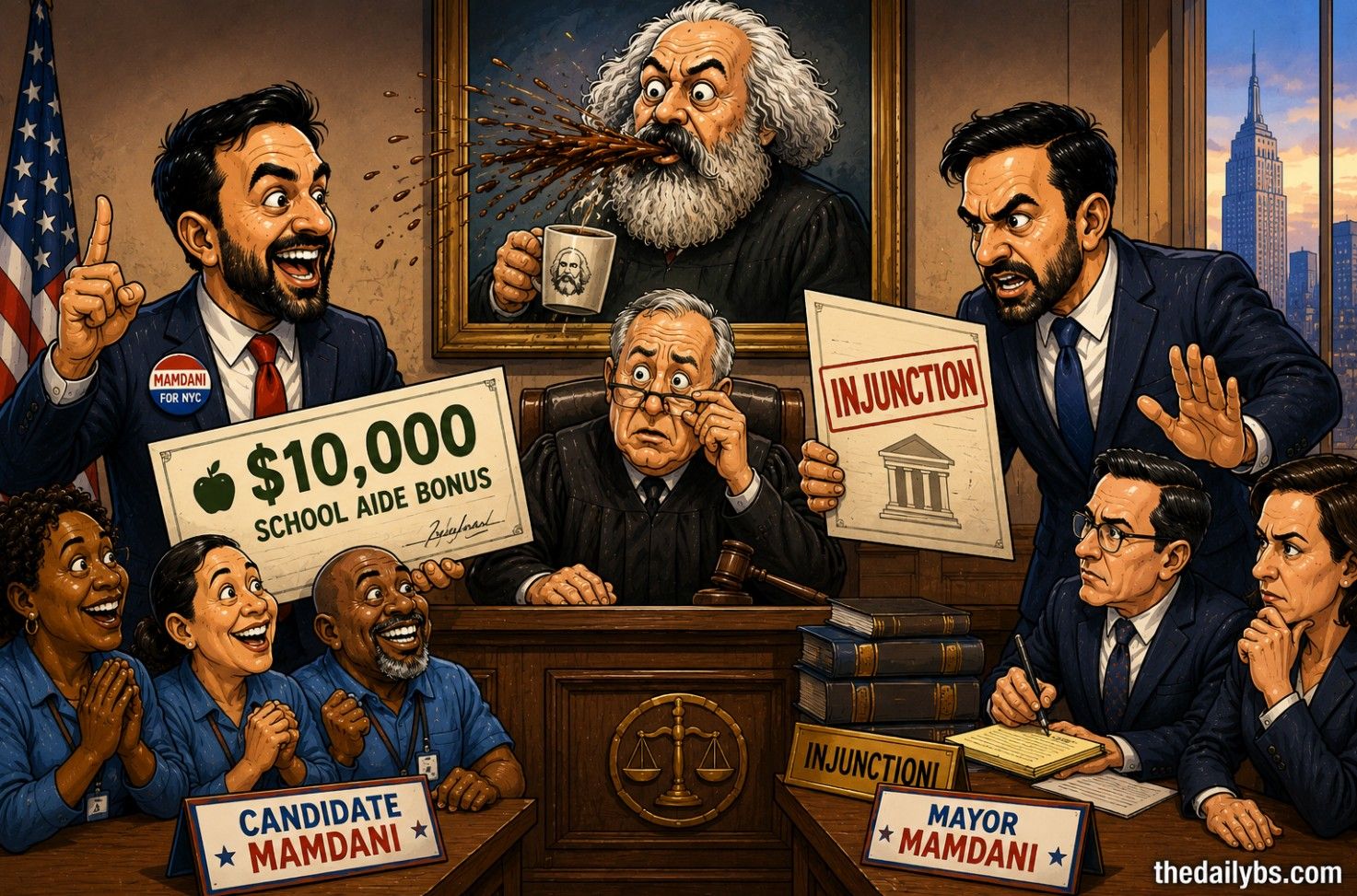
So now Mamdani isn’t battling Republicans, Donald Trump, landlords, billionaires or greedy corporations. He’s fighting the Democratic-controlled New York City Council and a teachers union. Somewhere, Karl Marx just spit out his coffee.
This is where the politics become particularly uncomfortable for Mamdani. The UFT says New York employs roughly 26,000 paraprofessionals, who have historically earned approximately $32,000 to $54,000 annually. During City Council testimony earlier this year, paraprofessionals described workers struggling to pay ordinary household expenses. Anthony Barnes of the union’s paraprofessional chapter told lawmakers:
“Imagine getting a check and you still can’t meet your bills.”
The union argued that the proposed $10,000 payment could make an enormous difference for workers living on those salaries. The final law provides payments of up to $10,000 for the 2026–27 school year, distributed in four installments and prorated based on how long an eligible employee remains on payroll. The administration estimates the program would cost roughly $324 million.
That’s real money.
Then again, this is New York City. The city can misplace $324 million somewhere between breakfast and the afternoon press conference. There’s another reason the union and Council aren’t treating this as some ceremonial bonus. New York’s schools are struggling to keep paraprofessionals. The UFT estimated last month that the school system had roughly 1,600 paraprofessional vacancies. The Council argues those shortages have consequences far beyond exhausted teachers and understaffed classrooms. Menin and De La Rosa point to the enormous amount New York spends resolving so-called Carter cases, in which families of special-needs students seek reimbursement for private educational services when the public-school system fails to provide appropriate services. The Council says those costs have reached approximately $1.5 billion.
Their theory is pretty simple: paying paraprofessionals enough to keep them working in city schools could cost taxpayers less than continuously dealing with the consequences of not having enough of them. Now we arrive at the part City Hall probably wishes would disappear.
Before he was Mayor Mamdani, Candidate Mamdani supported the RESPECT Check effort. The earlier proposal called for recurring annual payments rather than the one-year structure ultimately enacted. But Mamdani’s support wasn’t some obscure position dug out of a forgotten questionnaire. The UFT publicly celebrated it. The union wrote that it had been pushing aggressively for RESPECT Check legislation and specifically noted that “Mayor-elect Zohran Mamdani” had “pledged to support this bill when he takes office.”
That was then. This is now. Now Mayor Mamdani’s lawyers are trying to get it struck down. The administration argues that the legislation changed and that the current version undermines the collective-bargaining process. The mayor says his team is already negotiating with the UFT toward a permanent solution to paraprofessional compensation and staffing.
Perhaps. But politically, this is precisely the kind of before-and-after contrast politicians spend entire careers praying won’t wind up on a campaign commercial.
Candidate Mamdani: Give school aides more money!
Mayor Mamdani: Your Honor, we’d like an injunction.
The remarkable thing is how thoroughly this dispute scrambles the usual New York political alliances. You’ve got a democratic-socialist mayor invoking labor law to stop a compensation measure. You’ve got the teachers union defending a City Council workaround to collective bargaining. You’ve got a Democratic City Council telling a socialist mayor that he’s standing between low-paid school employees and thousands of dollars. And you’ve got Mamdani arguing that the responsible pro-labor position is actually to stop the checks and negotiate a permanent raise.
The administration does have a substantive point: a temporary $10,000 payment doesn’t permanently restructure salaries, and negotiated raises can become part of workers’ continuing compensation.
But the Council’s legislation anticipates that possibility. The program can disappear if a collective-bargaining agreement provides paraprofessionals an equivalent increase. Which means this courtroom battle isn’t really about whether these workers deserve better pay. Everybody involved says they do. They’re fighting over who gets to deliver it — and how.
- The Hill — Mamdani challenges City Council over $10,000 teachers’ aide bonuses
- New York Post — Mamdani sues to block new NYC law boosting teaching assistants’ pay by $10K
- Gothamist — Mamdani plans suit over law giving $10K bonus to NYC paraprofessionals
- Chalkbeat New York — NYC paraprofessionals’ $10,000 pay bump is now law. The Mamdani administration plans to sue.