

BS BULLETIN:
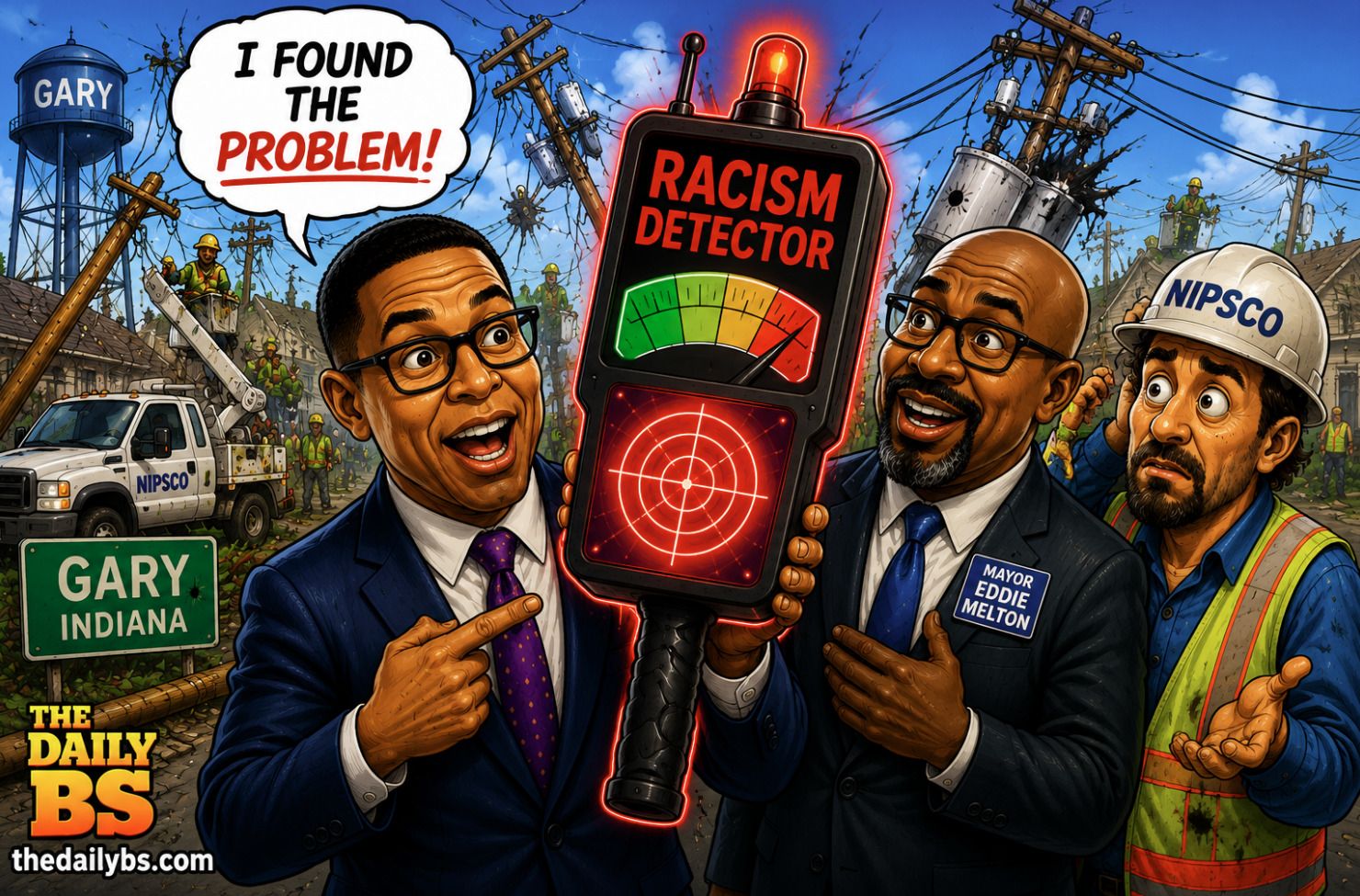
- Don Lemon suggested Gary, Indiana, was neglected after a massive blackout because the city is predominantly Black and working class.
- Mayor Eddie Melton told Lemon he agreed “100%.”
- Missing from that exchange: utility crews temporarily stopped work in one Gary neighborhood after gunfire struck a marked NIPSCO vehicle.
Gary, Indiana, has a serious problem.
Thousands of residents spent nearly two weeks without electricity after a brutal Aug. 11 storm devastated Northwest Indiana, knocking out power to more than 38,000 homes and businesses in Gary alone. That’s outrageous. Residents deserve answers.
But Don Lemon apparently already has one.
Race.
During an interview with Gary Mayor Eddie Melton, Lemon suggested the predominantly Black, working-class city was being neglected because of who lives there.
Melton agreed “100%,” according to the interview, saying communities of color are “typically” left behind during disasters like this. There is, however, quite a bit more to this story.
Just days earlier, Melton himself had delivered a rather different message. “I want to be clear, Gary has not been left behind,” the mayor said during an Aug. 19 press conference.
And when CNN asked Melton Tuesday what could explain the extraordinary delay, his answer was considerably more complicated than racism. “I don’t think we have a full explanation as of yet,” Melton said.
He pointed to the extraordinary storm itself, including winds reaching 99 mph, and acknowledged that the damage extended beyond Gary. “The entire northwest Indiana has been without power,” Melton said.
He also identified another enormous problem: Gary’s aging electrical infrastructure. Poles had been snapped in half, transformers destroyed and transmission lines damaged. “It’s going to take some time to repair and replace an entire grid for the city of Gary,” Melton told CNN.
That doesn’t mean NIPSCO gets a pass. Far from it. Melton has called the restoration pace “unacceptable,” and Indiana Gov. Mike Braun has ordered an investigation into NIPSCO’s preparedness, vegetation management and whether money approved for infrastructure and reliability improvements was actually spent as promised.
But there is another detail that tends to disappear when the story gets reduced to “racism.” Someone shot at the repair crews.
NIPSCO temporarily halted work in part of Gary after employees scouting damaged infrastructure came under gunfire. According to the utility, its marked Jeep was struck twice and one bullet lodged in a headrest. “We’ve paused work out there until the city and company get a plan in place [for our safety],” NIPSCO said at the time. The crews later resumed restoration work.
That doesn’t explain why Gary endured such an extraordinarily long outage. The shooting affected part of the restoration operation and shouldn’t become a convenient excuse for every failure that occurred during the response. But surely it belongs somewhere in a conversation about why repairing Gary’s electrical grid has been difficult.
There is also no question that Gary has suffered from decades of economic decline.
Once a booming steel town of roughly 180,000 people, Gary now has about 67,000 residents. More than three-quarters of them are Black, and roughly one-third of the city lives below the poverty line. Automation, foreign competition and the collapse of steel employment helped hollow out the city, while population flight devastated its tax base and left thousands of abandoned properties behind. Those are real problems with a long and complicated history.
But here’s what makes the instant “Gary is being ignored because it’s Black” narrative especially odd: Gary is currently receiving enormous public and private investment.
The city is undertaking an $80 million campaign aimed at eliminating thousands of abandoned buildings and rebuilding its downtown. U.S. Steel has begun investing $950 million in its Gary mill, while FedEx plans a 300,000-square-foot distribution center expected to create 600 jobs. Gary also secured a $15 million state READI grant that, combined with other funding, is part of a redevelopment package exceeding $64 million.
In other words, there is a serious story here about whether a utility failed one of Indiana’s poorest cities. There is a serious story about aging infrastructure.
But “the city is Black, therefore racism” isn’t an investigation.
It’s a conclusion looking for evidence.
MY QUICK TAKE
Two weeks without electricity? I’d be furious too.
Investigate NIPSCO. Find out why the restoration took so long. Find out whether the utility maintained the infrastructure properly. Find out whether Gary received fewer resources than comparable communities and, if it did, find out why.
That’s called asking questions.
But Don Lemon skipping ahead to “Black and working class” while leaving out inconvenient details is something else.
And here’s the strangest part.
Mayor Melton actually has a pretty compelling case to make without playing the race card.
Gary got clobbered by a historic storm. Its infrastructure is old. Thousands of residents are poor. The utility’s response clearly deserves scrutiny.
Those facts are powerful enough.
Why cheapen them by pretending you’ve proven something you haven’t?
DBS WIRE SOURCES:
- Twitchy — Mayor agrees with Don Lemon that Gary is being neglected because it’s Black and working class
- Associated Press — Some homes and businesses in Gary still without power 13 days after storms
- CNN — Gary mayor discusses two-week power outage and restoration delays
- Wall Street Journal — Gary, Indiana, wants a comeback. Step one: Demolish a chunk of downtown
- U.S. Census Bureau — Gary, Indiana QuickFacts












How could it possibly be “black” and “working class” at the same time!?