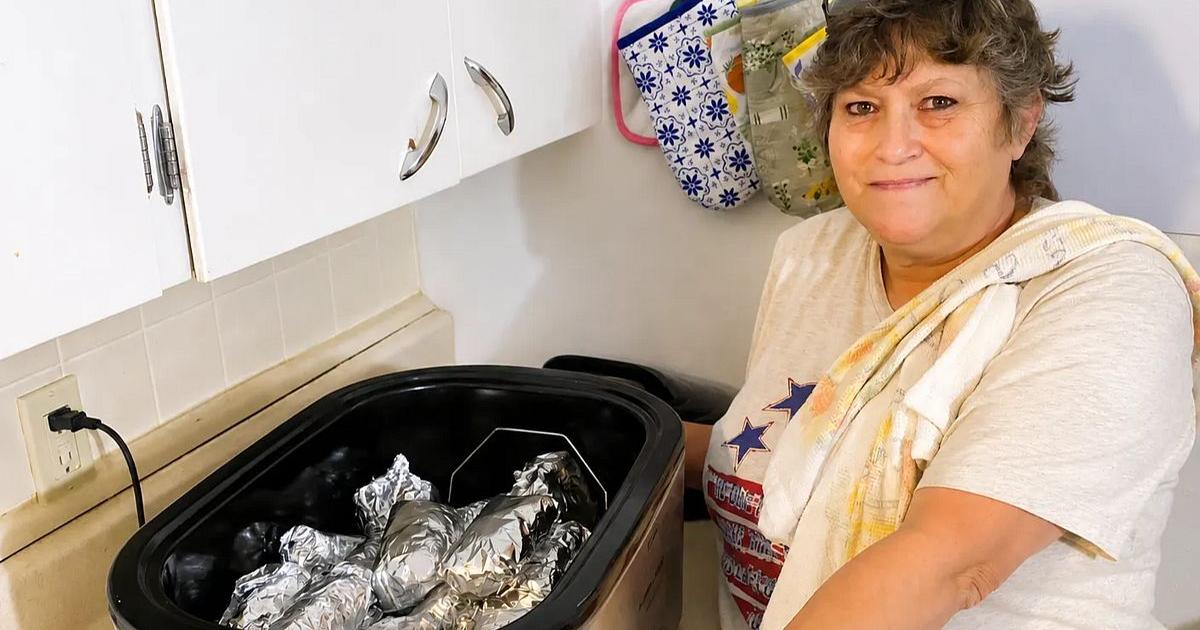
Small-town Missouri resident Kathy Kite stands by a large crockpot full of breakfast burritos, available to friends, neighbors and passersby for free. Photo: Courtesy of Ryan Mills / Used with Permission
(The Center Square) – A local Missouri health department has told Kathy Kite, a grandmother who serves free breakfast to her neighbors from her home, that she will face legal action if she continues doing so without a permit.
That letter came in July, and Kite has continued to serve breakfast since. Think tank and public interest law firm the Goldwater Institute has taken up her cause.
“Citizens should not be required to get the government’s permission before offering passers-by some coffee and a bite to eat while they socialize,” Dave Roland, the Institute’s Director of Allied Litigation, told The Center Square in a statement.
Breakfast at Kite’s started as a joke back in May. The local gas station had stopped serving breakfast, and when Kite asked one of the owners about it, he goaded her into making some at her house, sending some locals her way.
“I said, OK, come on over, guys. I’ll make you breakfast,” Kite said, recounting the story. “So the next morning, I got up at like 4 o’clock in the morning because they come at like five.”
It grew from there.
Now she makes 20-25 servings – which Kite noted usually amounts to about eight to 10 people, who often take some for their families – six days a week, and she does it all free of charge. She keeps a jar out where people can donate, but donations are entirely voluntary. Kite said her parents taught her to take care of those in need.
“My mom and dad were raised in the Depression, and so we were raised hearing the stories of how they went hungry,” Kite told The Center Square. “My mom once told me, she said, ‘You never know when you’re entertaining an angel. So if someone comes to your door, you welcome them in, and you give them something to drink. If they’re hungry, you feed them.’”
But the local health department received an anonymous complaint that claimed Kite’s food had made people sick and that her home was “very dirty and she had a lot of cats that made it unsanitary.”
Kite says she doesn’t have any cats and is not aware of her food having made anyone sick. Kite said her daughter owns a cleaning company and also helps Kite clean her home.
The Columbia/Boone County Department of Public Health and Human Services sent Kite a letter in July threatening legal action if she continued providing free breakfasts to community members without a permit or a commercial kitchen, which would likely require tens of thousands of dollars to install.
“A complaint has been issued for [Kite’s address.] The resident is allegedly serving items that are not approved under cottage law, making the business subject to inspection. Therefore, you are currently in violation of The City of Columbia Food Code numbers 8-301.11,” the letter states.
It goes on to cite the code.
“A person shall not operate a food establishment without a valid permit to operate issued by the regulatory authority.”
Under Missouri law, people are allowed to sell foods approved under cottage law – like baked goods and canned jams – but the law doesn’t seem to differentiate between those supplying unapproved foods for free or for sale.
The Center Square asked the department whether that included family and friends one might have over for dinner.
“It is not illegal to serve food to family and friends. Food establishments are required to have a permit,” wrote Austin Krohn, a spokesperson for the department, in response. “At the time the first complaint was received, Ms. Kite’s home had an open sign, tip jar, advertised food on social media and a sign in her yard – all things typically associated with a food establishment.”
Kite claims she bought the open sign to let people know when they could come by.
The Goldwater Institute says that food codes across the country fail to clearly distinguish between commercial food establishments and noncommercial food service. According to the department, the framework for the current food code was established in 1962, and state policies were in place before then.
“The model food code that’s been adopted over and over all over the country is written so broadly that it can indeed be applied outside of commercial contexts,” Roland said on a local radio show.
This has led to other instances where charitable people and organizations have come into conflict with health departments. In some cases, health departments have bleached unpermitted food. Roland also defended a St. Louis pastor who served food to the homeless for roughly 40 years before his ministry came under fire by local health officials.
This case is different even than those, Roland notes, because Kite is serving people in her own home.
“Americans have always embraced the virtue of opening their homes and tables to friends, family, and even strangers – and there has never been a need to get the government’s permission to engage in this sort of hospitality,” Roland told The Center Square.
Roland argued in a letter to the Columbia/Boone County health department submitted Thursday that Kite’s right to provide free food in her home stands on legal precedent set by the Supreme Court and that Missouri’s food code may violate both the state and federal Constitutions.
The letter gives the department until Friday, Aug. 28, to respond. If it holds its ground, the Goldwater Institute says it may file a lawsuit.