BS BULLETIN:
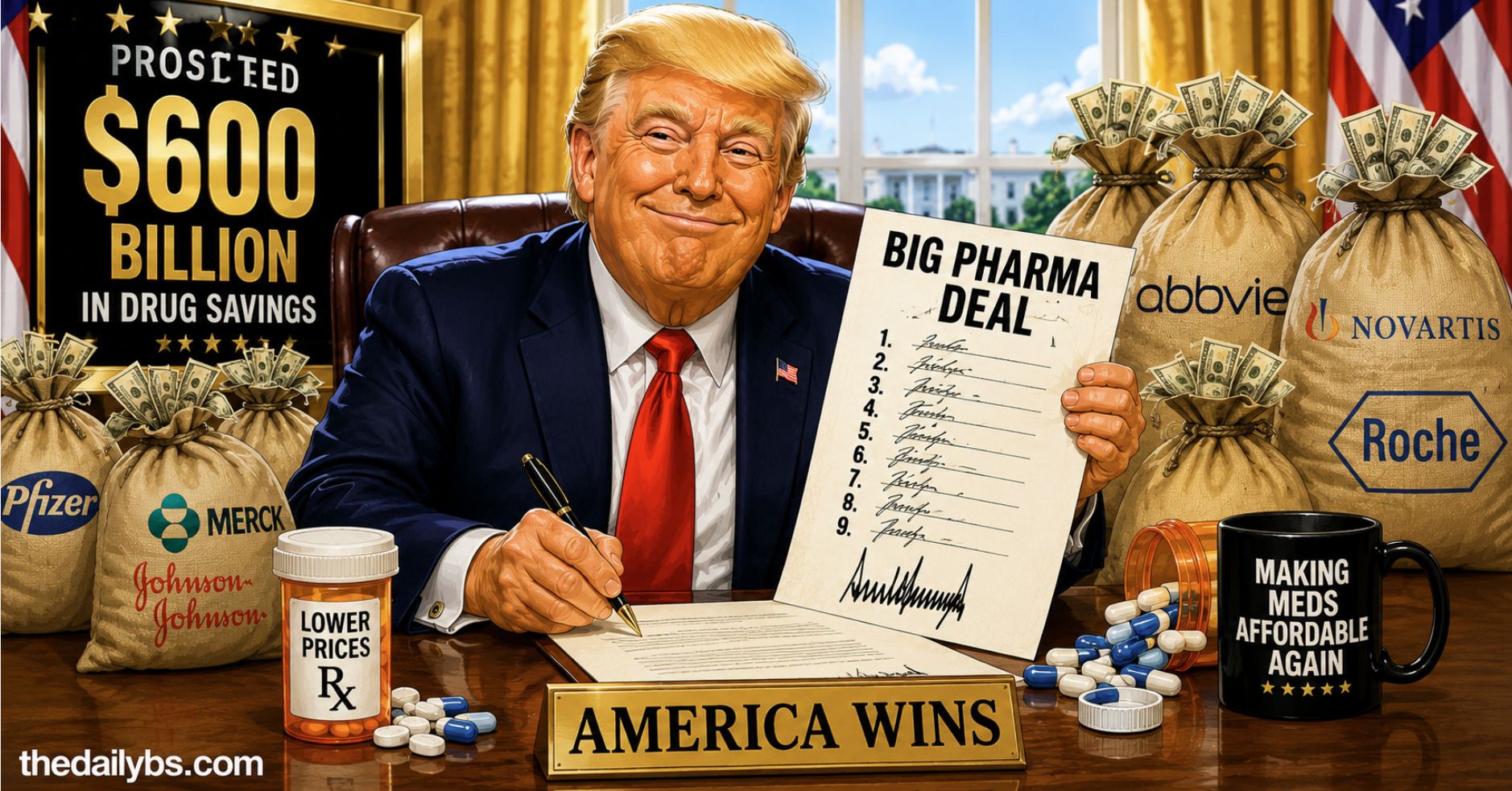
- President Trump announced agreements with nine more pharmaceutical manufacturers to bring U.S. prescription prices closer to the lowest prices paid in other developed countries.
- The administration now has Most-Favored-Nation agreements with 26 drugmakers covering 89% of America’s branded-drug market, with the White House projecting roughly $600 billion in savings over the next decade.
- The nine companies also committed at least $19.6 billion to U.S. manufacturing, while several will contribute pharmaceutical ingredients to a new strategic reserve intended to reduce America’s dependence on foreign suppliers.
President Trump says Americans have spent enough time playing sugar daddy to the world’s prescription-drug market.
Nine more pharmaceutical manufacturers have now agreed to Trump’s Most-Favored-Nation pricing initiative, dramatically expanding one of the administration’s biggest healthcare gambles.
“Our most favored nations’ discounts represent the largest reduction in prescription drug prices in the history of our country,” Trump declared from the Oval Office Monday.
He called the latest agreements a “major step forward.”
And this isn’t a tiny corner of Big Pharma anymore.
The nine companies joining the initiative are Alcon, Astellas Pharma, BeOne Medicines, BridgeBio, CSL, Kyowa Kirin, Sun Pharma, Teva Pharmaceuticals and UCB.
Add them to the 17 manufacturers that previously struck agreements with the administration and Trump now has 26 companies participating.
According to the White House, they represent 89% of America’s branded-drug market.
The basic Trump argument is wonderfully uncomplicated: Why should Americans pay substantially more for the same medicine than somebody living in Europe?
According to a 2024 RAND study cited in coverage of Monday’s announcement, U.S. prescription-drug prices averaged nearly three times those in comparable countries.
Trump put the imbalance another way Monday. The United States accounts for about 13% of global prescription-drug consumption, he said, while generating roughly 75% of pharmaceutical-company profits.
That’s quite a tip.
Trump’s Most-Favored-Nation system is designed to change the equation by tying U.S. prices to the lower prices drugmakers offer in other wealthy countries.
And there are several different pieces to these agreements. The nine newest manufacturers will make their drugs available to every state Medicaid program at Most-Favored-Nation prices. They’ve also agreed that new medicines they launch will be priced under the MFN system.
Some discounted medications will be available directly to consumers through TrumpRx, the administration’s online prescription marketplace.
The drugs covered by the new agreements treat some decidedly non-trivial conditions:
- Cancer.
- Parkinson’s disease.
- Hemophilia.
- Macular degeneration.
- Glaucoma.
- Liver disease.
- Skin disorders.
- And other chronic and rare illnesses.
Then there’s the number guaranteed to get everybody’s attention. $600 billion.
Trump said Monday that the agreements are projected to save Americans more than $600 billion.
The administration isn’t claiming $600 billion magically appears in patients’ checking accounts tomorrow morning. The White House Council of Economic Advisers estimates Trump’s MFN framework will generate approximately $600 billion in savings over the next decade.
Its May analysis breaks that projection down further.
The largest component — about $529 billion — comes from expected savings on future medicines launched under MFN pricing across U.S. markets. Another estimated $64.3 billion comes from putting existing medicines into state Medicaid programs at MFN prices.
Then there are direct-to-consumer savings through TrumpRx. The White House says Americans have already saved more than $700 million using TrumpRx since the website launched in February.
In July, seniors without obesity-drug coverage became eligible for GLP-1 medications for $50 per month. The administration says more than 500,000 seniors have used that program in two months, collectively saving about $216 million.
The latest agreements aren’t only about prices. The nine companies committed at least $19.6 billion collectively toward manufacturing in the United States. Several are also donating substantial quantities of active pharmaceutical ingredients to America’s Strategic Active Pharmaceutical Ingredients Reserve.
Teva, for example, is contributing ingredients used to manufacture an antibiotic and a blood-pressure medication.
Sun Pharma is contributing ingredients for antibiotics.
UCB is contributing 163 tons of an ingredient used in an anticonvulsant medication.
The idea is to make America less dependent on foreign countries for critical medicine if a war, pandemic or other emergency disrupts the supply chain.
MY QUICK TAKE
There are complicated healthcare policies.
This isn’t one of them.
If an American and a German walk into two pharmacies carrying prescriptions for the same drug, made by the same company, in the same dosage, explaining why the American should pay two or three times more requires some mighty creative economics.
Trump’s answer is basically:
Knock it off.
Will these deals actually produce the full $600 billion the White House projects?
We’ll see.
But getting 26 drugmakers representing nearly 90% of the branded-drug market to sit at the table is considerably more interesting than another Washington speech promising that someday, somehow, somebody is going to make prescriptions cheaper.
Now comes the only number that ultimately matters: What Americans actually pay at the pharmacy counter.
DBS WIRE SOURCES
- New York Post — Trump unveils more prescription drug pricing discounts projected to save Americans $600B: ‘Major step forward’
- The White House — President Donald J. Trump Announces Deal with Nine Additional Pharmaceutical Manufacturers to Lower Drug Prices for Americans
- CBS News — Trump announces deal with 9 new pharmaceutical firms in move to ease drug costs
- The Washington Post — Trump touts new drug-price deals, seeking a midterm edge
- FactCheck.org — Trump Claims Credit for Drug Price Decline. Experts Say It’s More Complicated.