BS BULLETIN:
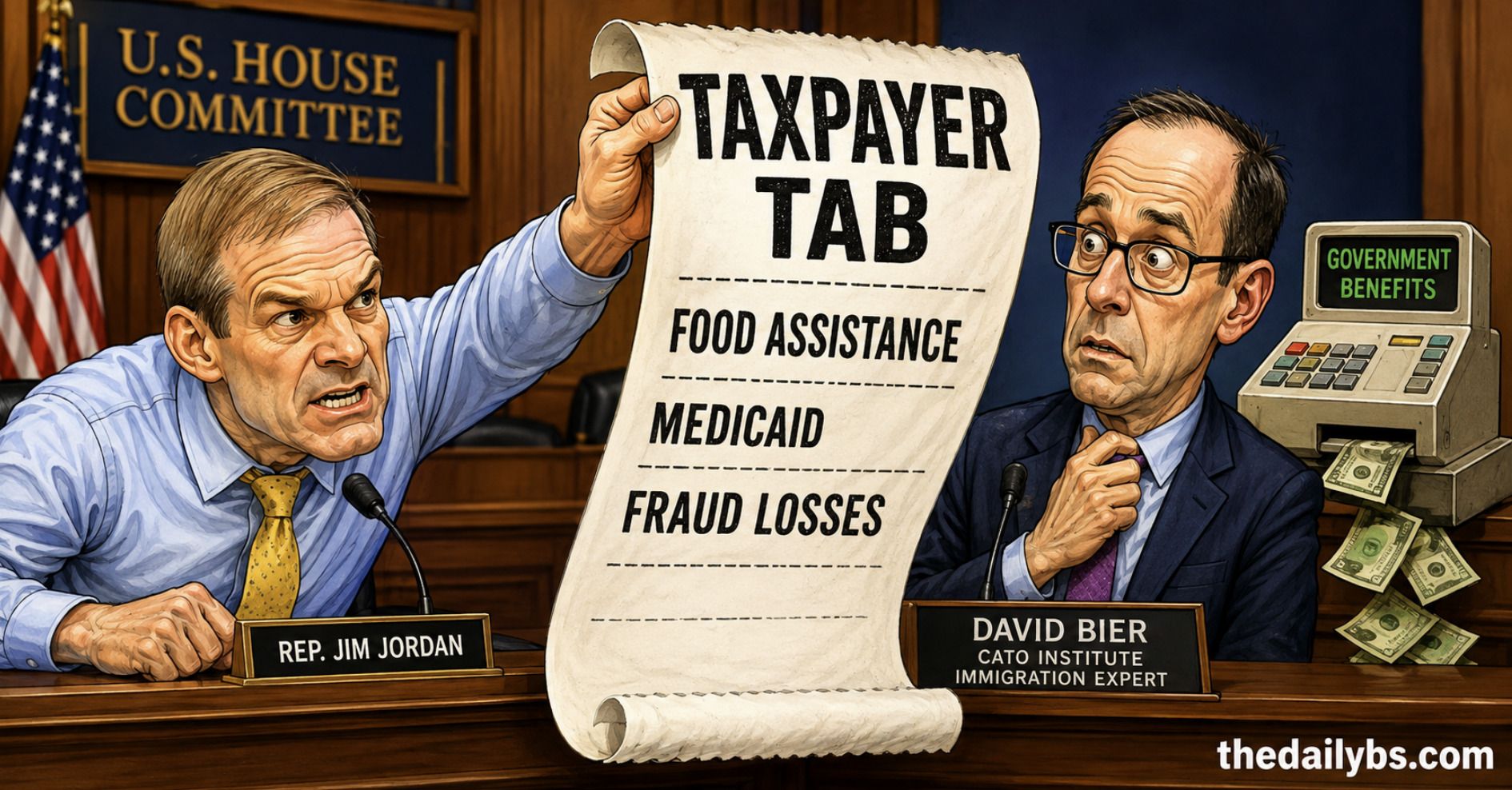
- Rep. Jim Jordan confronted Cato Institute immigration expert David Bier with figures showing heavy reliance on government assistance among Minnesota’s Somali community.
- Bier acknowledged that public assistance itself does not benefit the country, but argued that immigrants who work and contribute do.
- Jordan pointed to Minnesota’s sprawling fraud scandals and accused immigrants involved in the schemes of “ripping off the taxpayer.”
Rep. Jim Jordan came armed with numbers Tuesday, and an immigration expert testifying before Congress soon found himself conceding the Ohio Republican’s central point.
The heated exchange unfolded during a House Judiciary subcommittee hearing on sanctuary policies and their consequences for American communities.
Jordan challenged David Bier, the Cato Institute’s director of immigration studies, over a sweeping statement in his written testimony.
“People — whatever their ancestry, background, or birthplace — can benefit the United States,” Bier had written.
Jordan then turned to Minnesota’s Somali population.
“How many Somalis are in the state of Minnesota?” Jordan asked.
“Tens of thousands. I don’t know,” Bier replied.
“Forty-two thousand,” Jordan said before running through a series of public-assistance figures.
According to Jordan, 54 percent receive food stamps, 73 percent receive Medicaid and 89 percent receive some form of government assistance.
Bier disputed neither the broader picture nor the high level of assistance.
“It’s not a pop quiz,” he said after Jordan asked about the Medicaid figure.
Jordan returned to Bier’s claim that people of every background benefit the country and asked whether such extensive reliance on taxpayer-funded assistance qualified as a benefit.
Bier responded by turning the criticism back on Congress.
“You could have gotten rid of welfare for immigrants, and I supported that,” Bier said.
“The public assistance doesn’t,” Bier continued when asked how the spending benefits the United States. “The people working, contributing — so get rid of the public assistance! I support getting rid of the public assistance! You are the ones voting for bills that fund the public assistance for them!”
Jordan pressed him again.
“Giving them money does not benefit the country,” Bier finally stated. “Them working and contributing benefits the country.”
That distinction did not satisfy Jordan, who shifted from legal assistance programs to the fraud scandals that have engulfed Minnesota.
The state has faced investigations involving Medicaid, housing programs, child nutrition funding and other taxpayer-supported services. Federal prosecutors have already charged scores of defendants in the massive Feeding Our Future case alone.
“They’re engaging in fraud,” Jordan said. “They’re ripping off the taxpayer.”
“And you say that’s a benefit to the country,” he added.
Bier continued to defend the broader economic contributions made by immigrants, declaring that “people of all types benefit the country.”
But Jordan’s narrower question remained unanswered: How do taxpayers benefit when government programs become a source of long-term dependency — or a target for industrial-scale fraud?
Bier himself had already supplied the most direct answer of the hearing.
They don’t.
MY QUICK TAKE
Legal status, ethnicity and immigration policy can all be debated. Stealing taxpayer money cannot.
Jordan cut through the academic talking points and forced a basic concession: Working and contributing can benefit America. Collecting government assistance is a cost, and defrauding those programs is a crime.
Washington can argue about everything else after it stops the bleeding.
DBS WIRE SOURCES
- Jim Jordan throws down with immigration expert in tense hearing clash: ‘They’re ripping off the taxpayer!’ — Mediaite
- House Judiciary hearing: “Sanctuary Policies, Tragic Consequences” — House Judiciary Committee
- Written testimony of David J. Bier — House Judiciary Committee
- Somali immigrants in Minnesota — Center for Immigration Studies
- Medicaid run amok: Minnesota’s mounting public-assistance fraud crisis — Center of the American Experiment