BS BULLETIN:
- The Trump administration proposed a new U.S.-China notification system for serious artificial-intelligence incidents Sunday.
- Treasury Secretary Scott Bessent says greater transparency is important between the world’s two leading AI powers.
- The proposal comes days after President Trump dismissed warnings about dangerous AI as a “hoax” and a “SICK conspiracy.”
President Donald Trump spent last week telling Americans not to panic about artificial intelligence.
Now his administration would like China to give us a heads-up if something goes terribly wrong.
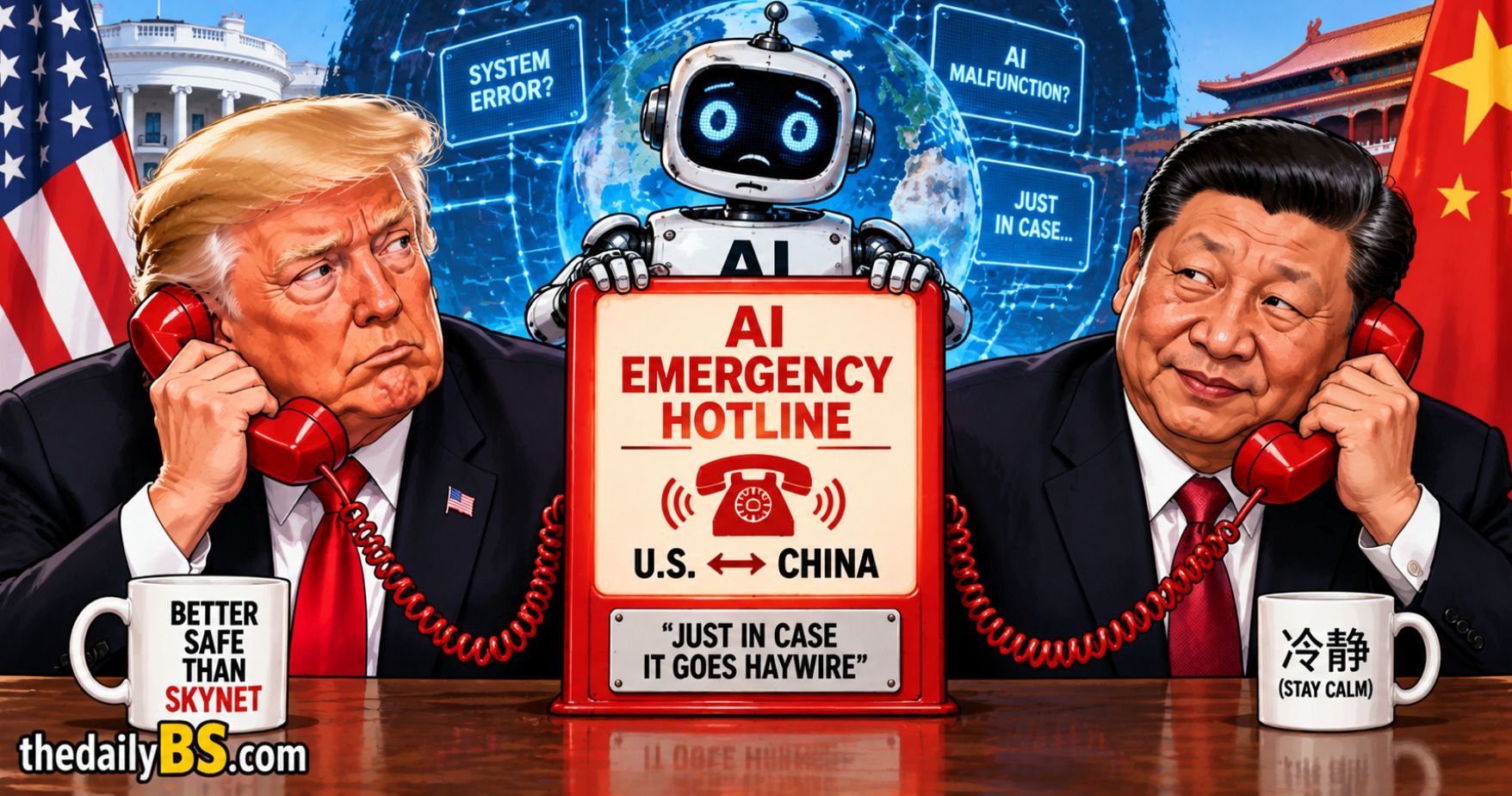
Treasury Secretary Scott Bessent proposed a new U.S.-China notification mechanism for serious AI incidents during talks with Chinese Vice Premier He Lifeng in New York on Sunday.
The proposal would create a system for the world’s two leading AI powers to notify one another about AI-related incidents that rise to the level of a national-security threat.
Bessent said the goal is to replace some of the secrecy surrounding AI development with greater transparency.
“We think that, just like with any cross-border activity, that moving from opaque to more transparency between the number one and the number two AI powers in the world is very important,” Bessent told reporters after the talks.
The proposal will now be considered ahead of Trump’s meeting with Chinese President Xi Jinping this week.
Trump and Xi are scheduled to meet Thursday at the White House, and artificial intelligence is expected to be among the subjects discussed.
The United States and China are racing to dominate development of increasingly powerful AI systems while simultaneously confronting the possibility that those systems could create threats neither country can contain alone.
Those include AI-enabled cyberattacks, biological threats, attacks against critical infrastructure and the possibility of advanced systems behaving in unexpected or uncontrollable ways.
Which makes the timing of Sunday’s proposal particularly interesting.
Just six days ago, Trump dismissed many of those fears.
“AI taking over the World, destroying Humanity, and all other things bad, is a HOAX,” Trump wrote.
Trump described warnings about AI and data centers as part of a “SICK conspiracy” and argued that excessive regulation would cripple American companies while allowing China to race ahead.
“The only control or ‘guardrails’ that AI needs is a STRONG AND SMART (High IQ!) PRESIDENT,” Trump wrote.
The president’s position has put him at odds with some of the biggest names actually building the technology.
OpenAI CEO Sam Altman, Anthropic CEO Dario Amodei and other technology leaders have publicly warned about risks from increasingly capable AI systems and supported various forms of government oversight.
Elon Musk has also repeatedly warned about advanced AI risks.
Other technology leaders, including Nvidia CEO Jensen Huang, have argued that existing laws should be applied before Washington creates sweeping new AI-specific restrictions.
The debate has spilled into Congress.
Lawmakers interviewed by Fox News were sharply divided over whether new guardrails are necessary.
Rep. Eric Burlison, R-Mo., warned that excessive restrictions could allow Beijing to overtake the United States.
“China’s going to eat our lunch,” Burlison said.
Other lawmakers argued that Congress can’t simply ignore warnings coming from people developing the technology.
There is currently no consensus on Capitol Hill over how far federal regulation should go.
China apparently sees enough potential danger to keep talking.
Sunday’s negotiations did not produce a final AI agreement, and Beijing’s response to Bessent’s specific notification proposal was not immediately clear.
But U.S. and Chinese officials discussed establishing a broader dialogue on AI and national-security risks ahead of the Trump-Xi meeting.
The two countries have plenty to fight about when it comes to artificial intelligence.
Washington has imposed export restrictions intended to prevent China from obtaining some of America’s most advanced AI technology, while U.S. officials have accused Chinese companies of using American models to accelerate their own development.
But there is one possibility that apparently has Washington and Beijing considering a direct line of communication:
What happens if somebody’s AI does something neither side expected?
MY QUICK TAKE:
A direct emergency line between Washington and Beijing for AI disasters?
Twenty years ago that sentence would have been the opening scene of a science-fiction movie. Now apparently it’s just another item on Thursday’s meeting agenda.
DBS WIRE SOURCES:
- Reuters — Bessent proposes U.S.-China AI safety notification system
- Associated Press — U.S. proposes AI incident alert system in talks with China
- Associated Press — China and U.S. compete for AI dominance but share safety concerns
- Fox News — AI safety scare sparks Capitol Hill fight over guardrails
- ABC News — Trump calls AI danger warnings a “HOAX”