*fictional depiction
BS BULLETIN:
- Tennessee grandmother Angela Lipps is suing Fargo, North Dakota, and a police detective for $10 million after spending months behind bars for bank thefts she didn’t commit.
- A facial-recognition search had identified Lipps as a potential lead, but her lawsuit alleges police treated the result as a positive identification without adequately corroborating it.
- Lipps says she’d never been to North Dakota — and bank records ultimately showed she was more than 1,000 miles away when the crimes occurred.
The computer found its suspect. There was just one rather substantial problem.
It had the wrong woman.
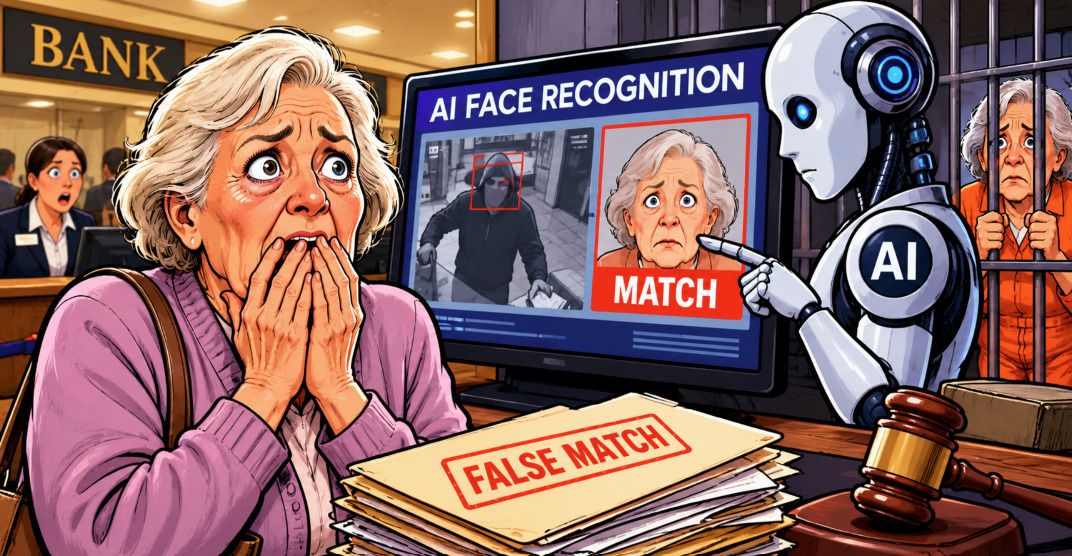
Angela Lipps, a 50-year-old Tennessee grandmother, is suing the city of Fargo and a police detective for $10 million after a facial-recognition lead helped send her into a nightmare that lasted for months.
U.S. Marshals arrested Lipps at gunpoint in July 2025 while she was babysitting four children. Authorities believed she was connected to a series of North Dakota bank thefts in which a woman allegedly used fake identification to withdraw tens of thousands of dollars.
Lipps faced eight felony charges. And according to her lawsuit, the investigation that eventually put her behind bars started with facial-recognition technology.
Police investigating the thefts had an image from a fraudulent ID allegedly used by the suspect. A facial-recognition search identified a social-media photograph of Lipps as a possible match.
Here’s where the distinction becomes awfully important. Facial-recognition results are supposed to be investigative leads — not magic computer declarations that say, “Yep, that’s her.” Lipps’s lawsuit alleges that distinction effectively disappeared. She claims police moved forward despite glaring evidence that she wasn’t the woman they were looking for.
For starters, Lipps says she had never been to North Dakota.
The actual suspect captured on bank surveillance footage allegedly had a different build and different facial features.
Lipps also has a neck tattoo. The woman in the surveillance footage apparently didn’t. According to the lawsuit, investigators didn’t conduct photo lineups with the bank tellers before Lipps was arrested and didn’t adequately investigate her travel or financial records.
Lipps was in Tennessee when the crimes occurred. She spent 108 days in a Tennessee jail before eventually being transported to North Dakota, according to her complaint. Once there, she was held on $100,000 bond while facing charges that could have put her in prison for years.
Eventually, Lipps and her attorney produced bank records showing she was back home in Tennessee at the time of the alleged North Dakota thefts.
Prosecutors dismissed the charges on Christmas Eve. By then, according to the lawsuit, Lipps had lost her residence, her car and other personal property while sitting behind bars. She alleges she was released in Fargo in bitter winter weather with virtually no money and no way to get home.
Fargo officials have previously acknowledged that mistakes were made during the investigation.
At a March press conference, Mayor Tim Mahoney said that when the police chief discovered errors involving how facial recognition had been used, officials addressed them.
Lipps now wants a jury to decide whether that is anywhere close to enough.
Her lawsuit alleges false arrest, imprisonment and malicious prosecution and accuses the Fargo Police Department of failing to adequately train and supervise officers using facial-recognition technology.
The city has declined to comment on the pending litigation.
MY QUICK TAKE
This isn’t really a story about evil AI. The computer didn’t put Angela Lipps in jail. People did.
A facial-recognition system can say two faces might match. Fine. That’s a lead. Then a human being is supposed to do something positively revolutionary: Investigate.
According to this lawsuit, a woman spent months behind bars before somebody finally got to the rather basic question of where she actually was when the banks were robbed.
We keep hearing that AI is going to replace human beings.
Apparently the more immediate danger is human beings deciding the AI means they don’t have to do their jobs.
DBS WIRE SOURCES:
- Fox News — Grandmother sues after alleged AI facial recognition error led to months in jail, experts sound alarm
- ABC News — Grandmother falsely accused of bank theft after alleged AI facial recognition match sues for $10 million
- Fox News — Facial recognition jails innocent grandmother, attorney says