BS BULLETIN:
- Chuck Schumer has repeatedly said lowering costs is Democrats’ central issue heading into the midterms.
- The House passed the Ratepayer Protection Act 417–3, with overwhelming support from both parties.
- Schumer says the bill is too weak because states would be required to consider its standards, not automatically impose them.
Senate Minority Leader Chuck Schumer has spent much of 2026 making one promise unmistakably clear.
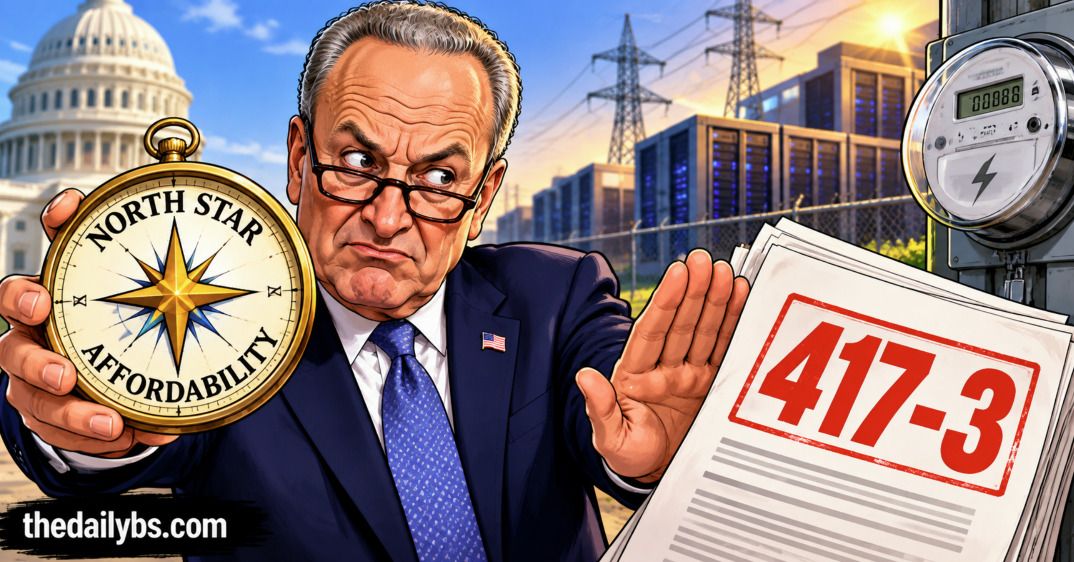
“Lower costs are going to be the North Star now and through all of 2026,” Schumer said in January while laying out Democrats’ midterm agenda.
Now one of Washington’s fights over lowering electricity bills has produced a rather awkward argument over what exactly counts as doing something.
The House overwhelmingly passed the Ratepayer Protection Act earlier this month, 417–3. The legislation is aimed at preventing ordinary utility customers from getting stuck with infrastructure costs created by massive new data centers.
Sen. Jon Husted, R-Ohio, is pushing the legislation in the Senate.
His pitch is simple:
“If you create the cost, you should pay the cost.”
Under the measure, state utility regulators would have to consider standards requiring extremely large electricity users — including data centers demanding 100 megawatts or more — to cover the incremental cost of generation, transmission and distribution upgrades needed to serve them. Companies could also be required to provide financial assurances so ratepayers aren’t left holding the bill if a project disappears.
That “consider” language is at the heart of the Democratic objection.
Schumer was asked why Democrats would not support the bill.
“Because we don’t vote for frauds,” he said. “It’s voluntary.”
Schumer has separately argued that data centers need tougher protections for consumers.
“Data centers must pay their fair share,” he said while unveiling Democrats’ energy agenda in March.
He called for “strong, enforceable consumer protections” designed to ensure household electric bills don’t rise because of new data centers.
Other Senate Democrats are making essentially the same argument.
Sen. Chris Van Hollen, D-Md., told Fox News that he would consider moving forward if Republicans also allowed a vote on his Power for the People Act, saying lawmakers need to “do something real.”
Republicans argue Democrats are letting the perfect become the enemy of the possible.
Senate Majority Leader John Thune accused Democrats of trying to “play politics” with affordability issues until the November election.
There is also a larger fight over permitting reform.
Republicans and Democrats spent months negotiating changes designed to speed approvals for energy and infrastructure projects, but the talks broke down last week despite apparent progress on several sticking points. Republican leaders say faster permitting would increase energy supply and reduce costs; Democrats have sought guarantees for renewable-energy projects and environmental protections.
Those negotiations may resume after the election.
For now, Schumer is campaigning on lower prices while arguing that the Republican-backed ratepayer bill doesn’t go far enough to actually deliver them.
MY QUICK TAKE
Here’s the part worth understanding because it gets lost in the partisan yelling.
The House bill doesn’t simply order every giant data center in America to pick up its entire electric-grid tab tomorrow.
It tells states to consider a federal standard that, if adopted, would make those huge power users cover the incremental infrastructure costs they create.
That’s why Republicans can accurately say their bill is designed to make data centers pay — and Democrats can accurately complain that Washington isn’t directly forcing states to do it.
So we have reached the glorious point in the affordability debate where your electric bill may depend on the legal meaning of the word “consider.”
DBS WIRE SOURCES
- Fox News — Schumer and the Senate affordability fight
- Sen. Jon Husted — Ratepayer Protection Act
- Senate Democrats — Schumer’s energy affordability plan
- U.S. House Clerk — Ratepayer Protection Act vote record
- Senate Republican Leader — permitting reform negotiations