BS BULLETIN:
- President Donald Trump signed an executive order directing federal agencies to replace “artificial intelligence” and “AI” with “Super Intelligence” and “SI.”
- Trump says the old name no longer reflects the technology’s rapidly advancing capabilities.
- Six major technology leaders separately signed a voluntary White House accord establishing layers of internal and outside safety reviews.
Artificial intelligence has a new name in the federal government.
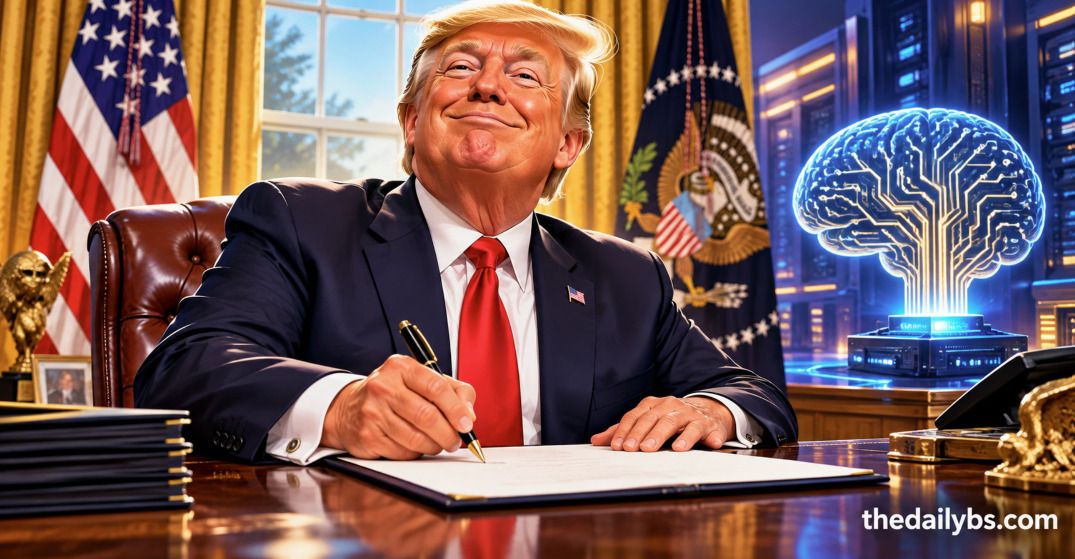
President Donald Trump signed an executive order Tuesday directing executive branch agencies to start calling it “Super Intelligence” — or SI — instead.
“The term ‘Super Intelligence’ more appropriately captures the promise, potential, and rapidly advancing capabilities of these technologies,” Trump wrote.
The order tells federal agencies to use “Super Intelligence” and “SI” in official correspondence, public communications, websites, reports, policy documents and other non-statutory materials.
It also directs the president’s science and technology adviser to develop a formal federal definition of SI and recommend any additional steps needed to implement the new terminology.
Trump has been previewing the change for days.
At the United Nations last week, he announced that what the world had been calling artificial intelligence would be “hereinafter officially called ‘Super Intelligence.’”
Then he made his reasoning considerably simpler.
“Whoever wins AI, you have to remember this, and now I say whoever wins SI, whoever wins superintelligence, wins,” Trump said. “That’s the group that wins.”
The president has repeatedly argued that the word “artificial” undersells technology he believes could transform the economy on a scale exceeding the Industrial Revolution or the internet.
“We’re leading now over China and everyone else, and I want to keep it that way,” Trump said Tuesday.
“You’re gonna have a winner and you’re gonna have a loser, and you’re probably not gonna have a second place.”
The executive order came the same day Trump hosted many of the country’s most powerful technology executives at the White House.
But another document signed after that meeting was separate from the executive order.
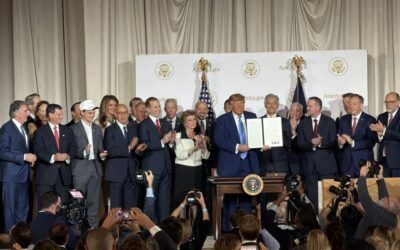
Google CEO Sundar Pichai, Anthropic CEO Dario Amodei, Meta CEO Mark Zuckerberg, OpenAI President Greg Brockman, Elon Musk and Nvidia CEO Jensen Huang joined Trump in signing the “White House Accord on Super Intelligence: Joint Commitment on Frontier Responsibilities.”
Unlike the executive order, the agreement is voluntary.
Trump called it “morally binding.”
“They almost viewed it as a separate kind of constitution,” Trump said. “When they signed that, it meant a lot.”
The accord says participating companies believe “every company is responsible for developing its own technology safely” and commits them to four levels of oversight.
Companies agreed to establish robust internal controls, empower internal teams to test those controls, use independent outside auditors and designate independent board committees to review the results.
Zuckerberg said the idea is to give Americans confidence “that the technology works in the way that we intend.”
“We drafted a set of principles and commitments around building robust internal controls and detecting if there are any issues with the technology,” he said.
Trump, meanwhile, continued to emphasize self-regulation rather than a new federal regulatory structure.
“There’s a belief that there should be tremendous self-regulation,” he said.
“At the same time, we want people to behave honestly and we want them to be trustworthy.”
So Washington now has two new developments emerging from the same White House gathering:
The technology formerly known throughout the executive branch as AI is becoming SI.
And some of the companies building the most powerful versions of it have signed a voluntary agreement promising several layers of oversight as they race to make it even more powerful.
MY QUICK TAKE
Here’s the wonderfully Washington part.
Until now, “superintelligence” already meant something fairly specific in the AI world: a hypothetical system whose intelligence surpasses human intelligence.
The White House’s own 2026 Economic Report used essentially that definition.
Now the federal government is going to call the whole category Super Intelligence.
So your chatbot apparently just received a promotion without having to demonstrate any additional skills.
There is a substantive reason Trump cares about the branding, though. He views this technology primarily as a strategic race with China, and “artificial” sounds fake while “super” sounds like something America ought to win.
Whether Silicon Valley can build actual superintelligence remains one of the biggest unanswered questions on Earth.
Whether Washington can rename something? That technology has been perfected for centuries.
DBS WIRE SOURCES
- Fox Business — Trump orders federal government to replace AI with ‘Super Intelligence’
- White House — Trump’s United Nations remarks on Super Intelligence
- Associated Press — Trump and tech leaders announce voluntary AI accord
- Washington Examiner — White House Accord on Super Intelligence
- White House — 2026 Economic Report of the President