THE DAILY BS: HOW MUCH CAN YOU HANDLE?
SPARE ME THE BS (I’ve got things to do).
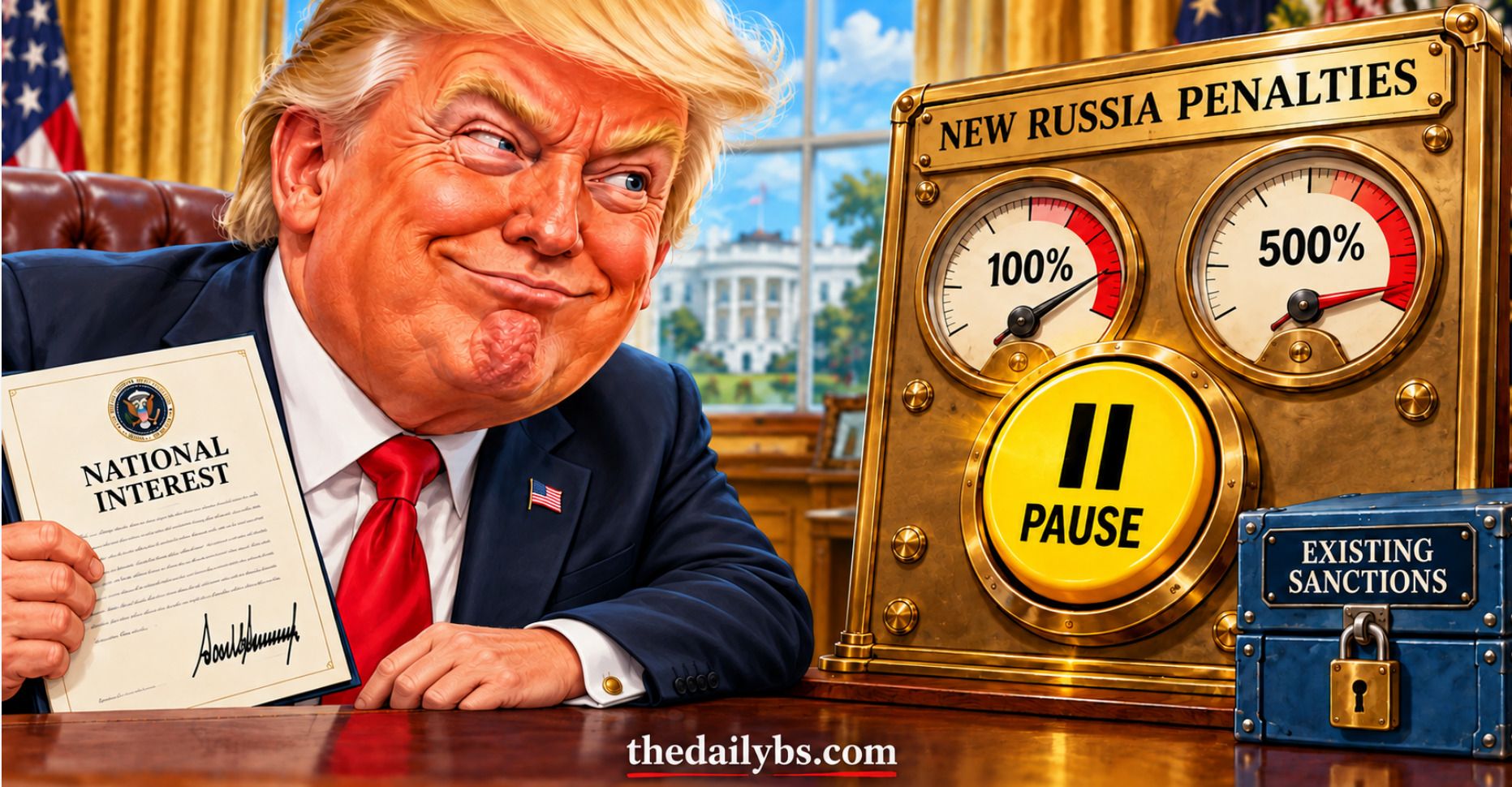
- Trump signed an executive order Friday waiving major sanctions and tariffs under the Lindsey O. Graham Sanctioning Russia and Iran Act.
- The paused measures included a 500% tariff on Russian goods and 100% duties targeting major purchasers of Russian oil and gas.
- The White House cited U.S. national interests; previously existing Russia sanctions remain in place, and the new measures could be reinstated.
LAY IT ON ME (I’ve got time).
President Donald Trump just put one of Washington’s biggest anti-Russia sanctions packages on ice.
And the timing is hard to miss.
With new penalties scheduled to take effect Sunday, Trump signed an executive order Friday waiving major portions of the Lindsey O. Graham Sanctioning Russia and Iran Act of 2026.
The legislation, which Trump himself signed September 18, included some eye-popping economic weapons.
A 500 percent tariff on Russian imports. Another 100 percent tariff targeting the largest importers of Russian oil and natural gas. Additional penalties aimed at countries facilitating sanctions evasion.
Then, two days before the measures were scheduled to take effect, the president reached for the waiver authority Congress had included in the law.
Trump’s explanation appears in the executive order itself.
“I have submitted to the Congress a certification that the issuance of such a waiver at this time is in the national interests of the United States.”
That’s the administration’s official justification.
And it comes at a particularly consequential moment for energy markets.
Trump has been seeking ways to ease fuel prices amid disruptions associated with the conflict involving Iran. His administration has also pursued arrangements allowing additional Russian petroleum supplies to reach international markets.
Higher sanctions on countries purchasing Russian energy could complicate that strategy.
But they were precisely the kind of pressure Sen. Lindsey Graham and other supporters of the legislation wanted to impose on Moscow.
The law was designed to raise the economic cost of Russia’s war against Ukraine while pressuring foreign governments that continue buying Russian oil and gas.
Trump’s order does not repeal the law.
It suspends the application of major provisions using a presidential waiver explicitly authorized by Congress.
The order states that the exemptions will remain in effect “until such time as the President or the Secretary of State” determines that further action is appropriate, following required consultations.
That leaves the administration free to reconsider the sanctions later.
Another distinction matters: This is not a blanket elimination of every sanction Washington has imposed on Russia.
The executive order expressly preserves existing measures imposed under an earlier Russia-related national emergency.
So reports that Trump has simply ended all Russian sanctions would be inaccurate.
Still, the scale of the waived penalties is substantial.
A 500 percent import tariff is not the sort of economic threat Moscow or its trading partners could easily ignore.
Likewise, the potential 100 percent duties on major energy purchasers were intended to make continued Russian oil purchases considerably more expensive.
Instead, those new duties are being held back.
The move also puts Trump’s increasingly strained relationship with Ukrainian President Volodymyr Zelensky into sharper focus.
Trump has criticized Ukraine’s strikes against Russian oil infrastructure, arguing that the attacks contribute to higher international fuel prices.
Zelensky maintains that Russian energy revenues help finance Moscow’s invasion and that Ukraine has legitimate reasons to target infrastructure supporting the war.
Ukraine’s position is straightforward: Reducing the pressure on Russia risks giving Vladimir Putin additional resources and breathing room.
Trump’s calculation appears to be different.
He is prioritizing the immediate consequences for American energy costs while reserving the option to restore new sanctions if circumstances change.
For supporters of economic pressure on Moscow, Friday’s decision raises questions about whether a bipartisan sanctions law will ever be fully enforced.
For the White House, the waiver preserves flexibility during volatile energy markets and diplomatic negotiations.
DBS WIRE SOURCES (I’ve got all day).
- White House — Full October 16 executive order waiving Graham Act penalties
- CBS News — Trump waives Russian oil tariffs before law takes effect
- Financial Times — Trump exempts Russia from additional sanctions