

THE DAILY BS: HOW MUCH CAN YOU HANDLE?
SPARE ME THE BS (I’ve got things to do)
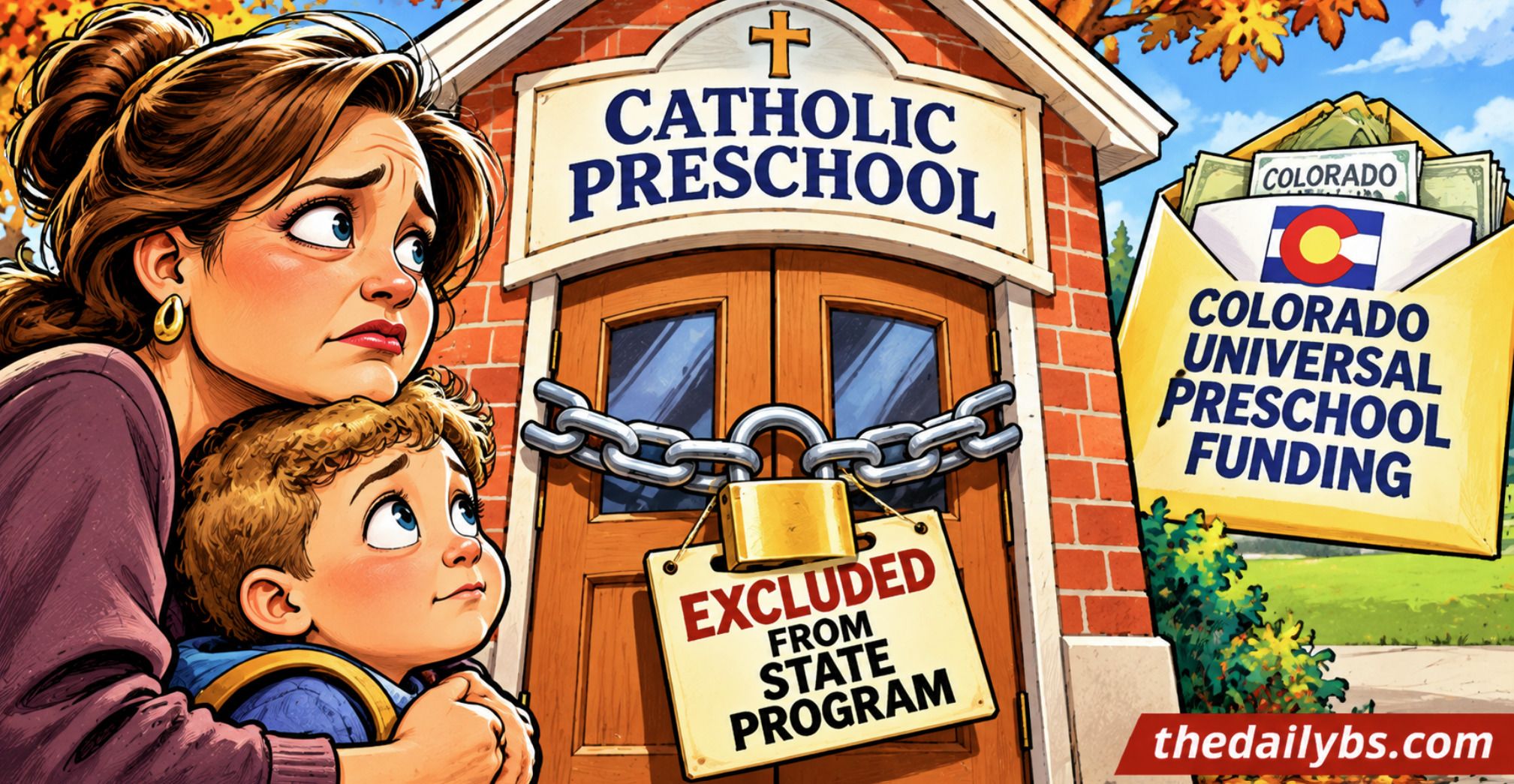
- The Supreme Court hears arguments Tuesday over Colorado’s exclusion of Catholic schools from its taxpayer-funded preschool program.
- Catholic parents report losing thousands in benefits, including one family estimating $24,000 in missed assistance.
- Colorado allows certain specialized preschools to limit enrollment, but Catholic schools say their religious requirements leave them shut out.
LAY IT ON ME (I’ve got time)
Colorado promised families universal preschool. Now the United States Supreme Court is preparing to decide whether the state’s definition of universal can accommodate Catholic schools that insist on remaining Catholic.
The justices will hear arguments Tuesday, November 3, in St. Mary Catholic Parish v. Roy, a religious liberty case involving two Catholic parishes, the Archdiocese of Denver and Colorado’s taxpayer-funded preschool program.
For parents caught in the dispute, the stakes are considerably more immediate than a constitutional argument in Washington.
They’re paying tuition bills.
Dan and Lisa Sheley have seven children, four of whom have attended St. Mary’s preschool. The couple told CBS Colorado they estimate they’ve missed out on approximately $24,000 in state assistance.
Another parent, Erika Nagle, estimated her family had lost $18,000.
Those are substantial amounts of money for families who were told the state was establishing a program intended to make preschool available to everyone.
The program began in 2023 and generally provides up to 15 hours of publicly funded preschool each week for Colorado four-year-olds. Participating families can choose among approved public and private providers.
But there’s a condition.
Participating schools must guarantee equal enrollment opportunities regardless of characteristics including religious affiliation, sexual orientation and gender identity.
Catholic schools in the lawsuit require families to support Catholic teaching on marriage, sexuality and gender. The state says those admission requirements conflict with the program’s nondiscrimination rules.
The Catholic schools argue that Colorado is effectively requiring them to surrender their religious standards to participate in a public benefit program.
And here is where the controversy becomes particularly interesting.
Colorado permits certain providers to specialize in serving particular populations, including children with disabilities, low-income families and other designated groups. The Catholic plaintiffs argue that the state’s system of exceptions undermines its insistence that their religious enrollment policies cannot be accommodated.
Colorado disputes that characterization, maintaining that its rules protect families from discrimination based on legally protected characteristics.
The dispute has reached the Supreme Court after the Tenth Circuit Court of Appeals upheld Colorado’s position.
But the legal argument is only part of the story.
In an opinion published Sunday by Fox News, attorney Andrea Picciotti-Bayer, who filed a supporting Supreme Court brief on behalf of Catholic families, described parents taking second jobs, accepting lower-paying employment for tuition discounts and separating their children’s schooling because they could not afford the same Catholic preschool for everyone.
One mother started a florist business to help cover tuition. Another family includes a child with spina bifida whose medical needs make Colorado’s Medicaid coverage particularly important.
These aren’t abstract examples from a law school textbook.
They’re families who pay taxes into a preschool program but cannot use the benefit at their preferred Catholic schools under the current rules.
Picciotti-Bayer argues that the arrangement resembles the old Blaine amendments, nineteenth-century restrictions on public funding for religious education associated with anti-Catholic hostility.
The historical comparison is significant.
In 1875, James G. Blaine proposed a federal constitutional amendment restricting public support for sectarian schools. The proposal failed in the Senate, but numerous states subsequently adopted similar provisions.
The Supreme Court has already confronted religious-school funding restrictions in cases including Trinity Lutheran, Espinoza and Carson v. Makin.
Those decisions established important protections against excluding religious institutions from otherwise available public benefits because of their religious status or activities.
Colorado’s case presents a different question: whether a state may enforce nondiscrimination conditions on religious schools participating in a publicly funded educational program, particularly when the program contains exceptions for other providers.
Picciotti-Bayer estimates that approximately 1,500 children across 30 Catholic preschools have been affected. She also reports a roughly 20% decline in Catholic preschool enrollment and two school closures.
Those figures come from the plaintiffs’ side of the dispute and are part of the argument that Colorado’s rules have consequences beyond the courtroom.
The state, meanwhile, argues that its enrollment requirements protect all families, including same-sex parents, from being denied access to publicly funded preschool because of who they are.
In court filings quoted by CBS Colorado, state officials said the requirements were intended to ensure Catholic families and same-sex parents alike could enroll their children without discrimination based on protected characteristics.
The Supreme Court has agreed to examine two questions involving the application of religious freedom protections and the effect of exceptions within the state’s regulatory system.
The justices have not agreed to reconsider the broader precedent of Employment Division v. Smith, even though the Catholic plaintiffs asked them to do so.
That makes Tuesday’s hearing particularly important for religious schools nationwide.
A decision addressing how states treat religious providers within programs containing secular exceptions could have implications beyond Colorado’s preschool classrooms.
For the Sheleys, Nagles and other families involved, the issue is already painfully practical.
They supported a program promising educational choices for parents. Now they are asking the nation’s highest court whether that promise extends to the religious schools they actually chose.
And Colorado’s Supreme Court showdown begins Tuesday morning.
DBS WIRE SOURCES (I have all day)
- Fox News — Colorado’s universal preschool revives vile anti-Catholic laws
- CBS Colorado — Catholic parents say state preschool program excludes their families
- Becket — Catholic families and preschools prepare for Supreme Court arguments
- Fox News — Supreme Court agrees to hear Catholic parish’s challenge
- Cornell Law — St. Mary Catholic Parish v. Roy: legal arguments and case background







Elect one Homosexual Guvoner and the place goes to hell.