THE DAILY BS: HOW MUCH CAN YOU HANDLE?
SPARE ME THE BS (I’ve got things to do)
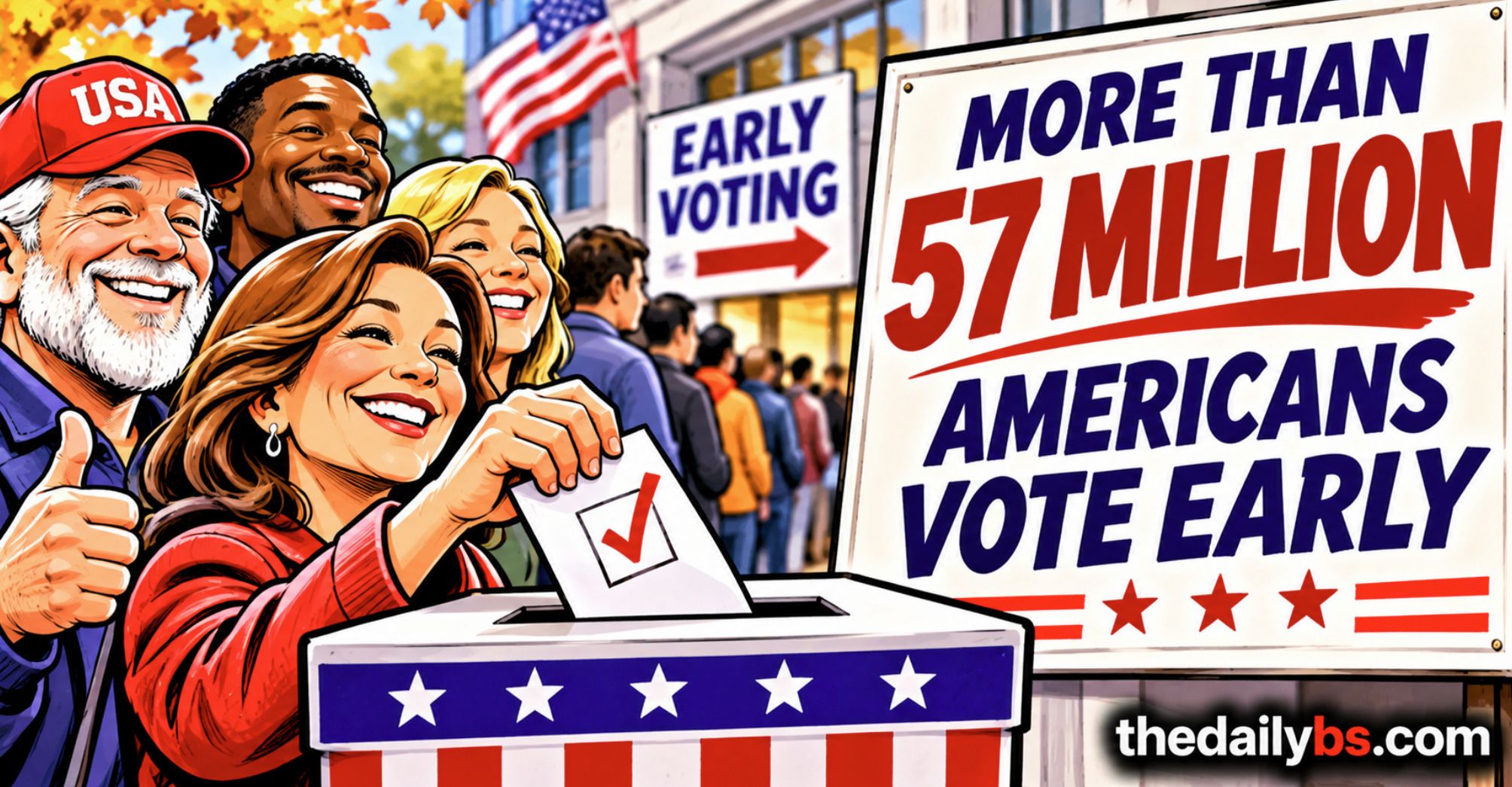
- More than 57 million Americans cast ballots before Election Day, surpassing the roughly 46 million early votes recorded in the 2022 midterms.
- University of Florida election data showed approximately 32 million in-person early votes and more than 25 million returned mail ballots as of Monday evening.
- Texas, Florida, Georgia, North Carolina and New York have recorded enormous participation, with control of Congress hanging in the balance.
LAY IT ON ME (I’ve got time)
Remember when Election Day meant everybody got up on Tuesday, went to the polls, complained about the line and headed home with a little sticker?
Apparently, that’s ancient history.
Before a single Election Day polling place opened Tuesday morning, more than 57 million Americans had already voted in the 2026 midterms.
That’s not a typo.
Fifty-seven million.
According to the University of Florida Election Lab, the country has already surpassed the approximately 46 million early ballots cast during the entire 2022 midterm election.
And the numbers offer an important clue about how American elections are changing.
As of Monday evening, the Election Lab had recorded approximately 32 million early in-person votes and more than 25 million returned mail ballots.
That represents an increase of roughly 11 million early votes over the previous midterm total, with Election Day voting still to come.
And if you think that sounds like a large number of people interested in what happens in Washington, congratulations. You’ve discovered something most politicians prefer to learn before their consultants send the final invoice.
The surge is being recorded across major battlegrounds and states with closely watched races.
Texas has already recorded more than 7.7 million early ballots, according to figures compiled by election analysts.
Florida has recorded more than 5.4 million.
North Carolina has surpassed 2.8 million early votes.
Georgia has also recorded more than 2.8 million votes cast before Election Day, while New York reported nearly two million early in-person voters during its designated early-voting period.
These totals reflect different state reporting procedures, but the national trend is unmistakable.
Americans are voting earlier, and a remarkable number are taking part in the first midterm election of Trump’s second presidency.
There’s another significant change hiding inside those numbers.
In 2022, mail voting accounted for a larger share of early ballots than in-person early voting.
This year, the balance has shifted.
More Americans have voted early in person than by mail.
That’s particularly interesting given the years of fierce political arguments over absentee voting, mail ballots, drop boxes and election procedures.
Republicans, including Trump, have long raised concerns about aspects of mail voting.
But Republican campaigns have also increasingly emphasized the importance of getting supporters to vote before Election Day.
After all, a vote cast early is a vote a campaign no longer has to chase on Tuesday.
Democrats have traditionally relied heavily on early voting operations, particularly in states with large urban populations and extensive mail-voting systems.
The changing balance between in-person and mail voting adds another dimension to the familiar Election Day arguments about which party is better organized.
And the numbers are substantial enough that neither side can simply dismiss them.
PBS NewsHour reported Monday that the 57 million early votes represented a midterm record and approximately 24% more participation than four years earlier.
The comparison is especially striking because the current total was recorded before Election Day.
Millions more voters are expected to cast ballots Tuesday.
The political stakes could hardly be higher.
Republicans are fighting to retain control of the House and Senate.
Democrats are hoping that dissatisfaction with the economy, inflation and the conflict with Iran will produce a backlash against the administration.
Trump, meanwhile, is warning voters about the consequences of handing Congress to his opponents.
The result could determine how much of his domestic agenda advances over the next two years.
But all that political theater still leaves one enormous unanswered question.
Who are these 57 million voters supporting?
Campaign strategists are examining party registrations, county-level turnout and voting histories, searching for clues.
Those numbers can be useful, but a registered Republican is not guaranteed to vote Republican, and a registered Democrat is not guaranteed to vote Democrat.
Independent voters complicate matters further.
And in states without party registration, analysts often rely on estimates based on voting history and other information.
The actual results will be determined by the ballots, not by television pundits interpreting early turnout.
Consider New York.
The state reported 1,965,043 early in-person votes, nearly 67% more than the comparable period in 2022.
In four counties of the congressional district being vacated by Republican Elise Stefanik, early turnout more than doubled.
Democrats say those figures indicate enthusiasm among their voters.
Republicans believe their candidates have benefited from increased participation as well.
Both theories are plausible until the votes are counted.
In Texas, the enormous early turnout is being watched closely because of the state’s high-profile Senate contest and competitive congressional races.
Florida’s early-voting numbers are also drawing attention from both parties.
And in North Carolina and Georgia, where turnout can influence closely contested statewide and congressional races, every additional vote matters.
So the country is heading into Election Day with two simultaneous political realities.
A record number of Americans have already participated.
And nobody yet knows how those votes will translate into control of Congress.
The 57-million figure is also not the final nationwide number.
States continue to report ballots, some mail votes are still arriving, and election officials must process and reconcile their records.
That means the final early-voting total could rise further.
But the record is already established.
Whatever arguments politicians make about Americans becoming cynical, disillusioned or tired of Washington, millions of voters have decided their ballots are worth casting.
Maybe they love the direction of the country.
Maybe they hate it.
Maybe they’re voting to protect Trump’s agenda.
Maybe they’re voting to stop it.
Or maybe they’re simply convinced that somebody in Washington needs a serious performance review.
One thing is clear.
By the time Election Day officially arrived, tens of millions of Americans had already rendered their verdicts.
The rest of us are about to find out what they said.
DBS WIRE SOURCES (I have all day)
- University of Florida Election Lab: 2026 early-voting tracker and national totals
- CBS News: November 2 election updates — more than 57 million early votes
- PBS NewsHour: November 2 — record national early-voting participation
- Associated Press: Election Eve campaign developments and record turnout
- New York Post: New York early voting surges nearly 70%