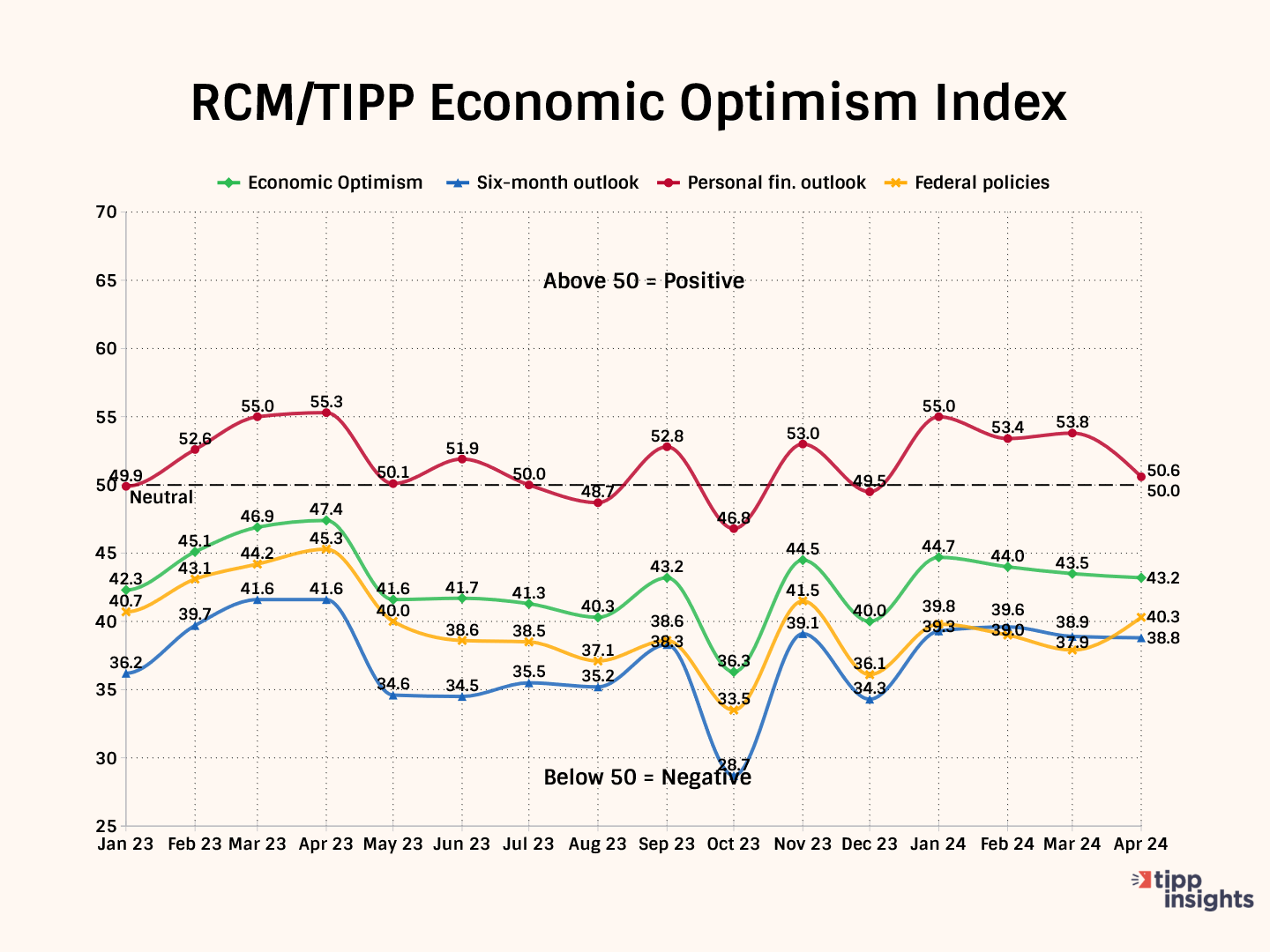
The RealClearMarkets/TIPP Economic Optimism Index, a leading gauge of consumer sentiment, dropped 0.7% in April to 43.2. Since September 2021, the index has stayed in negative territory for 32 consecutive months.
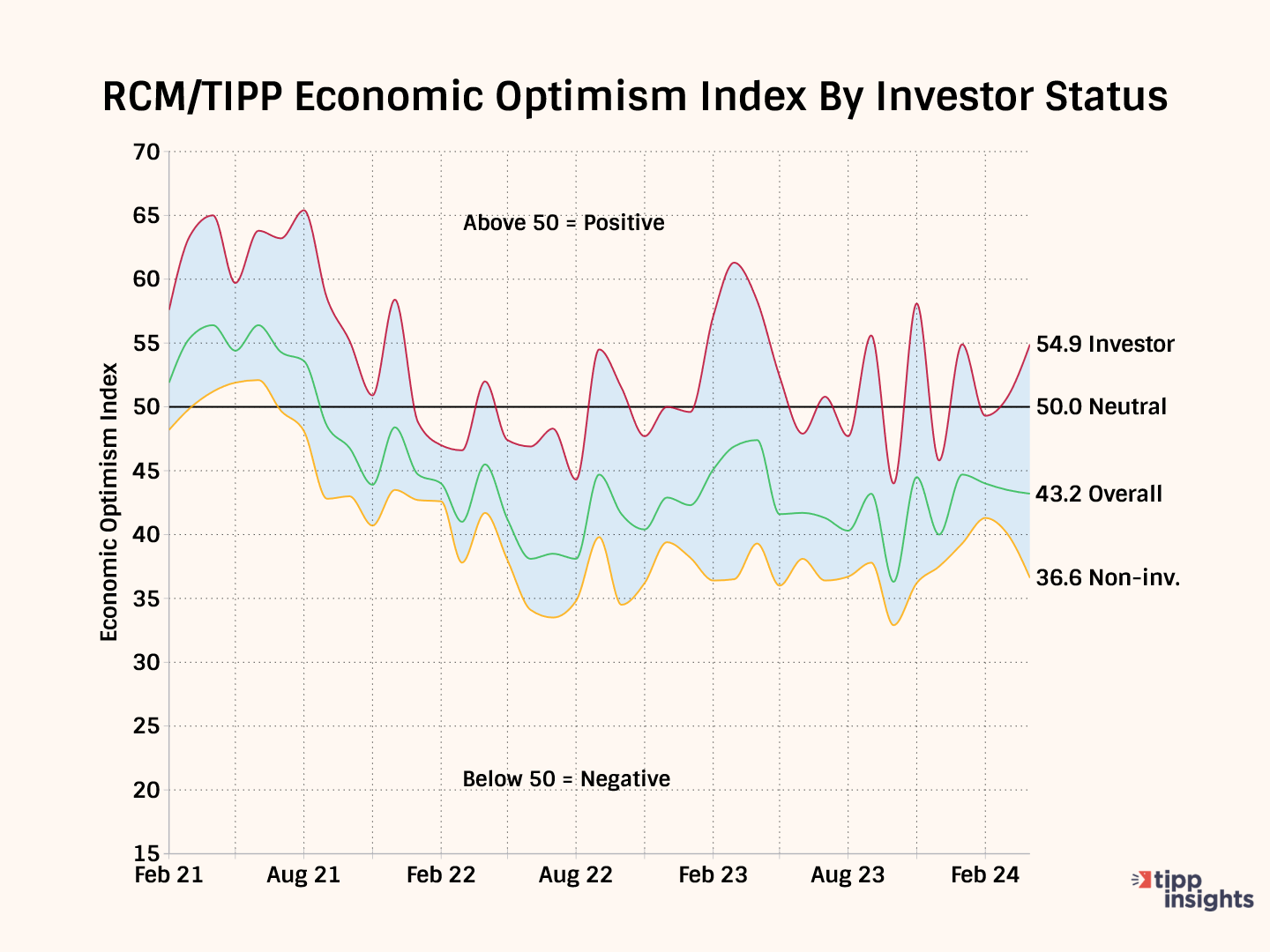
Reflecting the recent stock market gains, optimism among investors gained 8.3% from 50.7 in March to 54.9 in April, while it dropped by 8.7% among non-investors, from 40.1 in March to 36.6 in April.
The RCM/TIPP Economic Optimism Index is the first monthly measure of consumer confidence. It has established a strong track record of foreshadowing the confidence indicators issued later each month by the University of Michigan and The Conference Board. From February 2001 to October 2023, TIPP released this index monthly in collaboration with its former sponsor and media partner, Investor’s Business Daily.
RCM/TIPP surveyed 1,432 adults from April 3 to April 5 for the March index. The online survey utilized TIPP’s network of panels to obtain the sample. A more detailed methodology is available here.
RCM/TIPP Economic Optimism Index
The RCM/TIPP Economic Optimism Index has three key components. In April, two of these components declined, while one showed improvement. The index and its components range from 0 to 100. A reading above 50.0 signals optimism, anda reading below 50.0 indicates pessimism. 50 is neutral.
- The Six-Month Economic Outlook, which measures how consumers perceive the economy’s prospects in the next six months, dropped slightly from 38.9 in March to 38.8 in April, marking a 0.3% decrease. In October 2023, this component posted 28.7, its lowest reading since the index debuted in February 2001.
- The Personal Financial Outlook, a measure of how Americans feel about their own finances in the next six months, declined sharply by 5.9% from its previous reading of 53.8 in March to 50.6 this month. In January, the component exceeded the neutral reading of 50.0 and has since remained in positive territory for the fourth month.
- Confidence in Federal Economic Policies, a proprietary RCM/TIPP measure of views on the effectiveness of government economic policies, improved from 37.9 in March to 40.3 this month, reflecting a 6.3% gain.
Party Dynamics
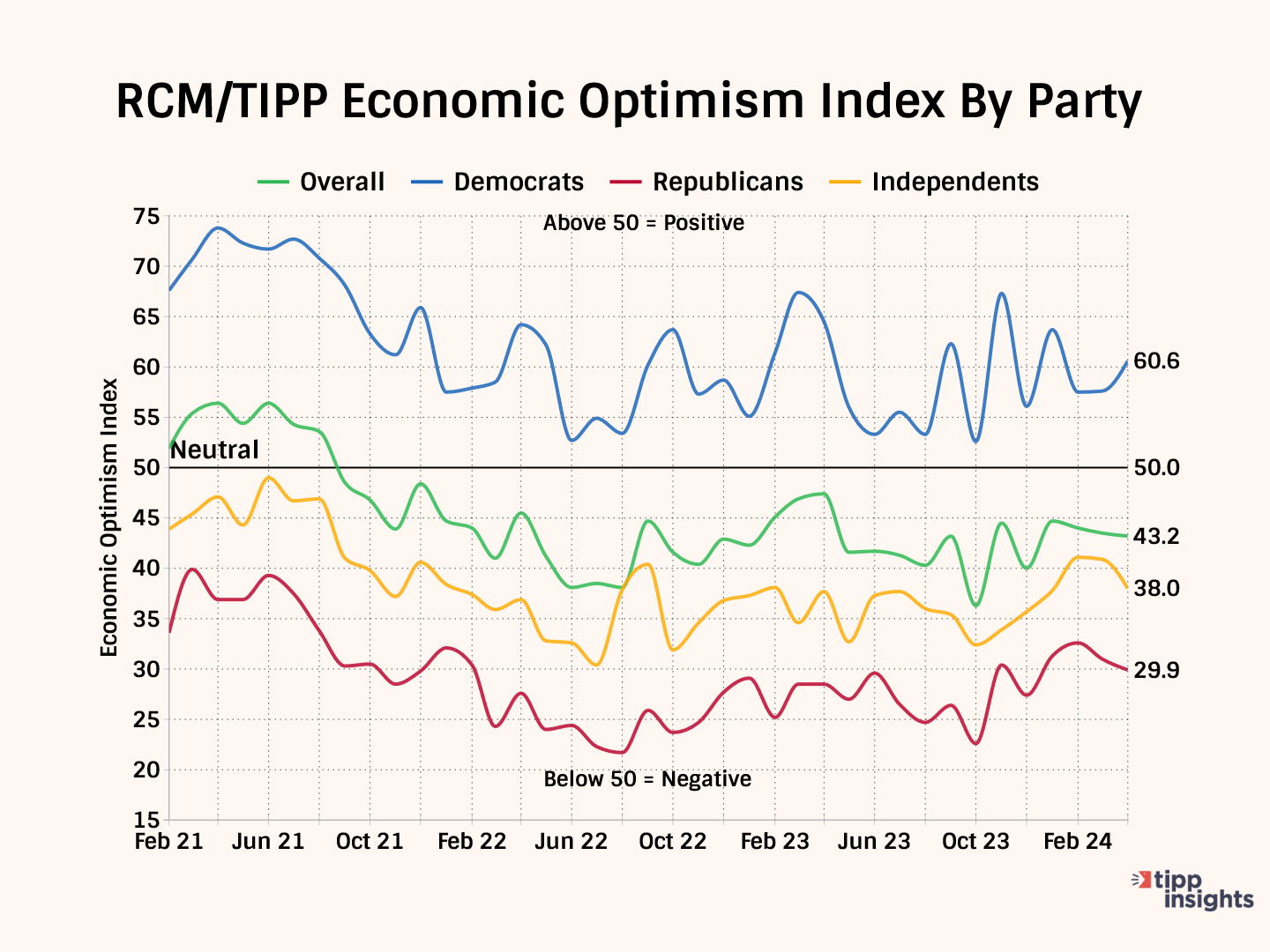
Democrats posted the highest confidence levels in April, at 60.6, increasing sharply from 57.6 in March, a 5.2% gain.
Meanwhile, Republicans’ confidence declined 1.1 points to 29.9 this month, a drop of 3.5%. It has stayed in the pessimistic zone for 41 consecutive months since December 2020, after the last presidential election.
Independents’ confidence has been in pessimistic territory for 49 months since April 2020, the month after the onset of the pandemic. In April, independents dropped 2.9 points, or 7.1%, and posted 38.0 on the index.
Investor Confidence
Respondents are considered “investors” if they currently have at least $10,000 invested in the stock market, either personally or jointly with a spouse, either directly or through a retirement plan. We classified 32.5% of respondents who met this criterion as investors and 61% as non-investors. We could not ascertain the status of 6% of respondents.
Reflecting the recent stock market gains, optimism among investors gained 4.2 points or 8.3%, from 50.7 in March to 54.9 in April, while it dropped by 3.5 points or 8.7% among non-investors, from 40.1 in March to 36.6 in April.
The economic optimism gap between investors and non-investors widened again to 18.3 in April from 10.6 in March and 8.0 in February.
Momentum
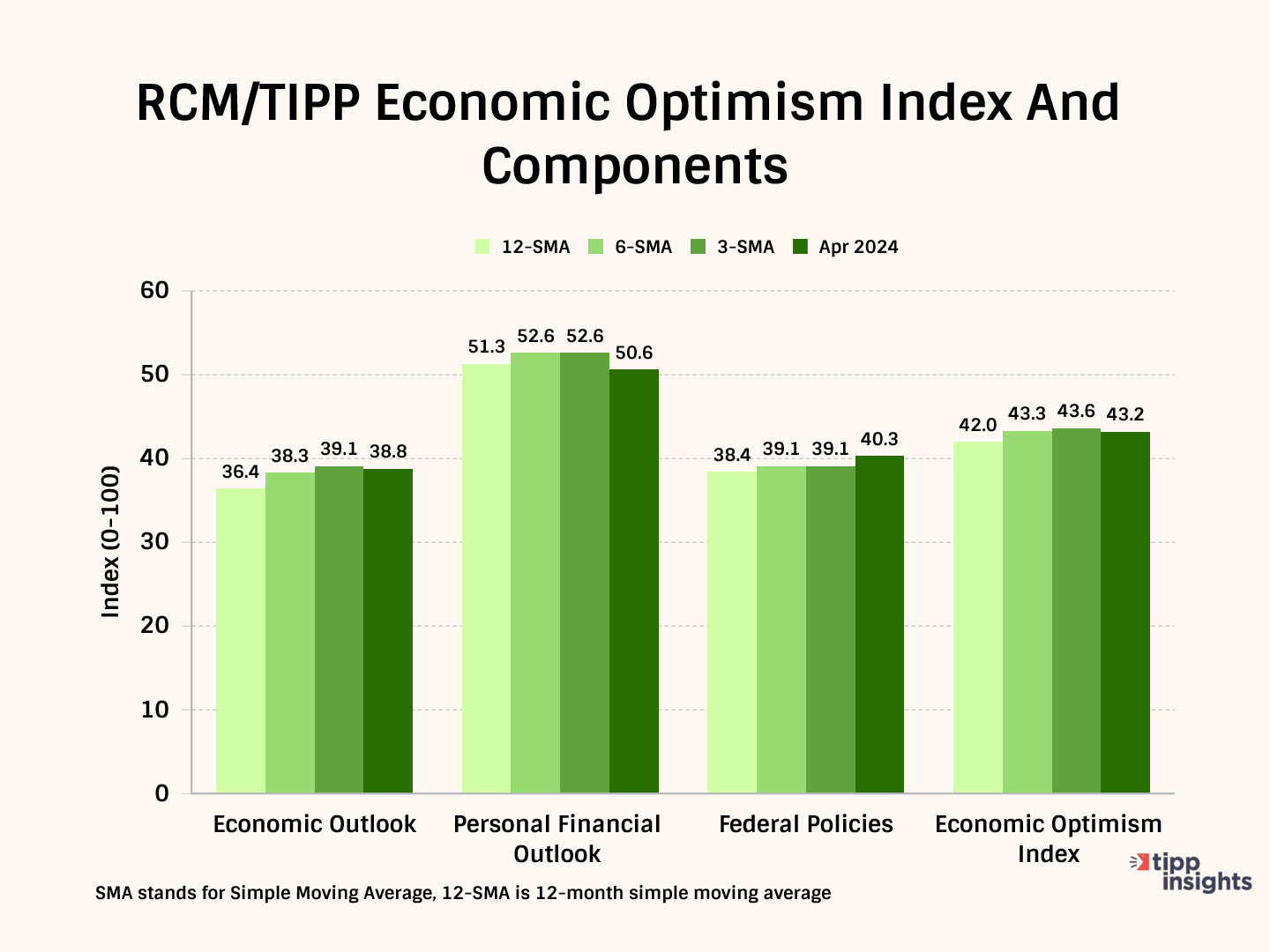
Comparing a measure’s short-term average to its long-term average is one way to detect its underlying momentum. For example, if the 3-month average is higher than the 6-month average, the indicator is bullish. If the 6-month average exceeds the 12-month average, the same holds true.
In April, the Economic Outlook and Personal Financial Outlook components and the Economic Optimism Index are lower than their respective three-month moving averages. However, the Federal Policies component bucks this trend, registering a higher reading of 40.3 compared to its three-month moving average of 39.1.
Also, the three-month moving averages for all the components and the Optimism Index are equal to or higher than the six-month moving average. As a result, the data shows a mixed picture.
Demographic Analysis
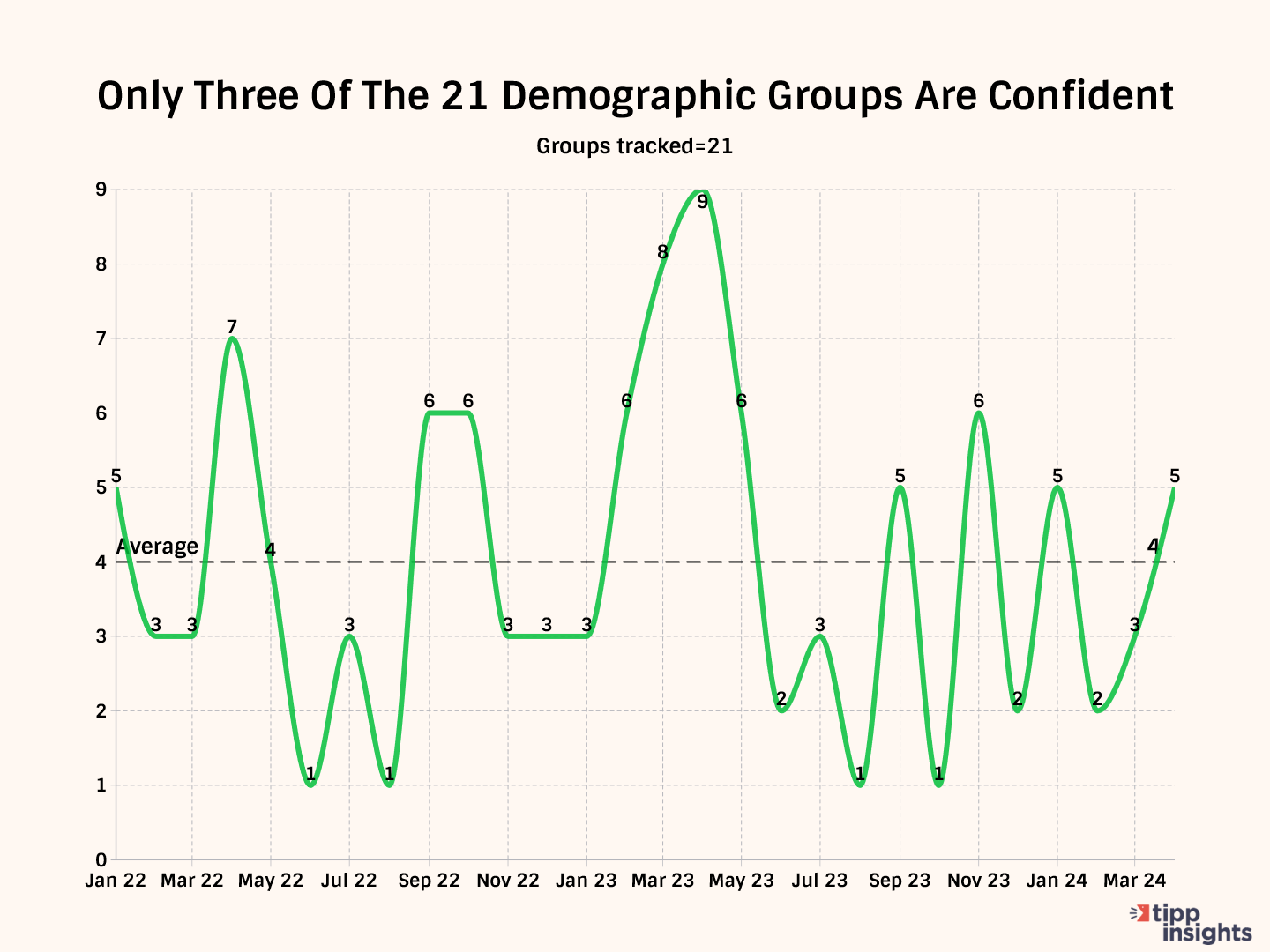
The number of groups in the positive zone indicates the breadth of optimism in American society. This month, three of the 21 demographic groups we track—such as age, income, education, race, etc.—are above 50.0, indicating optimism on the Economic Optimism Index. Starting with three groups in January 2023, we saw steady improvement, peaking at nine groups in April and then declining to one group in August. Since August, it has been in the range of one to six. In April, only five groups are in the positive zone.
Six of the 21 groups improved on the index, compared to 10 in March, 10 in February, and 19 in January.
Inflation
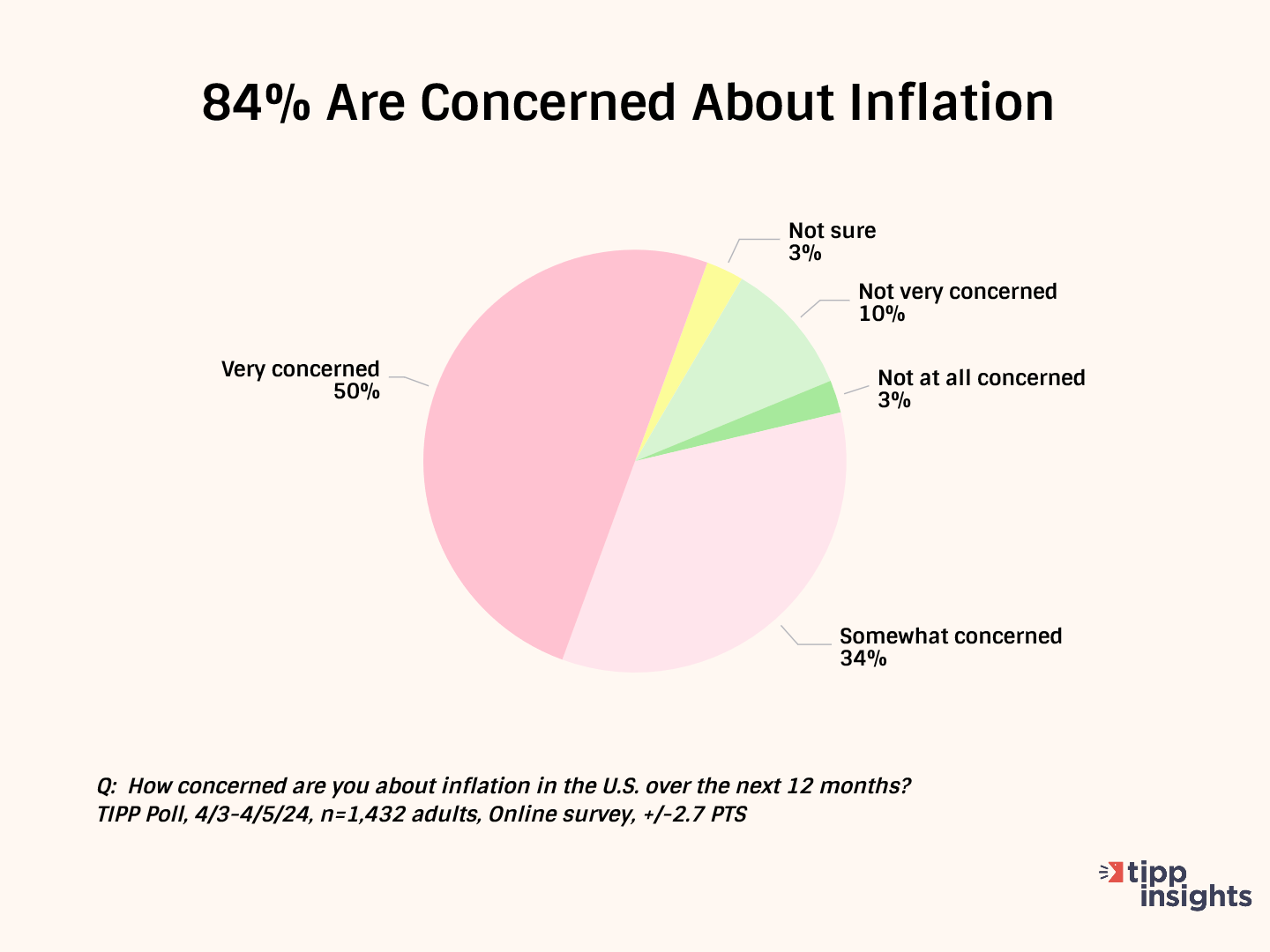
The survey showed that 84% are worried about inflation. One-half (50%) are very concerned, and another 34% are somewhat concerned.
Americans continue to suffer because real wages have not increased, despite the CPI rate falling from a 40-year high of 9.1% in June 2022 to 3.5% in March 2024.
The Federal Reserve believes that long-run inflation of 2%, measured by the annual change in the price index for personal consumption expenditures, is most consistent with its maximum employment and price stability mandate.
On Saturday, we will cover inflation in greater detail.
Recession
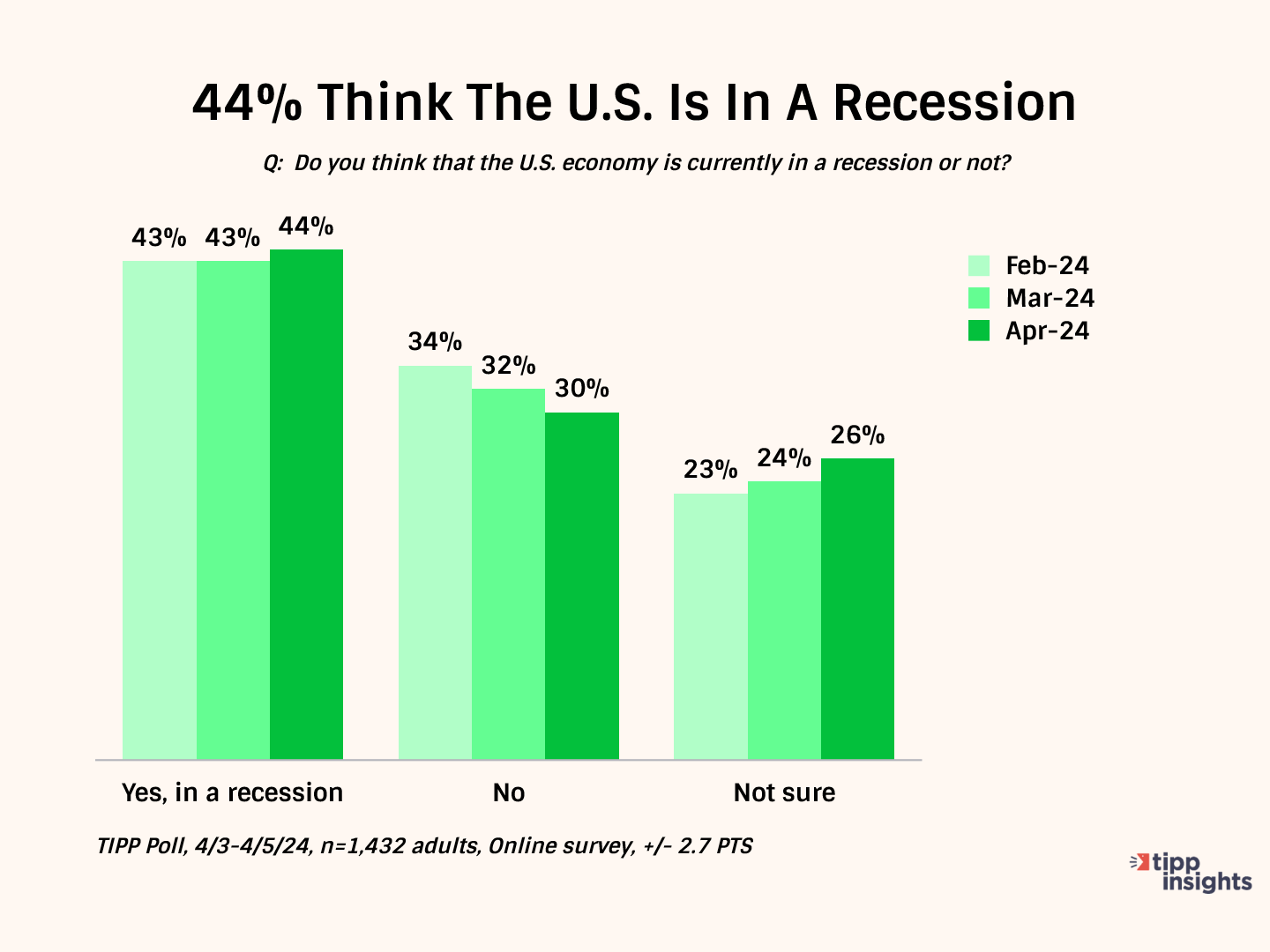
Four in ten (44%) Americans believe we are in a recession, while 26% are unsure. 30% believe we are not in a recession.
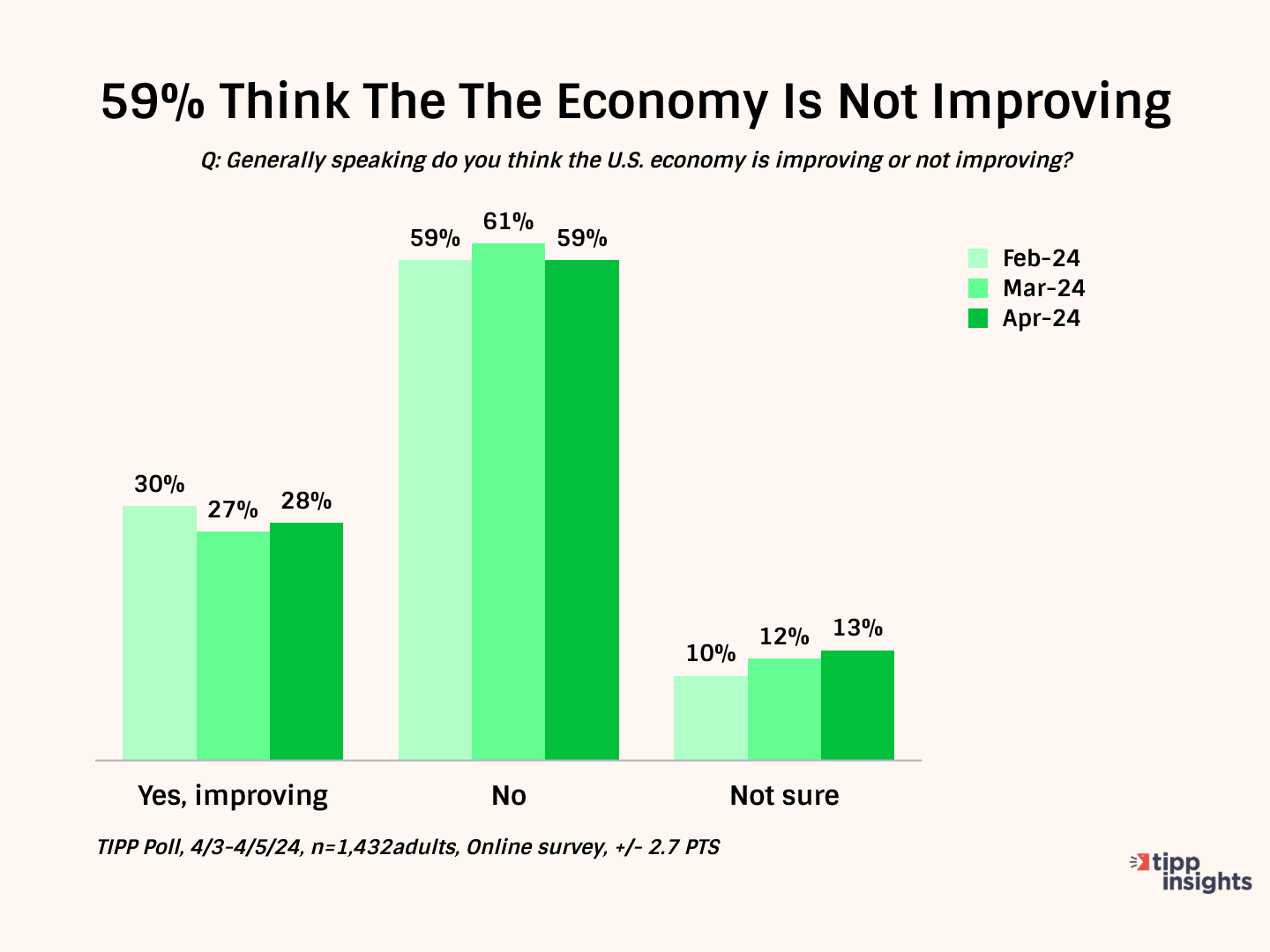
Further, over one-half (59%) think the U.S. economy is not improving, while 28% believe it is improving.
Fiscal Profligacy
Government spending has spiraled out of control, resulting in a national debt exceeding $34 trillion. The debt increases by $1 trillion every 100 days.
Most Americans are concerned about the sustainability of this trajectory. The high interest rates are also hurting Americans and sapping their confidence.
We anticipate a stagflationary economy in 2024. The risks on the downside outweigh those on the upside. Watch the real estate, stock, and job markets, and see if Washington can cut spending.
ICYMI – Recent TIPP Poll Stories
America’s Heart Wants To Help Ukraine, But The Mind Wants The War To End: TIPP Poll
TIPP Takes
Geopolitics, Geoeconomics, And More
1. Hamas Leader Says No Change In Truce Position After Sons Killed – AFP
Hamas chief Ismail Haniyeh insisted that the death of three of his sons in an Israeli air strike would not influence truce talks in Gaza.

Israel confirmed the killings, which came as talks in Cairo for a temporary ceasefire and hostage release deal dragged on without signs of a breakthrough. Speaking to Al Jazeera, Haniyeh suggested that the strike, which also killed four of his grandchildren, was an attempt to shift Hamas’s negotiating stance.
2. Israel Would Let 150,000 Gazans Return North In Potential Truce, Officials Say – Reuters
Israel has agreed in Gaza war ceasefire talks in Egypt to concessions about the return of Palestinians to the north of the enclave but believes Hamas does not want to strike a deal.

Officials with knowledge of the talks said that under a U.S. proposal for a truce, Israel would allow the return of 150,000 Palestinians to north Gaza with no security checks. In return, they said, Hamas would be required to give a list of female, elderly, and sick hostages it still holds alive.
3. U.S. Allies Believe Iran Proxies Will Strike Israel Soon – Al Arabiya
The U.S. and its allies believe major missile or drone strikes by Iran or its proxies against military and government targets in Israel are imminent, according to people familiar with the intelligence.

The potential assault, possibly using high-precision missiles, may happen in the coming days, the people said, requesting anonymity. It is seen as more a matter of when, not if, one of the people said, based on U.S. and Israeli intelligence assessments.
4. Biden Vows ‘Ironclad’ Support For Israel Amid Iran Attack Fears – BBC
President Joe Biden warned that Iran is threatening to launch a “significant attack” after Israel struck the Iranian consulate in Syria 10 days ago.

“We’re going to do all we can to protect Israel’s security,” he added.
Earlier on Wednesday, Iran’s leader said the Israeli attack in Damascus was equivalent to an attack on Iran itself.
5. Russia’s Crude Is Trading At $15 Above the Price Cap – Oilprice.com
Russia’s flagship crude grade, Urals, is currently being exported at a price of around $75 per barrel, a price that’s $15 a barrel above the $60 price cap set by the G7 and partners if the oil is to be moved with the help of Western shippers, insurers, and financiers.

According to Bloomberg data, last month, nearly a quarter of Russia’s crude oil shipments—23%—were insured by members of the International Group of P&I Clubs.
U.S. officials attribute the price rise to the wider oil market developments and geopolitical dynamics.
6. Top U.S. General Tells Congress Ukraine ‘Cannot Sustain Fight Against Russia Alone – RFE/RL
General Christopher Cavoli, the commander of European Command, told the House Armed Services Committee that the severity of the situation in Ukraine “can’t be overstated” as troops on the battlefield run short of ammunition and as the country’s air-defense capabilities are depleted.

“Ukraine cannot sustain this fight alone. The United States, our allies, and partners must continue to provide Ukraine with munitions, weapons, and materiel,” Cavoli said.
7. Russia Ranked Top Of Global Cybercrime Index, With Ukraine Second – dpa
A new study ranks the most significant sources of cybercrime threats and names Russia, Ukraine, and China as the world’s cybercrime hotspots.

The World Cybercrime Index said Russia housed the greatest cybercrime threat, followed by Ukraine, China, the United States, and Nigeria. The ranking was based on surveys of almost 100 cybercrime experts who were asked to identify the most significant sources of five major types of cybercrime.
8. Floods In Russia, Kazakhstan Continue As Anger Swells Over Putin’s Government Response – UPI
The third-longest river in Europe has burst from its banks, joining others as floods have swept across parts of Russia and Kazakhstan with more flooding on the way, according to multiple reports.

Melting snow was the cause of the Ural River flooding, which has so far forced more than 100,000 people to evacuate, and protests have sprung up against Russian authorities over the government’s response.
The flooding is likely to keep up through mid-April.
9. Fitch Downgrades Outlook On China To Negative – RFA
Fitch downgraded its outlook on China’s sovereign credit rating to negative, citing growing risks to public finances as the country shifts away from its reliance on the flagging real estate market to a supposedly more sustainable growth model.

It expected the general government deficit to rise to 7.1% of GDP this year from 5.8% in 2023. In December, the world’s largest rating agency, Moody’s, downgraded its outlook on the country’s credit rating to negative, also expressing concerns about the struggling property sector.
10. In China, Drones, Social Media Monitor Foreign Journalists: Report – RFA
They also detain, harass, and threaten them with non-renewal of their work permits if they report on topics deemed sensitive by the government, according to a new report on journalists’ working conditions.

Four out of five members who responded to the Foreign Correspondents’ Club of China annual working conditions survey said they had experienced “interference, harassment or violence” while trying to do their jobs in China during the past year, the FCCC report found.
11. China’s Xi Jinping Meets Former Taiwanese President – RFA
Chinese President Xi Jinping reasserted China’s territorial claim on democratic Taiwan, likening it to a “family reunion,” in a meeting with former Taiwan President Ma Ying-jeou, who is currently on a controversial tour of China.

Xi, who referred to Ma as “Mr. Ma Ying-jeou” rather than as Taiwan’s former president, said there was no topic off the table in discussions with Taiwan. The meeting comes as Xi’s administration has refused government-to-government talks offered by Taiwan President Tsai Ing-wen.
12. Zambia Uncovers ‘Sophisticated’ Chinese Cybercrime Syndicate – BBC
A “sophisticated internet fraud syndicate” has been uncovered in Zambia, leading to the arrest of 77 people, including 22 Chinese nationals.

It was a “significant breakthrough in the fight against cybercrime,” the authorities said after a multi-agency raid on a Chinese-run company. The firm employed Zambians who believed they were to be call-center agents.
13. Biden “Considering” Dropping Charges On WikiLeaks Founder Julian Assange – AFP
President Joe Biden said he was “considering” Australia’s request to drop the prosecution of WikiLeaks founder Julian Assange on espionage charges.

Australia’s parliament passed a motion in February with the prime minister’s support calling for an end to the legal saga surrounding Assange, who has been held in Britain since 2019 while fighting extradition to the United States.
Australian citizen Assange, 52, has been indicted by the U.S. government over his role in the 2010 leaking of a huge trove of classified documents related to the wars in Iraq and Afghanistan.
14. European Parliament Agrees On Stricter EU Migration Rules – D.W.
Following years of debate, European Union lawmakers have passed a landmark reform of the bloc’s asylum system to reduce irregular migration. The new rules will take effect in 2026.

The new EU Asylum and Migration Pact aims to manage migration’s impact on the bloc by accelerating the rejection of invalid applications and sharing the burden of processing asylum requests more evenly among member states.
15. North Korea’s Kim Jong Un Says Now Is Time To Be Ready For War – Reuters
North Korean leader Kim Jong Un said unstable geopolitical situations surrounding his country mean now is the time to be more prepared for war than ever, as he inspected the country’s main military university, KCNA news agency said.

North Korea has stepped up weapons development in recent years under Kim. It has forged closer military and political ties with Russia, allegedly aiding Moscow in its war with Ukraine in return for help with strategic military projects.
16. France Takes Steps To Legalize Assisted Suicide For Terminally Ill Patients – UPI
The French government introduced an end-of-life care bill as an option for mentally competent and terminally ill adults.

The legislation will be debated over the next six weeks before being presented to the National Assembly. From there, it will go to the French Senate for final approval.
If the bill is approved, assisted dying could become legal in France by 2026 and would join 30 other places around the globe that allow an individual to end their life.
17. Americans Eat Enough Grilled Cheeses Each Year To Fill 900 Olympic Swimming Pools – SWNS
A new state-by-state poll of 5,000 U.S. adults found that a single average person eats 36 grilled cheeses yearly.

Grilled cheese sandwiches were found to be best for quick and easy weekday meals (53%), during cravings (38%), and on rainy days (27%).
The study revealed respondents’ belief that the hypothetically “perfect” grilled cheese looks like two slices of American cheese on white bread, medium toasted, cut diagonally.
18. ‘Gig Economy’ Jobs Linked To Higher Risk Of Alcohol-Related Illness – HealthDay News
People who take poorly paid temp jobs as freelancers or independent contractors are 43% more likely to develop an alcohol-related illness than those with full-time permanent employment, researchers found.

“Young adulthood is a particularly sensitive period in life concerning the initiation and formation of health-related behaviors, such as alcohol use,” concluded the research team.
“Subsequently, young adults in precarious employment might use alcohol as a coping strategy for stress and form a habit of consuming larger quantities of alcohol compared with individuals in [standard employment] of the same age,” the researchers said in a journal news release.
Republished with permission from TIPP Insights